

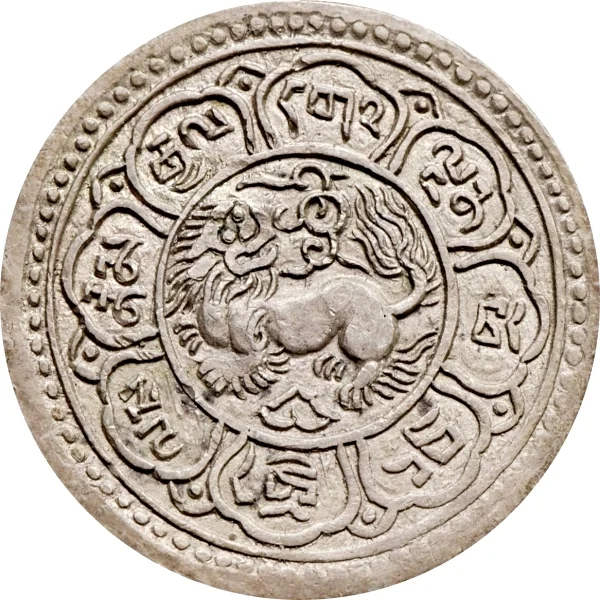

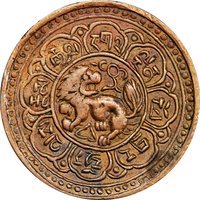
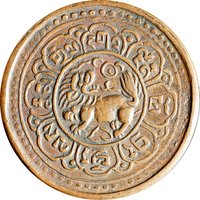
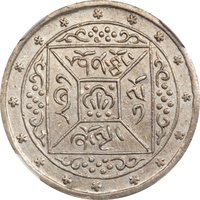
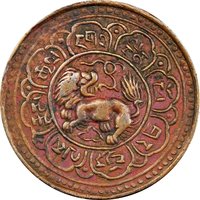
Obverse
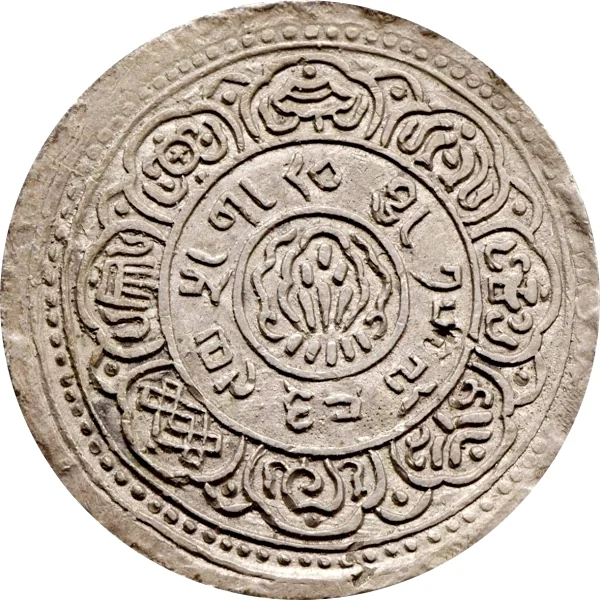
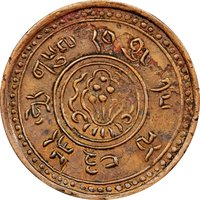
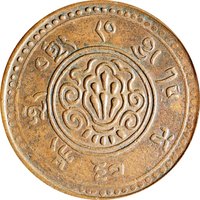
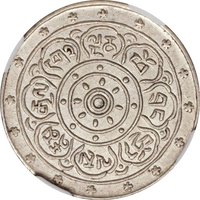
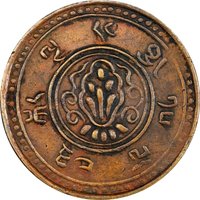
Reverse
Edge
Reeded or smooth.
Mintings
| Year | Mint Mark | Mintage | Quality | Collection |
|---|---|---|---|---|
| 1909 | — | — | ||
| 1914 | — | — | ||
| 1918 | — | — | ||
| 1919 | — | — |
Historical background
In 1909, Tibet's currency situation was characterized by a complex and unstable system of multiple coinages, reflecting both its traditional economic structures and increasing external pressures. The primary circulating medium was the Tibetan silver tangka, a locally minted coin that varied in purity and weight across different regions and issuers, including major monasteries and the Lhasa government. Alongside these, Chinese silver sycee ingots and dayan coins circulated, particularly in eastern Tibetan areas under greater Qing influence, while Indian rupees flowed in from the south via trade with British India. This lack of a standardized, unified currency created difficulties for trade and taxation, and the fluctuating value of these metals often led to economic uncertainty.
This monetary fragmentation was exacerbated by the political crisis of the period, as the Qing dynasty launched a military expedition in 1909 to reassert direct control over Tibet. The arrival of Qing troops under Zhao Erfeng intensified the demand for Chinese currency to pay soldiers and provisions, further disrupting local markets. The Tibetan government, led by the 13th Dalai Lama, viewed the Qing advance as an invasion, leading to a political and economic standoff. The circulation of money became implicitly tied to political allegiance, with Qing authorities attempting to impose their monetary standards as a symbol of sovereignty.
Ultimately, the currency turmoil of 1909 was a microcosm of Tibet's contested sovereignty. The competing coinages physically represented the struggle between the Lhasa administration, the weakening but aggressive Qing state, and the economic influence of British India. This instability would culminate in early 1910 when Qing forces occupied Lhasa, prompting the Dalai Lama to flee to India, and leading to a further, though short-lived, imposition of Qing monetary authority before the dynasty's collapse in the 1911 Revolution.
This monetary fragmentation was exacerbated by the political crisis of the period, as the Qing dynasty launched a military expedition in 1909 to reassert direct control over Tibet. The arrival of Qing troops under Zhao Erfeng intensified the demand for Chinese currency to pay soldiers and provisions, further disrupting local markets. The Tibetan government, led by the 13th Dalai Lama, viewed the Qing advance as an invasion, leading to a political and economic standoff. The circulation of money became implicitly tied to political allegiance, with Qing authorities attempting to impose their monetary standards as a symbol of sovereignty.
Ultimately, the currency turmoil of 1909 was a microcosm of Tibet's contested sovereignty. The competing coinages physically represented the struggle between the Lhasa administration, the weakening but aggressive Qing state, and the economic influence of British India. This instability would culminate in early 1910 when Qing forces occupied Lhasa, prompting the Dalai Lama to flee to India, and leading to a further, though short-lived, imposition of Qing monetary authority before the dynasty's collapse in the 1911 Revolution.
Series: 1909 Tibet circulation coins
✨ Legendary