

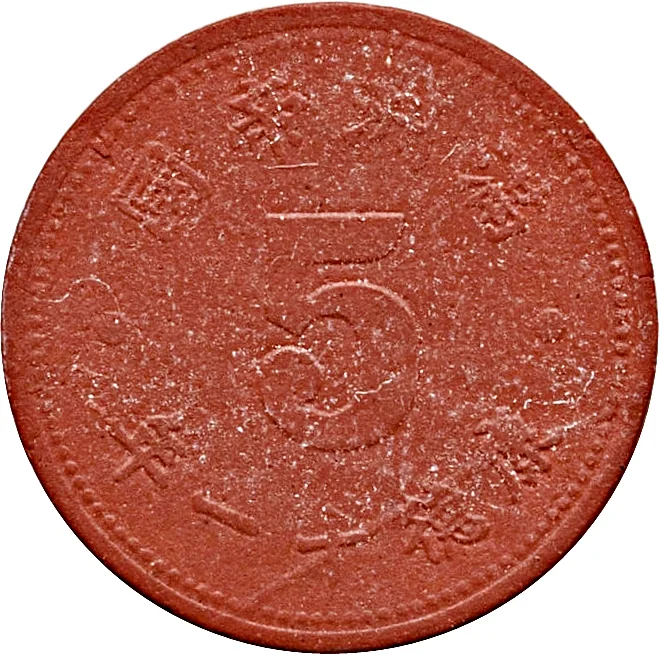
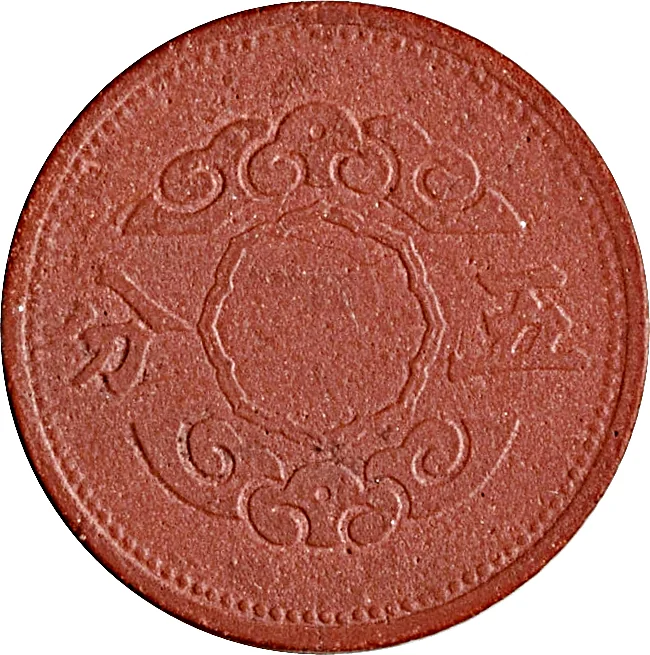
5 fen – Manchukuo
Add to wishlist
China
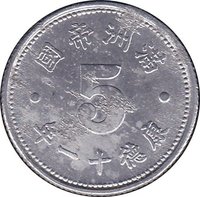
Obverse
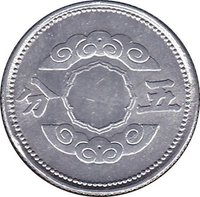
Reverse
Edge
Plain
Mintings
| Year | Mint Mark | Mintage | Quality | Collection |
|---|---|---|---|---|
| 1944 | — | — | ||
| 1945 | — | — |
Historical background
By 1944, the currency situation in Manchukuo was one of severe inflationary crisis and collapsing confidence, directly tied to the failing fortunes of its Japanese overlords in the Pacific War. The official currency, the Manchukuo yuan, issued by the Central Bank of Manchukuo, had been pegged at par to the Japanese yen since the puppet state's founding in 1932. This system facilitated the extraction of resources for Japan's war machine, but by 1944, the money supply was being expanded recklessly to cover massive government deficits and the soaring costs of Japan's total war effort. The Bank of Japan provided unlimited backing, effectively turning Manchukuo into a monetary satellite, printing money without economic support to fund military-industrial production and the occupation apparatus.
Hyperinflation took hold as the money supply exploded while the economy, stripped of resources and crippled by Allied blockades, contracted sharply. Essential goods became scarce, leading to a drastic divergence between official prices and those on the rampant black market, where the yuan traded at a fraction of its face value. The population, including Japanese settlers, increasingly resorted to barter or hoarded tangible goods. Despite strict wartime controls on prices and currency exchange, public trust in the yuan evaporated. Its value was sustained only by coercive measures requiring its use for official transactions and salaries, but its real purchasing power plummeted month by month.
This monetary collapse was a clear symptom of Manchukuo's impending dissolution. The currency system, entirely dependent on Japanese military power and economic integration, disintegrated as Japan's defensive perimeter shrank and its home islands came under direct threat. By late 1944, the financial administration was a hollow shell, managing a worthless currency for a state whose existence was contingent on a war it was clearly losing. The hyperinflation of the Manchukuo yuan presaged the complete political and economic collapse that would follow Japan's surrender in August 1945, rendering the currency a worthless relic.
Hyperinflation took hold as the money supply exploded while the economy, stripped of resources and crippled by Allied blockades, contracted sharply. Essential goods became scarce, leading to a drastic divergence between official prices and those on the rampant black market, where the yuan traded at a fraction of its face value. The population, including Japanese settlers, increasingly resorted to barter or hoarded tangible goods. Despite strict wartime controls on prices and currency exchange, public trust in the yuan evaporated. Its value was sustained only by coercive measures requiring its use for official transactions and salaries, but its real purchasing power plummeted month by month.
This monetary collapse was a clear symptom of Manchukuo's impending dissolution. The currency system, entirely dependent on Japanese military power and economic integration, disintegrated as Japan's defensive perimeter shrank and its home islands came under direct threat. By late 1944, the financial administration was a hollow shell, managing a worthless currency for a state whose existence was contingent on a war it was clearly losing. The hyperinflation of the Manchukuo yuan presaged the complete political and economic collapse that would follow Japan's surrender in August 1945, rendering the currency a worthless relic.
🌱 Fairly Common