

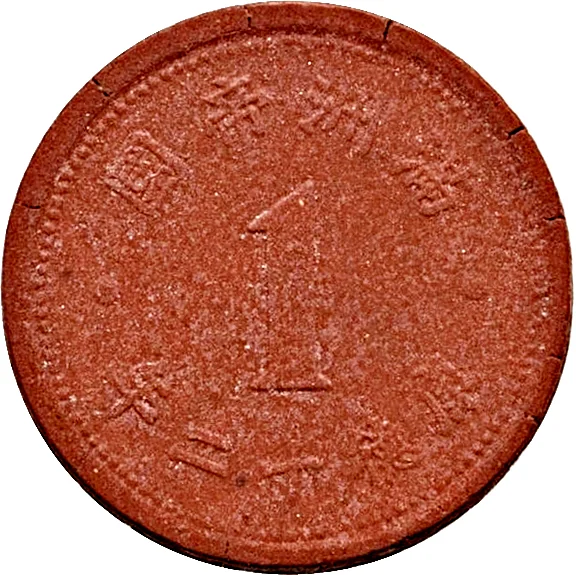
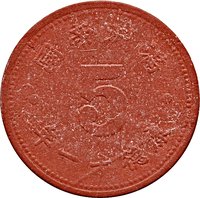
Obverse
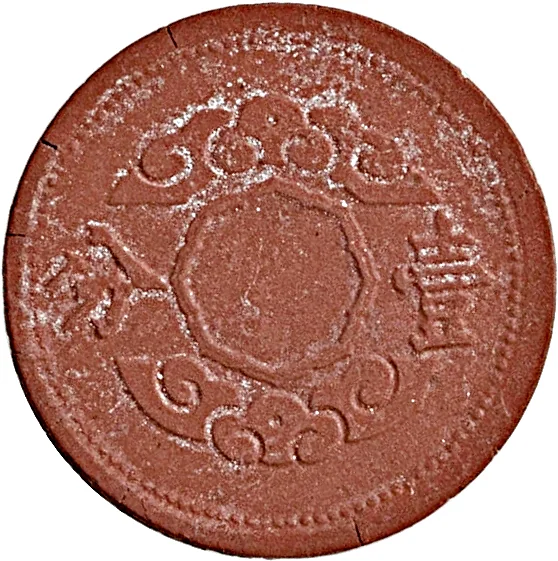
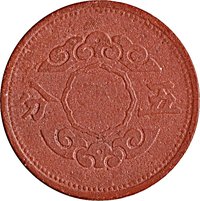
Reverse
Edge
Plain
Mintings
| Year | Mint Mark | Mintage | Quality | Collection |
|---|---|---|---|---|
| 1945 | — | — |
Historical background
By 1945, the currency situation in Manchukuo was one of catastrophic hyperinflation and complete loss of confidence, mirroring the collapse of the Japanese wartime empire. The Central Bank of Manchukuo’s currency, the yuan (or "Manchukuo yuan"), had been artificially pegged to the Japanese yen and was entirely dependent on Japan’s financial system. As Japan’s war fortunes reversed, the Japanese military and Manchukuo authorities financed their desperate defense by printing money without restraint, flooding the economy with currency to cover massive deficits. This led to a vicious cycle of soaring prices, severe shortages of basic goods, and a widespread black market where goods were traded for实物 (physical goods) or more stable currencies.
The monetary system was further destabilized by the concurrent circulation of multiple currencies. Alongside the devalued Manchukuo yuan, Japanese yen, Soviet Red Army occupation rubles (issued after the August invasion), and various local and private scrip all competed in a chaotic market. The Soviet invasion on August 9, 1945, shattered any remaining pretense of financial order. The Central Bank’s reserves were seized, and its operations ceased, rendering the Manchukuo yuan worthless fiat paper almost overnight. The economy reverted to barter, with items like food, cloth, and cigarettes becoming the de facto mediums of exchange.
In the immediate post-surrender vacuum, this currency collapse exacerbated the humanitarian crisis and social chaos. The former regime’s money was useful only as fuel or wallpaper, and no legitimate authority existed to issue a stable replacement. This financial ruin was a direct symptom of Manchukuo’s fundamental nature as a puppet state; its currency could not outlive the political and military power of its Japanese creator. The task of establishing a new monetary system would fall to the incoming Chinese civil war factions, who would eventually replace it with the Northeastern Bank yuan, folding the region back into China’s financial sphere.
The monetary system was further destabilized by the concurrent circulation of multiple currencies. Alongside the devalued Manchukuo yuan, Japanese yen, Soviet Red Army occupation rubles (issued after the August invasion), and various local and private scrip all competed in a chaotic market. The Soviet invasion on August 9, 1945, shattered any remaining pretense of financial order. The Central Bank’s reserves were seized, and its operations ceased, rendering the Manchukuo yuan worthless fiat paper almost overnight. The economy reverted to barter, with items like food, cloth, and cigarettes becoming the de facto mediums of exchange.
In the immediate post-surrender vacuum, this currency collapse exacerbated the humanitarian crisis and social chaos. The former regime’s money was useful only as fuel or wallpaper, and no legitimate authority existed to issue a stable replacement. This financial ruin was a direct symptom of Manchukuo’s fundamental nature as a puppet state; its currency could not outlive the political and military power of its Japanese creator. The task of establishing a new monetary system would fall to the incoming Chinese civil war factions, who would eventually replace it with the Northeastern Bank yuan, folding the region back into China’s financial sphere.
🌱 Fairly Common