

1 Scudo – Cisalpine Republic
Italy
Context
Year: 1800
French republican Year: 8
Country: Italy 
Issuer: Cisalpine Republic
Period:
(1797—1802)
Currency:
Demonetized: Yes
Total mintage: 3,494
Material
References
Numista: #21527
Value
Bullion value: $59.94
Obverse
Description:
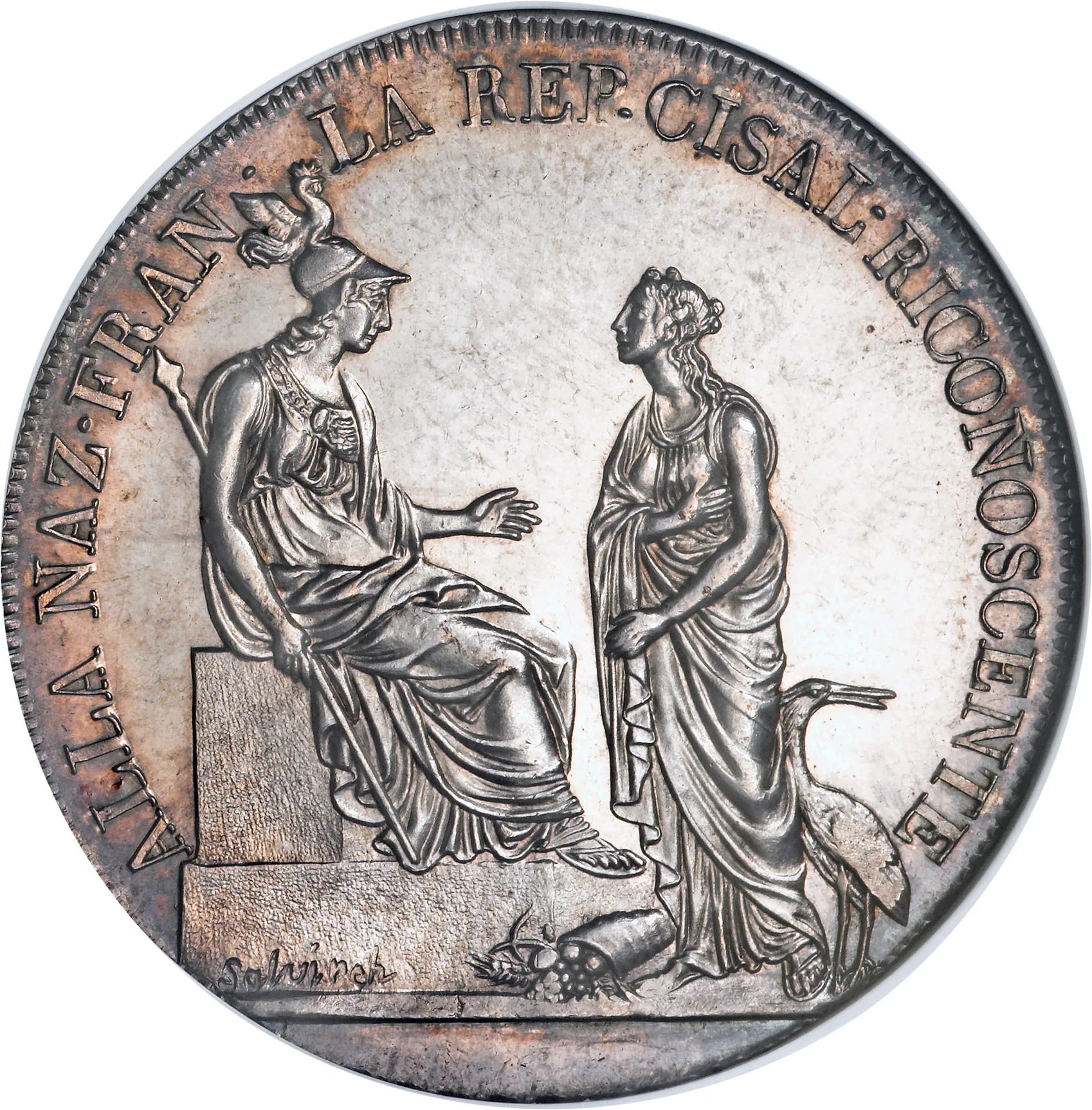
The allegorical figure of the Cisalpine Republic pays tribute to seated France, flanked by a stork (devotion) and a cornucopia (abundance). The author's name is incised on the throne's base.
Inscription:
ALLA NAZ·FRAN·LA REP·CISAL·RICONOSCENTE
Translation:
To the French Nation, the Cisalpine Republic Grateful
Script: Latin
Language: Italian
Engraver: Giuseppe Salvirch
Designer: Andrea Appiani
Reverse
Description:
Value and date
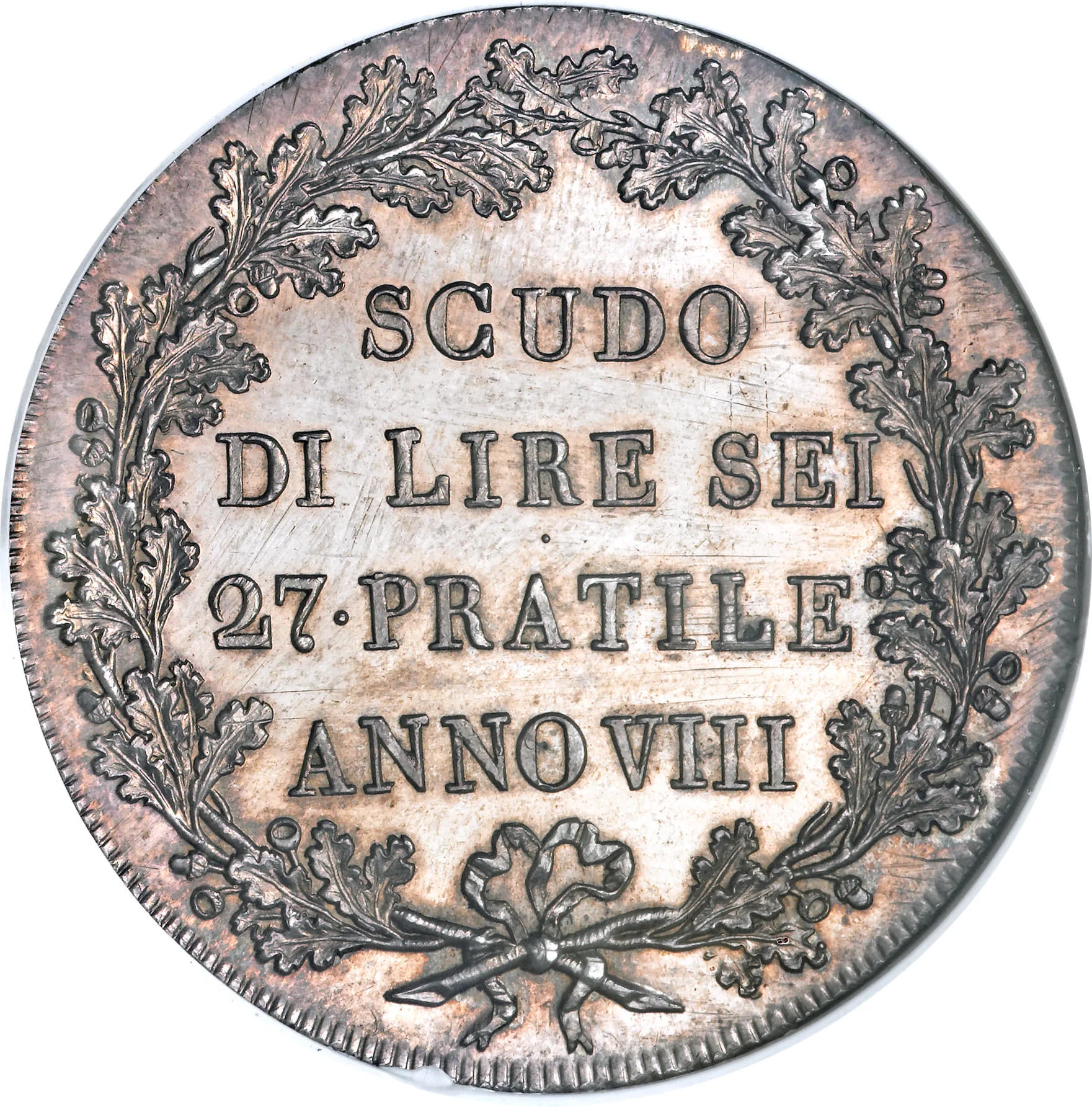
Between oak branches
Between oak branches
Inscription:
SCUDO
DI LIRE SEI
27·PRATILE
ANNO VIII
DI LIRE SEI
27·PRATILE
ANNO VIII
Translation:
Shield
Of Six Lire
27·Pratile
Year VIII
Of Six Lire
27·Pratile
Year VIII
Script: Latin
Language: Italian
Engraver: Giuseppe Salvirch
Edge
Smooth, with the motto in relief
Legend:
UNIONE E VIRTU'
Translation:
By union and virtue
Language: Italian
Categories
| Animal> Bird |
| Symbol> Cornucopia |
Mints
| Name | Mark |
|---|---|
| Milan | — |
Mintings
| Year | Mint Mark | Mintage | Quality | Collection |
|---|---|---|---|---|
| 1800 | — | 3,494 |
Historical background
The currency situation in the Cisalpine Republic in 1800 was one of profound instability and complexity, a direct legacy of its turbulent political past. The Republic, a French client state in Northern Italy, had inherited a chaotic monetary landscape from the previous Austrian Habsburg and various regional administrations. This resulted in a chaotic circulation of diverse coins: Austrian thalers, old Milanese scudi and lire, Venetian zecchini, and French-minted coins from the earlier, short-lived republic. The lack of a unified, trusted currency severely hampered trade and state finances, creating a system ripe for speculation and uncertainty.
In response, the government, under increasing French direction following Napoleon's reconquest in 1800, attempted reform. A law on 21 March 1800 aimed to establish a new national monetary system based on the lira, subdivided into 100 centesimi, aligning it metrically with the French franc to facilitate economic integration. However, this was largely a legislative fiction. The state lacked the bullion reserves and minting capacity to replace the circulating mosaic of old coins in the short term. Consequently, the older foreign and domestic coins remained in widespread use, their values fluctuating against the theoretical new lira.
Therefore, 1800 represents a transitional year of intent rather than resolution. The currency chaos was a microcosm of the Republic's broader challenges: it was a nascent state trying to impose modern, centralized systems on a fragmented economic reality, all while being financially drained to support French military needs. True monetary stabilization would only begin with the heavier-handed reforms of the Italian Republic (1802) and the later Kingdom of Italy, which eventually succeeded in issuing a unified, decimal-based coinage.
In response, the government, under increasing French direction following Napoleon's reconquest in 1800, attempted reform. A law on 21 March 1800 aimed to establish a new national monetary system based on the lira, subdivided into 100 centesimi, aligning it metrically with the French franc to facilitate economic integration. However, this was largely a legislative fiction. The state lacked the bullion reserves and minting capacity to replace the circulating mosaic of old coins in the short term. Consequently, the older foreign and domestic coins remained in widespread use, their values fluctuating against the theoretical new lira.
Therefore, 1800 represents a transitional year of intent rather than resolution. The currency chaos was a microcosm of the Republic's broader challenges: it was a nascent state trying to impose modern, centralized systems on a fragmented economic reality, all while being financially drained to support French military needs. True monetary stabilization would only begin with the heavier-handed reforms of the Italian Republic (1802) and the later Kingdom of Italy, which eventually succeeded in issuing a unified, decimal-based coinage.
💎 Extremely Rare