

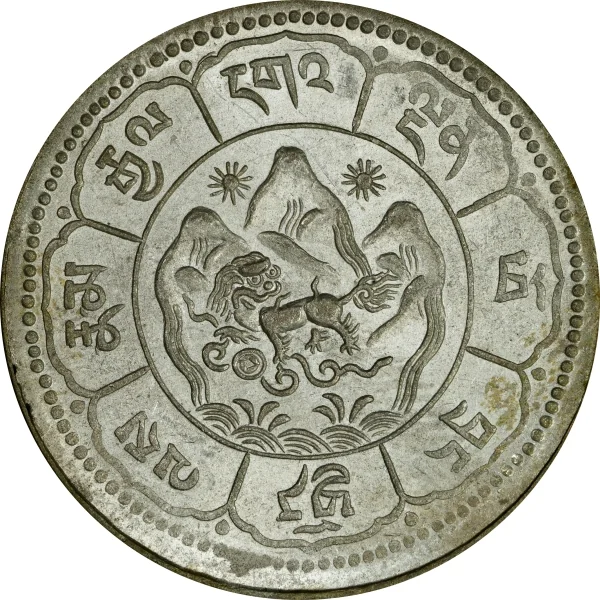
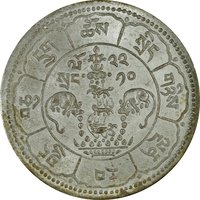
Obverse
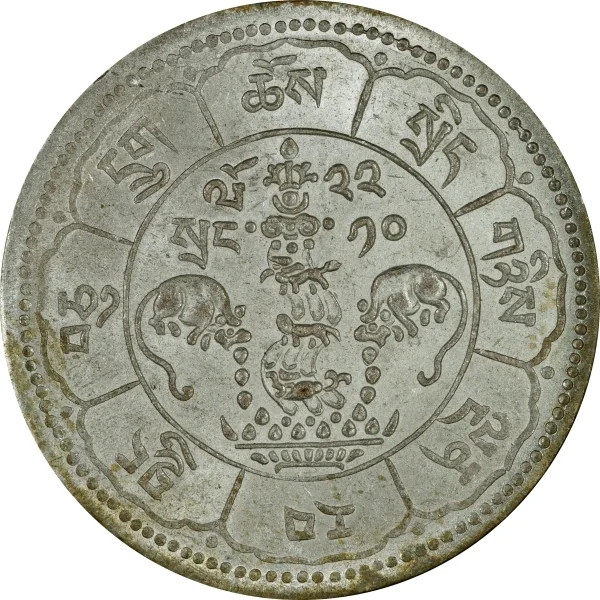
Reverse
Description:
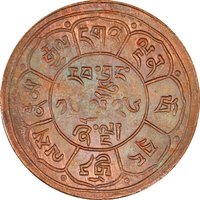
Two mongooses facing a victory banner over disharmony, within an eight-petalled lotus framed by Tibetan characters.
Inscription:
ཆོས་སྲིད་ གཉིས་ལྡན་ རབ་བྱུང་ བཅུ་དྲུག་
སོ ༢༢
སྲང ༡༠
སོ ༢༢
སྲང ༡༠
Translation:
Twofold System of Religion and Governance, Sixteenth Rabjung, Year 22, Weight 10 Srang.
Script: Tibetan
Language: Tibetan
Edge
Reeded.
Mintings
| Year | Mint Mark | Mintage | Quality | Collection |
|---|---|---|---|---|
| 1948 | — | — | ||
| 1949 | — | — |
Historical background
In 1948, Tibet operated under a complex and fragmented monetary system, reflecting its ambiguous political status. The region was de facto independent following the collapse of the Qing dynasty, but this independence was contested by the Republic of China. The primary currency in circulation was the Tibetan srang, a silver coin first minted in 1909, alongside paper banknotes issued by the Tibetan government. However, the monetary landscape was not unified; Indian rupees, Chinese yuan, and even Mexican silver dollars circulated in border areas, particularly for trade. This multi-currency environment highlighted Tibet's economic ties to both British India and China, as well as the weak central authority of the Lhasa government over its own financial system.
The Tibetan government faced significant economic challenges. Its mint in Lhasa struggled with inconsistent silver supplies, leading to fluctuations in coin quality and value. Furthermore, the paper currency, not fully backed by silver reserves, suffered from public distrust and inflation, especially as government expenditures increased. The economy remained largely agrarian and monastic, with limited modern banking infrastructure. International trade, a critical economic lifeline, was conducted primarily through India, making the Indian rupee a strong and preferred currency for larger transactions, thereby undermining the sovereignty of the Tibetan srang.
This precarious financial situation existed on the brink of profound change. The Chinese Civil War was reaching its climax, and the victory of the Chinese Communist Party in 1949 would soon alter Tibet's fate irrevocably. The currency fragmentation of 1948, therefore, symbolizes the final years of Tibet's autonomous period. Within three years, the People's Liberation Army's advance would lead to the Seventeen Point Agreement and the eventual incorporation of Tibet into the People's Republic of China, initiating a complete currency reform that replaced the Tibetan srang with the Chinese Renminbi and fully integrated the region into the national monetary system.
The Tibetan government faced significant economic challenges. Its mint in Lhasa struggled with inconsistent silver supplies, leading to fluctuations in coin quality and value. Furthermore, the paper currency, not fully backed by silver reserves, suffered from public distrust and inflation, especially as government expenditures increased. The economy remained largely agrarian and monastic, with limited modern banking infrastructure. International trade, a critical economic lifeline, was conducted primarily through India, making the Indian rupee a strong and preferred currency for larger transactions, thereby undermining the sovereignty of the Tibetan srang.
This precarious financial situation existed on the brink of profound change. The Chinese Civil War was reaching its climax, and the victory of the Chinese Communist Party in 1949 would soon alter Tibet's fate irrevocably. The currency fragmentation of 1948, therefore, symbolizes the final years of Tibet's autonomous period. Within three years, the People's Liberation Army's advance would lead to the Seventeen Point Agreement and the eventual incorporation of Tibet into the People's Republic of China, initiating a complete currency reform that replaced the Tibetan srang with the Chinese Renminbi and fully integrated the region into the national monetary system.
⭐ Rare