

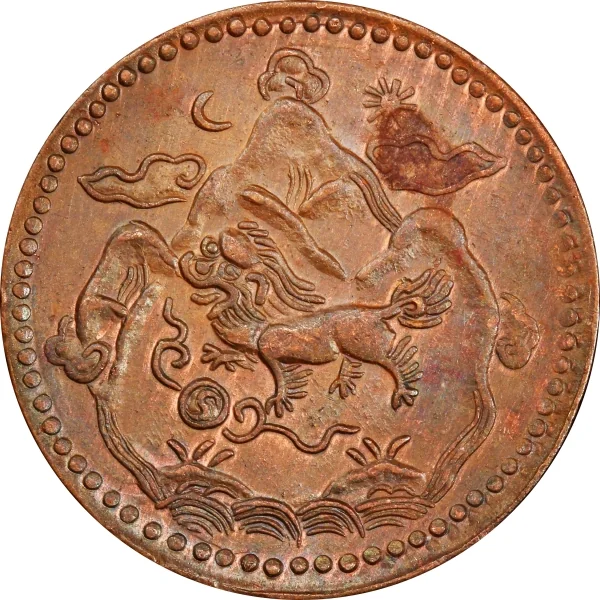
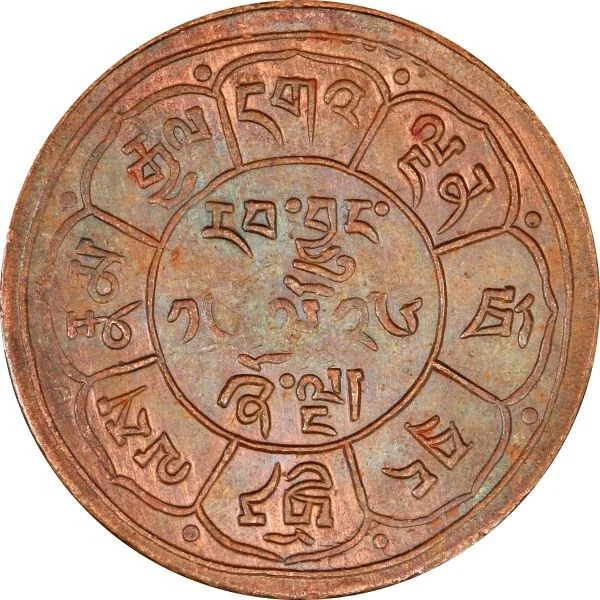

Obverse
Description:
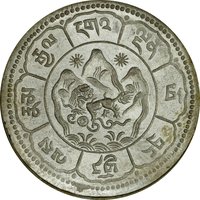
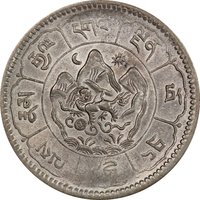
Snow lion facing left before Mount Kailash, with sun and moon behind.
Reverse
Edge
Reeded.
Mintings
| Year | Mint Mark | Mintage | Quality | Collection |
|---|---|---|---|---|
| 1949 | — | — | ||
| 1950 | — | — | ||
| 1951 | — | — | ||
| 1952 | — | — | ||
| 1953 | — | — |
Historical background
In 1949, Tibet operated under a distinct and complex monetary system, reflecting its de facto autonomous status prior to the decisive military and political changes that would occur in 1950-51. The primary currency in circulation was the Tibetan srang, a silver coin first minted in 1909, alongside its fractional units. Paper currency, introduced in the 1910s, was also in use but its value was unstable and often subject to depreciation. This system functioned independently from the financial structures of the Republic of China, though historical Chinese silver dollars (dayuan) and Indian rupees circulated in border regions due to trade links.
The economic and monetary landscape was fragile. The Tibetan government's minting operations faced challenges, including a debasement of coinage in the 1930s and 1940s which eroded public confidence. Furthermore, the paper currency, not fully backed by silver reserves, contributed to inflationary pressures. This internal vulnerability existed within a context of increasing geopolitical pressure, as the Chinese Communist Party's victory in the Chinese Civil War in 1949 brought the impending question of Tibet's status to the forefront.
Therefore, the currency situation at the close of 1949 was one of precarious isolation. While Tibet maintained its own sovereign coinage, the system was economically weak and stood on the brink of fundamental transformation. The advance of the People's Liberation Army toward Tibetan areas in early 1950 would soon lead to the end of this independent monetary system, initiating a process of integration with the Chinese renminbi that would be solidified after the Seventeen Point Agreement of 1951.
The economic and monetary landscape was fragile. The Tibetan government's minting operations faced challenges, including a debasement of coinage in the 1930s and 1940s which eroded public confidence. Furthermore, the paper currency, not fully backed by silver reserves, contributed to inflationary pressures. This internal vulnerability existed within a context of increasing geopolitical pressure, as the Chinese Communist Party's victory in the Chinese Civil War in 1949 brought the impending question of Tibet's status to the forefront.
Therefore, the currency situation at the close of 1949 was one of precarious isolation. While Tibet maintained its own sovereign coinage, the system was economically weak and stood on the brink of fundamental transformation. The advance of the People's Liberation Army toward Tibetan areas in early 1950 would soon lead to the end of this independent monetary system, initiating a process of integration with the Chinese renminbi that would be solidified after the Seventeen Point Agreement of 1951.
🌱 Fairly Common