

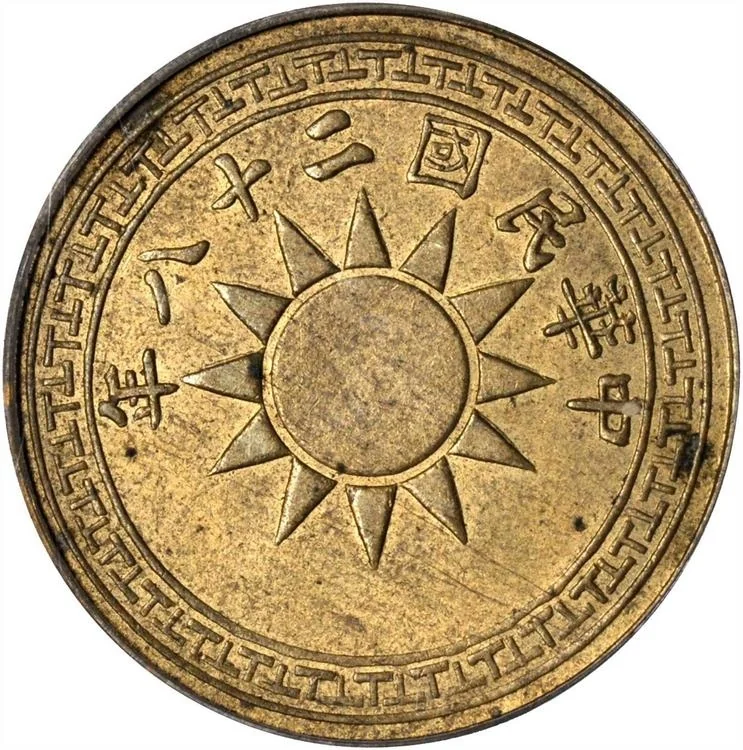
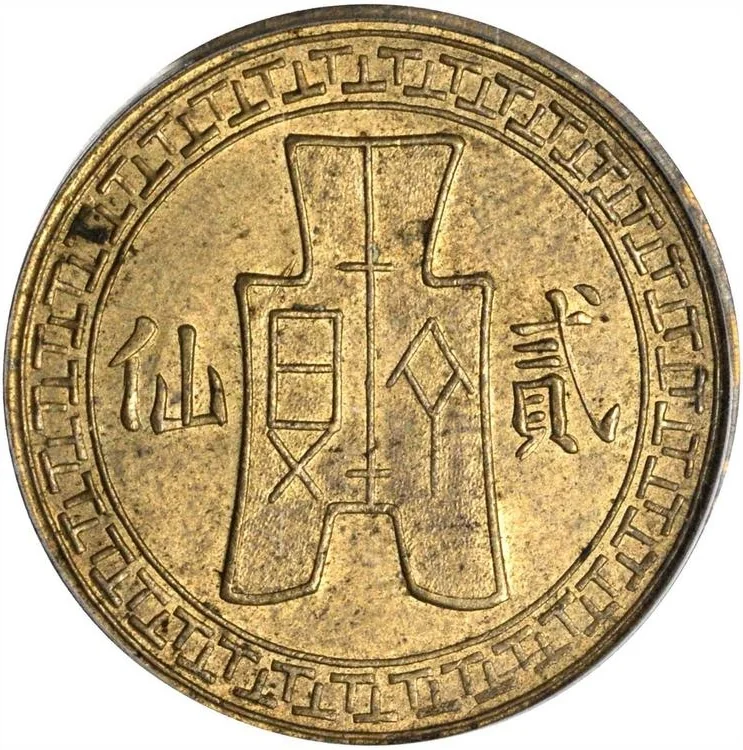
2 Fen – Republic of China
Standard circulation coins
Series: 3rd Series
China
Context
Year: 1939
Chinese republican Year: 28
Country: China 
Issuer: Republic of China
Period:
(1912—1949)
Currency:
(1912—1948)
Demonetized: Yes
Total mintage: 300,000,000
Material
References
Y: #Click to copy to clipboard354
Numista: #21110
Obverse
Reverse
Description:
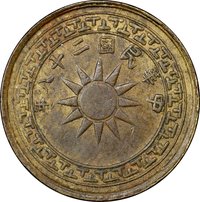
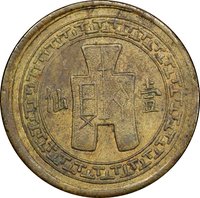
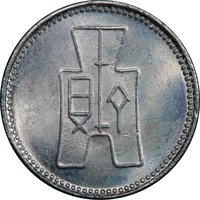
Ancient Chinese spade coin with one ideogram per side within a decorative border.
Inscription:
仙貳
貝齊
貝齊
Translation:
Immortal Two
Qi Coin
Qi Coin
Script: Chinese
Language: Classical Chinese
Edge
Plain
Categories
| Currency> Coin depiction |
Mintings
| Year | Mint Mark | Mintage | Quality | Collection |
|---|---|---|---|---|
| 1939 | — | 300,000,000 |
Historical background
In 1939, the currency situation in the Republic of China was defined by a state of severe monetary warfare and inflationary pressure, a direct consequence of the ongoing Second Sino-Japanese War. The Nationalist government (Kuomintang) had retreated to Chongqing, and its legal tender, the fabi (法幣), was under deliberate assault. The Japanese occupying forces in north and east China, through puppet regimes like the Provisional Government in Beijing and the Reformed Government in Nanjing, aggressively issued their own military scrip and puppet currencies (like the Federal Reserve Bank of China notes). Their strategy was to seize fabi reserves, force the circulation of their own unsupported notes, and then use the captured fabi to purchase vital goods from unoccupied China and foreign markets, thereby draining the Nationalist economy and fueling inflation.
Within the unoccupied "Free China," the government faced a catastrophic fiscal crisis. War expenditures were immense, but the industrial and tax base had been drastically reduced by territorial losses. To cover the deficit, the Chongqing government resorted to printing fabi with little restraint, as borrowing or taxation were insufficient. This rapid expansion of the money supply, coupled with the shrinking availability of goods due to blockade and disruption, initiated a vicious cycle of inflation. While prices had not yet reached the hyperinflationary levels of the mid-1940s, 1939 marked a critical turning point where the loss of confidence in the fabi became pronounced, and the cost of living began a steep, alarming climb.
Furthermore, the currency landscape was fragmented. Alongside the besieged fabi and the invading Japanese notes, various regional and local currencies persisted. Old silver coins and copper cash still circulated in some areas, and Communist-controlled regions in the northwest began experimenting with their own separate currency (the bianbi), issued by the Border Region banks to establish economic autonomy. Thus, by 1939, China’s monetary system was not unified but a contested and fractured battlefield, mirroring the country's political and military disintegration, with inflationary pressures setting the stage for the economic turmoil that would engulf the following war years.
Within the unoccupied "Free China," the government faced a catastrophic fiscal crisis. War expenditures were immense, but the industrial and tax base had been drastically reduced by territorial losses. To cover the deficit, the Chongqing government resorted to printing fabi with little restraint, as borrowing or taxation were insufficient. This rapid expansion of the money supply, coupled with the shrinking availability of goods due to blockade and disruption, initiated a vicious cycle of inflation. While prices had not yet reached the hyperinflationary levels of the mid-1940s, 1939 marked a critical turning point where the loss of confidence in the fabi became pronounced, and the cost of living began a steep, alarming climb.
Furthermore, the currency landscape was fragmented. Alongside the besieged fabi and the invading Japanese notes, various regional and local currencies persisted. Old silver coins and copper cash still circulated in some areas, and Communist-controlled regions in the northwest began experimenting with their own separate currency (the bianbi), issued by the Border Region banks to establish economic autonomy. Thus, by 1939, China’s monetary system was not unified but a contested and fractured battlefield, mirroring the country's political and military disintegration, with inflationary pressures setting the stage for the economic turmoil that would engulf the following war years.
Series: 3rd Series
⭐ Somewhat Rare