

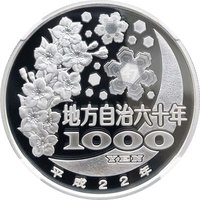
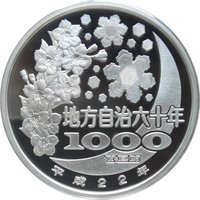
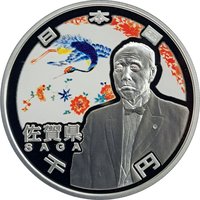
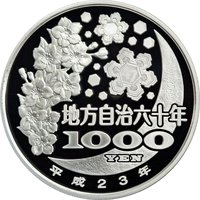
1000 Yen (Local Autonomy Law) – Japan
Non-circulating coins
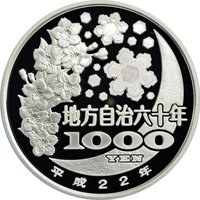
Commemoration: 60th anniversary of Local Autonomy Law
Japan
Context
Year: 2010
Japanese - Heisei era Year: 22
Issuer: Japan 
Ruler: Heisei
Currency:
(since 1871)
Total mintage: 100,000
Material
Diameter: 40 mm
Weight: 31.1 g
Silver weight: 31.07 g
Thickness: 3.5 mm
Shape: Round
Composition: 99.9% Silver
Standard: Silver ounce
Magnetic: No
Alignment: Medal alignment
flip
References
Y: #Click to copy to clipboard168
Numista: #19559
Value
Exchange value: 1000 JPY = $6.41
Bullion value: $88.92
Inflation-adjusted value: 1138.71 JPY
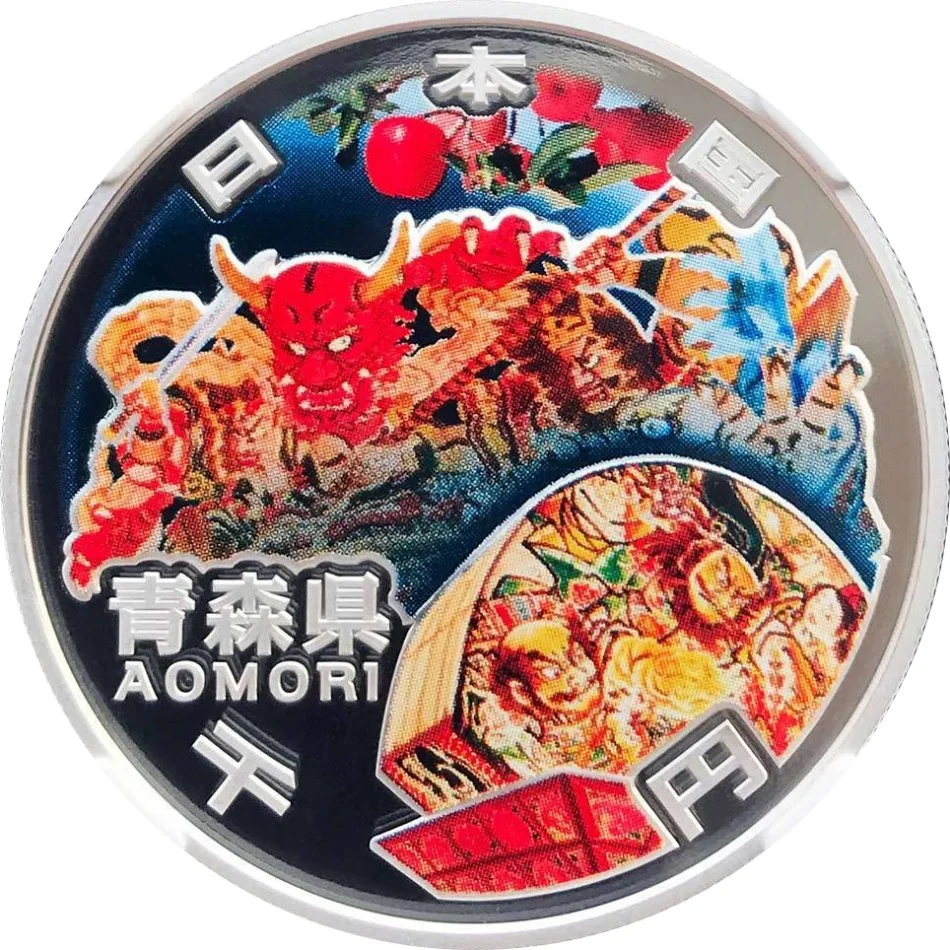
Obverse
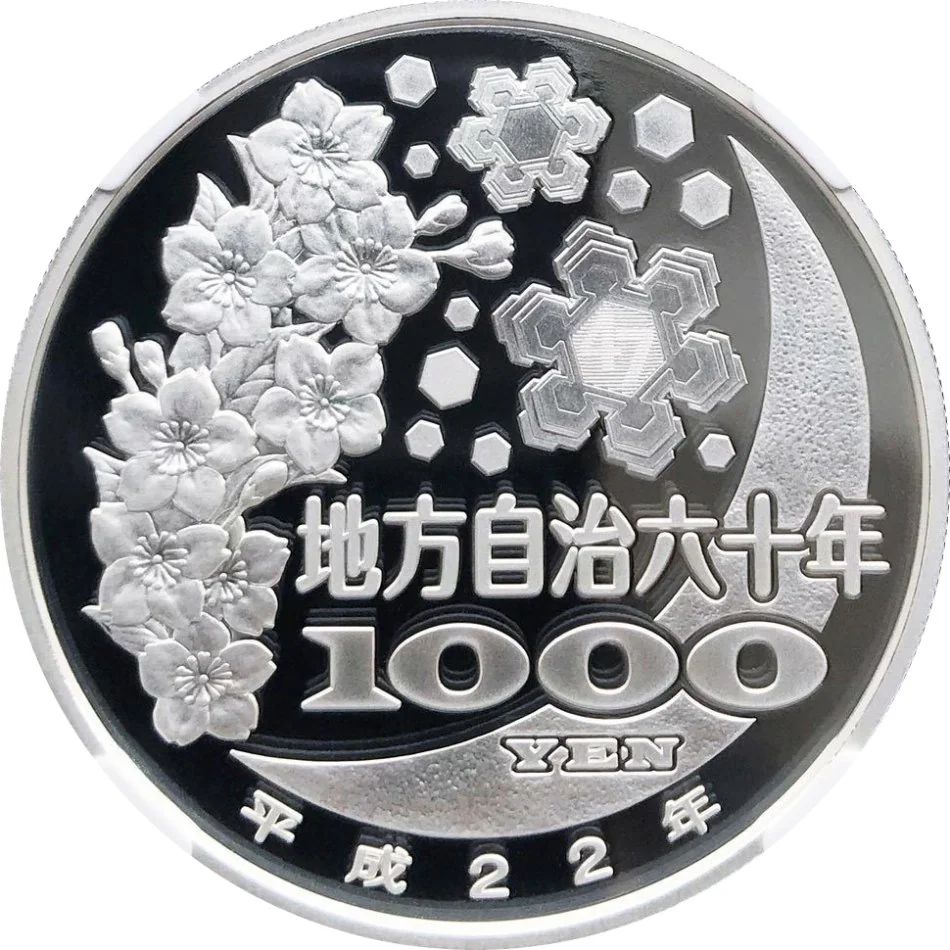
Reverse
Edge
Slanted reeding
Mints
| Name | Mark |
|---|---|
| Japan Mint | — |
Mintings
| Year | Mint Mark | Mintage | Quality | Collection |
|---|---|---|---|---|
| 2010 | — | 100,000 | Proof |
Historical background
In 2010, Japan's currency situation was dominated by the persistent challenge of yen appreciation. The year was marked by the yen reaching a 15-year high against the U.S. dollar, with the exchange rate breaching the ¥80/$ level. This surge was driven by Japan's status as a safe-haven currency; amid global economic uncertainty following the 2008 financial crisis, investors flocked to the yen, which was perceived as stable despite Japan's own domestic economic struggles. The strong yen severely threatened the country's export-dependent economy, as it made Japanese goods like cars and electronics more expensive overseas and eroded the repatriated profits of corporate giants such as Toyota and Sony.
The Japanese government and the Bank of Japan (BOJ) responded with a series of direct and unprecedented interventions. In September, for the first time in six years, Japan unilaterally sold yen in the foreign exchange market to weaken its value. This was followed by a major coordinated intervention with other G7 nations in March 2011, just as the year ended. Concurrently, the BOJ maintained an ultra-loose monetary policy, having already cut its benchmark interest rate to virtually zero (0.1%) and introduced comprehensive quantitative easing measures to combat deflation and curb the yen's rise.
This currency environment existed within a broader context of economic stagnation and deflationary pressure, a period often referred to as the "Lost Decades." Despite the strong yen, domestic demand remained weak, and consumer prices continued to fall. The government's efforts in 2010 thus represented a tense balancing act: fighting deflation with massive monetary stimulus while simultaneously attempting to directly manipulate the exchange rate to protect its vital export sector, highlighting the profound difficulties of managing a currency whose strength was both a symptom of global instability and a direct threat to national economic recovery.
The Japanese government and the Bank of Japan (BOJ) responded with a series of direct and unprecedented interventions. In September, for the first time in six years, Japan unilaterally sold yen in the foreign exchange market to weaken its value. This was followed by a major coordinated intervention with other G7 nations in March 2011, just as the year ended. Concurrently, the BOJ maintained an ultra-loose monetary policy, having already cut its benchmark interest rate to virtually zero (0.1%) and introduced comprehensive quantitative easing measures to combat deflation and curb the yen's rise.
This currency environment existed within a broader context of economic stagnation and deflationary pressure, a period often referred to as the "Lost Decades." Despite the strong yen, domestic demand remained weak, and consumer prices continued to fall. The government's efforts in 2010 thus represented a tense balancing act: fighting deflation with massive monetary stimulus while simultaneously attempting to directly manipulate the exchange rate to protect its vital export sector, highlighting the profound difficulties of managing a currency whose strength was both a symptom of global instability and a direct threat to national economic recovery.
💎 Very Rare