

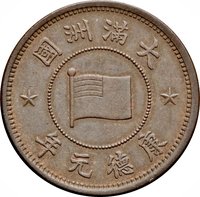
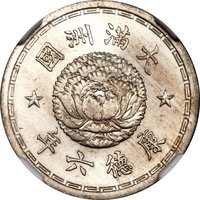
Obverse
Description:
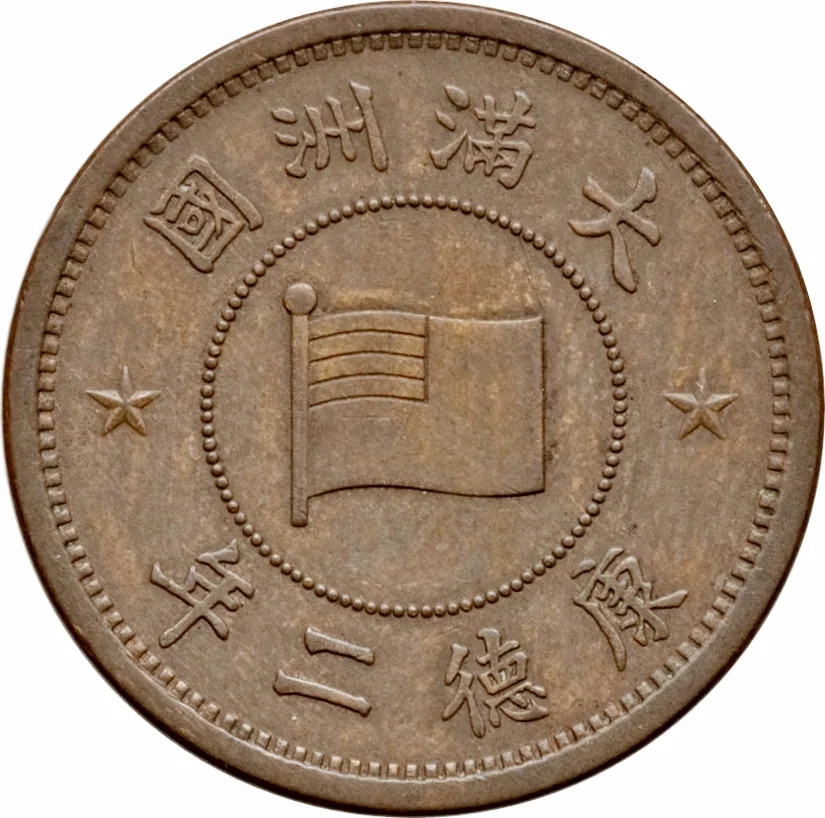
Flag encircled by pearls and text.
Inscription:
⋆國洲滿大⋆
年二德康
年二德康
Translation:
The Great Manchu State
The Second Year of Kangde
The Second Year of Kangde
Script: Chinese
Language: Classical Chinese
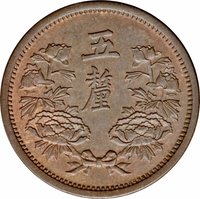
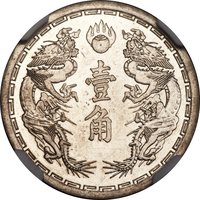
Reverse
Edge
Plain
Mintings
| Year | Mint Mark | Mintage | Quality | Collection |
|---|---|---|---|---|
| 1934 | — | — | ||
| 1935 | — | — | ||
| 1936 | — | — | ||
| 1937 | — | — | ||
| 1938 | — | — | ||
| 1939 | — | — |
Historical background
In 1934, the currency situation in Manchukuo was a critical instrument of Japanese imperial policy, designed to sever the region's economic ties with China and integrate it firmly into Japan's wartime economic sphere. Following the establishment of the puppet state in 1932, the Japanese Kwantung Army moved swiftly to replace the multitude of circulating currencies—including the Chinese yuan, local provincial notes, and old imperial coins—with a unified, controlled system. The centerpiece was the Manchukuo yuan, issued by the newly founded Central Bank of Manchukuo, which was established in 1932 with Japanese advisors effectively in control. By 1934, this currency had become the sole legal tender, its value pegged at parity to the Japanese yen, symbolizing the bloc's economic unity.
The system's primary function was to facilitate resource extraction and industrial development to feed Japan's growing war machine. The Manchukuo yuan was backed not by substantial gold or silver reserves, but by a foreign exchange reserve fund held in yen and managed under Japanese supervision. This linkage ensured financial stability for Japanese investors and trading firms operating in the region, while also allowing for the forced purchase of strategic materials like soybeans, coal, and iron ore at favorable, state-controlled prices. The currency regime effectively turned Manchukuo into a captive market, financing massive infrastructure and heavy industry projects through bank credit, often for Japanese conglomerates (zaibatsu).
Despite its political aims, the currency faced significant challenges. Widespread counterfeiting of the earlier "old yuan" notes by Chinese resistance groups and others aimed to undermine economic stability. Furthermore, while the official peg to the yen was maintained, inflationary pressures were beginning to build due to heavy government spending on industrial expansion and military-related projects. By 1934, the financial architecture was firmly in place, creating a dependent, managed economy that served Japanese interests, but it was a system increasingly geared toward militarization, laying the groundwork for the inflationary crises that would emerge in the late 1930s and during the Pacific War.
The system's primary function was to facilitate resource extraction and industrial development to feed Japan's growing war machine. The Manchukuo yuan was backed not by substantial gold or silver reserves, but by a foreign exchange reserve fund held in yen and managed under Japanese supervision. This linkage ensured financial stability for Japanese investors and trading firms operating in the region, while also allowing for the forced purchase of strategic materials like soybeans, coal, and iron ore at favorable, state-controlled prices. The currency regime effectively turned Manchukuo into a captive market, financing massive infrastructure and heavy industry projects through bank credit, often for Japanese conglomerates (zaibatsu).
Despite its political aims, the currency faced significant challenges. Widespread counterfeiting of the earlier "old yuan" notes by Chinese resistance groups and others aimed to undermine economic stability. Furthermore, while the official peg to the yen was maintained, inflationary pressures were beginning to build due to heavy government spending on industrial expansion and military-related projects. By 1934, the financial architecture was firmly in place, creating a dependent, managed economy that served Japanese interests, but it was a system increasingly geared toward militarization, laying the groundwork for the inflationary crises that would emerge in the late 1930s and during the Pacific War.
Series: 1934 Manchukuo circulation coins
🌱 Fairly Common