

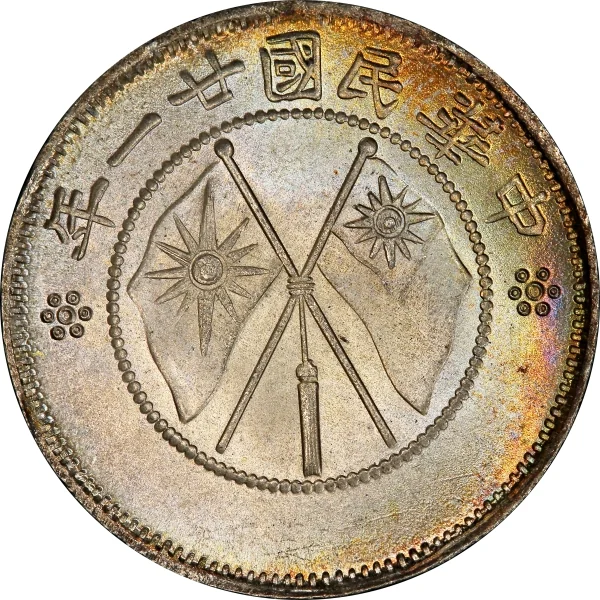
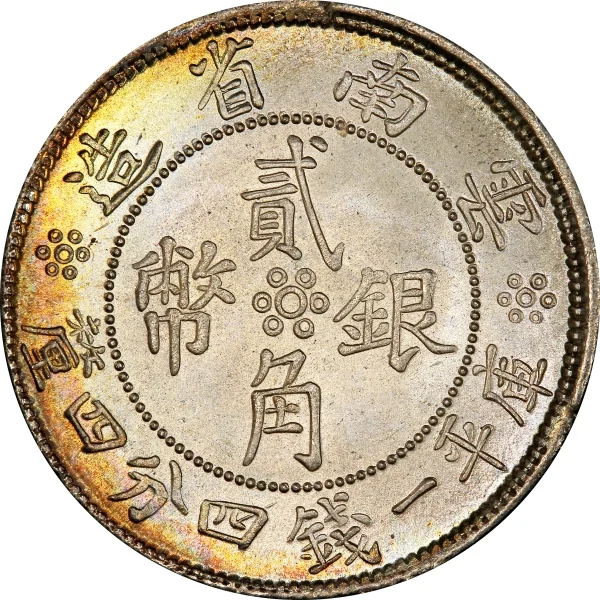
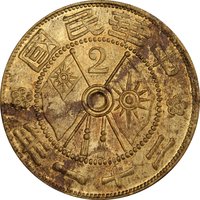
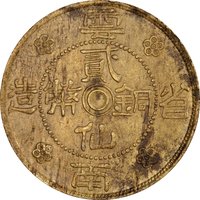
2 jiao – Yunnan Province
Add to wishlist
China
Context
Year: 1932
Chinese republican Year:: 21
Country: China
Issuer: Yunnan Province
Period:
(1912—1949)
Currency:
(1908—1949)
Demonetized: Yes
Material
References
Y: #
Numista: #17832
Value
Bullion value: $9.53
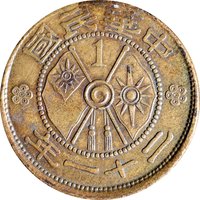
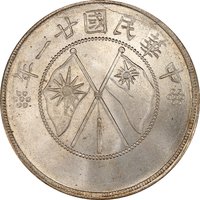
Obverse
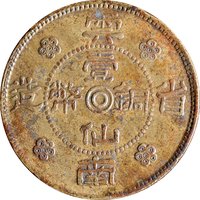
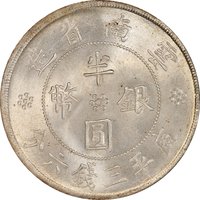
Reverse
Edge
Reeded.
Mintings
| Year | Mint Mark | Mintage | Quality | Collection |
|---|---|---|---|---|
| 1932 | — | — |
Historical background
In 1932, Yunnan Province operated under a complex and fragmented monetary system, a legacy of China's Warlord Era and its geographical isolation from central authority. While the Nanjing-based Nationalist Government (Kuomintang) had nominally unified China and was promoting its new currency, the fabi (legal tender), its reach in Yunnan remained limited. Provincial autonomy under Governor Long Yun meant that Yunnan's financial policies were largely self-determined, creating a currency environment distinct from the rest of the Republic of China.
The dominant currency in daily use was the Yunnan half-dollar silver coin, known as the "Dragon Dollar" or "Yunnan Yuan." These locally minted coins, often of varying and debased silver content, were the primary medium for tax collection, military pay, and substantial commercial transactions. Alongside this, a vast array of old Chinese silver dollars, foreign trade dollars (like Mexican pesos), and even silver bullion circulated. Crucially, the province was also flooded with low-denomination copper coins and privately issued paper notes from local banks, merchant guilds, and even pawnshops, leading to frequent instability and discounting between different forms of money.
This fragmented system presented significant challenges to trade and governance. The disparity between Yunnan's local currencies and the central fabi created exchange complexities for inter-provincial commerce. Furthermore, Governor Long Yun's government, needing to fund its administration and military, faced constant fiscal pressure, often resorting to manipulating the coinage or tolerating note issuance to cover deficits. Thus, in 1932, Yunnan's currency situation was one of precarious autonomy—a semi-independent silver-based system struggling with internal inconsistency while facing the gradual, but still distant, encroachment of national monetary unification from Nanjing.
The dominant currency in daily use was the Yunnan half-dollar silver coin, known as the "Dragon Dollar" or "Yunnan Yuan." These locally minted coins, often of varying and debased silver content, were the primary medium for tax collection, military pay, and substantial commercial transactions. Alongside this, a vast array of old Chinese silver dollars, foreign trade dollars (like Mexican pesos), and even silver bullion circulated. Crucially, the province was also flooded with low-denomination copper coins and privately issued paper notes from local banks, merchant guilds, and even pawnshops, leading to frequent instability and discounting between different forms of money.
This fragmented system presented significant challenges to trade and governance. The disparity between Yunnan's local currencies and the central fabi created exchange complexities for inter-provincial commerce. Furthermore, Governor Long Yun's government, needing to fund its administration and military, faced constant fiscal pressure, often resorting to manipulating the coinage or tolerating note issuance to cover deficits. Thus, in 1932, Yunnan's currency situation was one of precarious autonomy—a semi-independent silver-based system struggling with internal inconsistency while facing the gradual, but still distant, encroachment of national monetary unification from Nanjing.
⭐ Somewhat Rare