

1 yuan – Kirin Province
Add to wishlist
China
Context
Years: 1901–1905
Country: China
Issuer: Kirin Province
Ruler: Guangxu
Currency:
(1898—1909)
Demonetized: Yes
Material
References
Y: #
Numista: #17686
Value
Bullion value: $65.07
Obverse
Description:
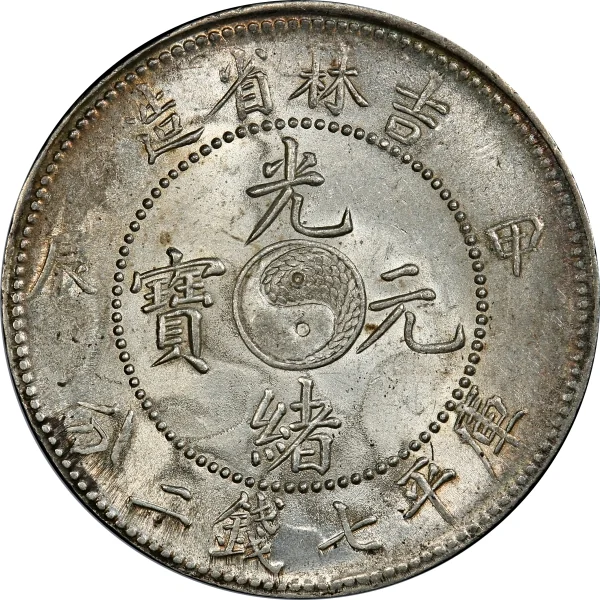
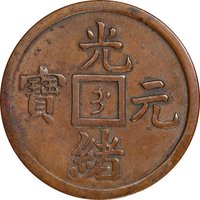
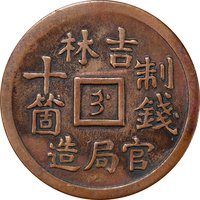
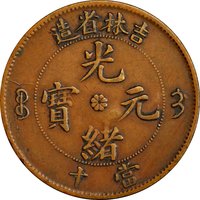
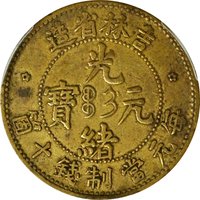
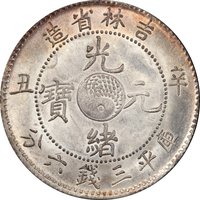
Yin-yang encircled by four central ideograms, surrounded by more characters.
Inscription:
造省林吉
辰甲
光
寶元
緒
分二錢七平庫
辰甲
光
寶元
緒
分二錢七平庫
Translation:
Made in Jilin Province,
Chen-Year, Jia-Year,
Guangxu Era,
Yuanbao,
Seven Mace and Two Candareens, Treasury Standard.
Chen-Year, Jia-Year,
Guangxu Era,
Yuanbao,
Seven Mace and Two Candareens, Treasury Standard.
Language: Classical Chinese
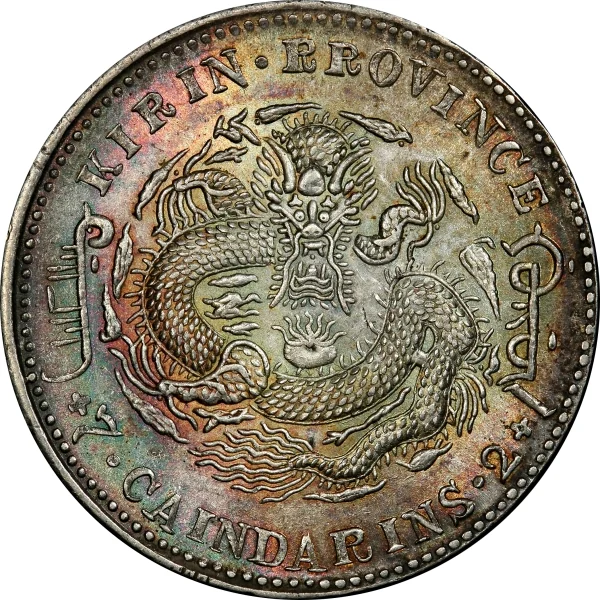
Reverse
Edge
Reeded.
Categories
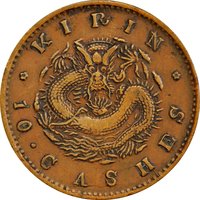
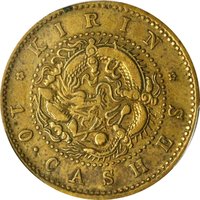
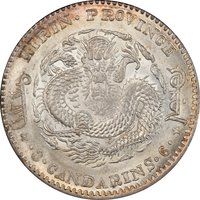
| Mythology> Fantastic animal |
Mintings
| Year | Mint Mark | Mintage | Quality | Collection |
|---|---|---|---|---|
| 1901 | — | — | ||
| 1902 | — | — | ||
| 1903 | — | — | ||
| 1904 | — | — | ||
| 1905 | — | — |
Historical background
In 1901, Kirin Province (present-day Jilin, China) existed within a complex and turbulent monetary environment, characteristic of the late Qing Dynasty's final years. The region did not have a unified, sovereign currency but was instead a zone of competing monetary systems. Officially, the province minted and circulated its own silver tael ingots (yuanbao) and copper-alloy cash coins with the reign mark "Kuang-hsü" (Guangxu), bearing the provincial mint mark "Kirin." However, the value and purity of these issues were inconsistent, and their circulation was often limited to major administrative centers.
The monetary landscape was profoundly complicated by foreign influence and market demand. To the south, the silver dollar coins of the Mexican "Eagle" and later the British "Trade Dollar" circulated widely due to their reliable silver content, often preferred in larger transactions. Most significantly, the Russian ruble, in both paper and silver coin form, dominated trade in northern Kirin, especially along the Chinese Eastern Railway zone, which was under Russian administration. This created a de facto dual-currency area where Russian notes and coins competed with, and often supplanted, local Qing currency.
This fragmentation was symptomatic of the Qing's weakening sovereignty and led to severe practical difficulties. Exchange rates between silver taels, copper cash, foreign silver dollars, and Russian rubles fluctuated wildly, hampering commerce and complicating tax collection. The situation fostered widespread counterfeiting of copper cash and contributed to local inflation. Ultimately, the currency chaos in Kirin in 1901 reflected the broader imperial decline, where regional economies were becoming financially integrated with foreign spheres of influence rather than with the central authority in Beijing.
The monetary landscape was profoundly complicated by foreign influence and market demand. To the south, the silver dollar coins of the Mexican "Eagle" and later the British "Trade Dollar" circulated widely due to their reliable silver content, often preferred in larger transactions. Most significantly, the Russian ruble, in both paper and silver coin form, dominated trade in northern Kirin, especially along the Chinese Eastern Railway zone, which was under Russian administration. This created a de facto dual-currency area where Russian notes and coins competed with, and often supplanted, local Qing currency.
This fragmentation was symptomatic of the Qing's weakening sovereignty and led to severe practical difficulties. Exchange rates between silver taels, copper cash, foreign silver dollars, and Russian rubles fluctuated wildly, hampering commerce and complicating tax collection. The situation fostered widespread counterfeiting of copper cash and contributed to local inflation. Ultimately, the currency chaos in Kirin in 1901 reflected the broader imperial decline, where regional economies were becoming financially integrated with foreign spheres of influence rather than with the central authority in Beijing.

✨ Legendary