

1 Yuan – Kansu Province
China
Context
Year: 1914
Chinese republican Year: 3
Country: China 
Issuer: Kansu Province
Period:
(1912—1949)
Currency:
(1920—1949)
Demonetized: Yes
Material
References
Y: #Click to copy to clipboard407
Numista: #16006
Value
Bullion value: $77.88
Obverse
Description:
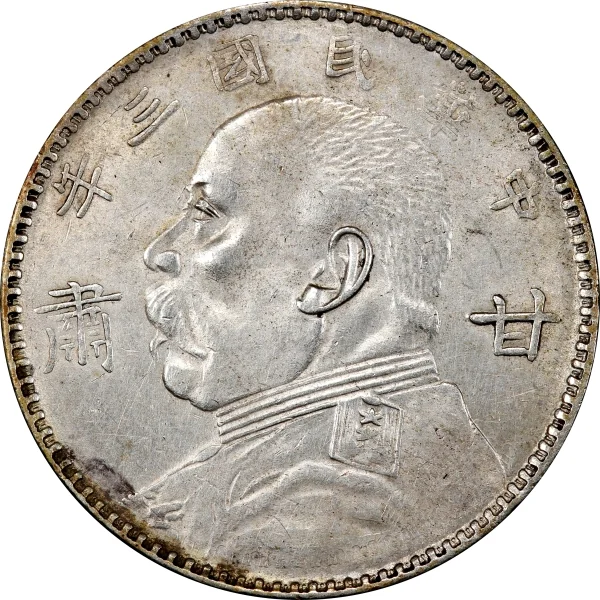
Yuan Shikai bust facing left, flanked by Chinese ideograms.
Inscription:
年三國民華中
肅甘
肅甘
Translation:
Republic of China Year 3
Gansu
Gansu
Script: Chinese
Language: Chinese
Engraver: Luigi Giorgi
Reverse
Description:
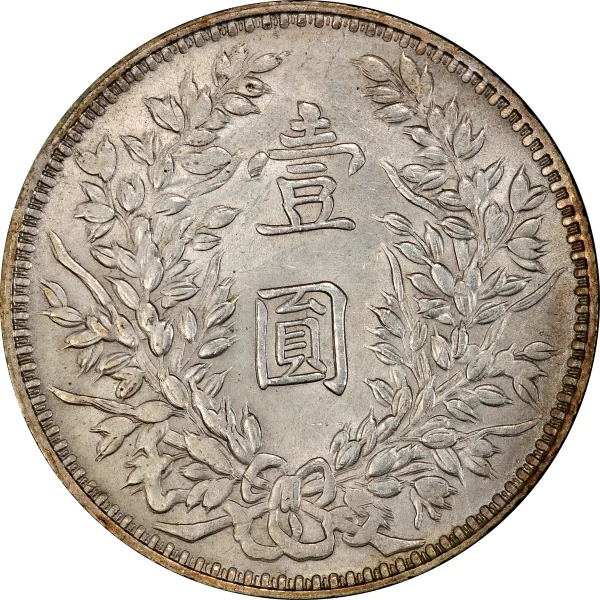
Chinese characters in wreath.
Inscription:
壹
圓
圓
Translation:
One Dollar
Script: Chinese
Language: Chinese
Engraver: Luigi Giorgi
Edge
Reeded.
Categories
| Person> Politician |
| Mustache/Beard |
| Symbol> Wreath |
Mintings
| Year | Mint Mark | Mintage | Quality | Collection |
|---|---|---|---|---|
| 1914 | — | — |
Historical background
In 1914, Kansu (Gansu) Province existed within a fractured monetary landscape, a direct consequence of China's political instability following the 1911 Revolution. The central authority of the fledgling Republic of China under Yuan Shikai was weak, especially in remote northwestern regions like Kansu. While the new republic attempted to introduce its own currency, the "Yuan Shikai Dollar," its circulation was limited. Instead, Kansu's economy operated on a complex and chaotic system of multiple, competing currencies, none of which held exclusive authority.
The primary mediums of exchange were a mixture of old imperial silver sycees (ingots) and silver dollars from various Chinese mints and foreign nations (notably Mexican "Eagle" dollars), valued by their intrinsic silver weight and purity. Critically, the province was flooded with unregulated paper notes issued by local military governors, provincial banks, and even private merchant guilds. These banknotes were promises to pay in silver, but their convertibility and value fluctuated wildly based on the issuer's credibility and the turbulent political climate, leading to frequent depreciation and localized inflation.
This monetary fragmentation severely hampered trade and economic stability. The lack of a uniform, trusted currency created opportunities for exploitation by military authorities and merchants, burdening the peasantry. The situation in Kansu was a microcosm of China's broader crisis: the absence of a strong central state directly manifested as a dysfunctional currency system, where local power-holders filled the vacuum with unstable fiduciary money, deepening regional economic isolation and hardship.
The primary mediums of exchange were a mixture of old imperial silver sycees (ingots) and silver dollars from various Chinese mints and foreign nations (notably Mexican "Eagle" dollars), valued by their intrinsic silver weight and purity. Critically, the province was flooded with unregulated paper notes issued by local military governors, provincial banks, and even private merchant guilds. These banknotes were promises to pay in silver, but their convertibility and value fluctuated wildly based on the issuer's credibility and the turbulent political climate, leading to frequent depreciation and localized inflation.
This monetary fragmentation severely hampered trade and economic stability. The lack of a uniform, trusted currency created opportunities for exploitation by military authorities and merchants, burdening the peasantry. The situation in Kansu was a microcosm of China's broader crisis: the absence of a strong central state directly manifested as a dysfunctional currency system, where local power-holders filled the vacuum with unstable fiduciary money, deepening regional economic isolation and hardship.

🌟 Limited