

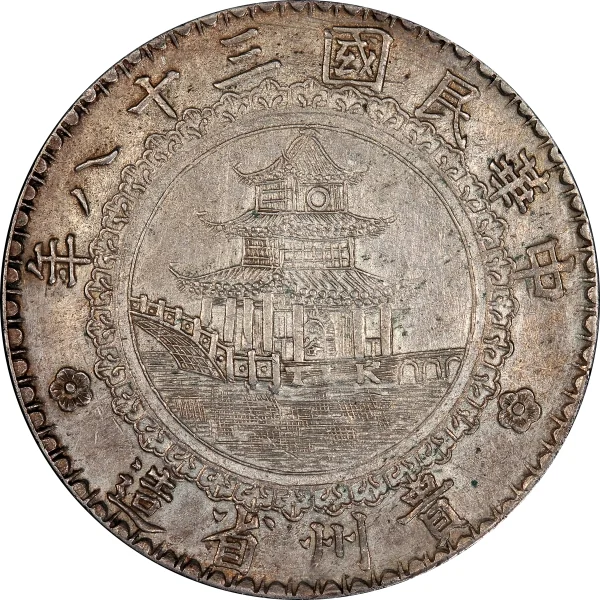
1 Yuan – Kweichow Province
China
Context
Year: 1949
Chinese republican Year: 38
Country: China 
Issuer: Kweichow Province
Period:
(1912—1949)
Currency:
(1888—1949)
Demonetized: Yes
Material
References
Y: #Click to copy to clipboard433
Numista: #10359
Value
Bullion value: $74.68
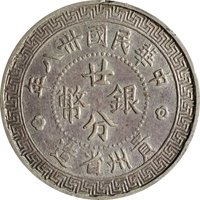
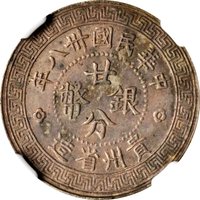
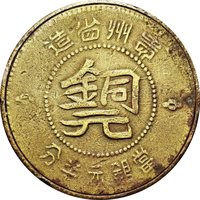
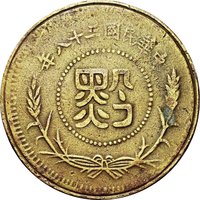
Obverse
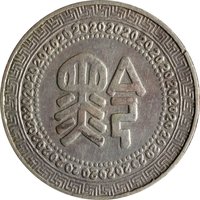
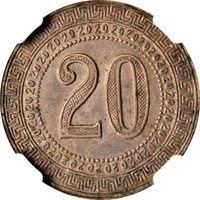
Reverse
Description:
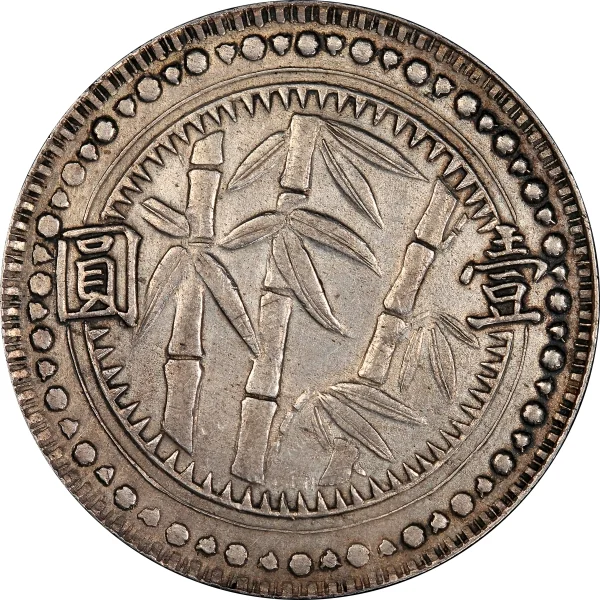
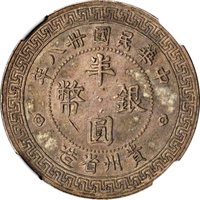
Three bamboo stalks with leaves, flanked by Chinese characters.
Inscription:
圓壹
Translation:
One Yuan
Script: Chinese
Language: Classical Chinese
Edge
Reeded.
Mintings
| Year | Mint Mark | Mintage | Quality | Collection |
|---|---|---|---|---|
| 1949 | — | — |
Historical background
In 1949, Kweichow (Guizhou) Province, like much of southern and western China, was a zone of monetary chaos and transition. As the Chinese Civil War reached its climax, the Nationalist (Kuomintang) government's currency system was in terminal collapse. Hyperinflation of the fabi (Nationalist yuan) had rendered it virtually worthless, leading to widespread rejection by the local population. In its place, a complex mix of older silver dollars (most notably the "big head" or Yuan Shikai silver coin), physical barter (especially salt and cotton yarn), and even opium often served as the primary media of exchange, reflecting a crisis of confidence in the central state's authority.
The situation shifted dramatically in the final months of 1949 as the People's Liberation Army (PLA) advanced into the province, completing its takeover by November. The new Communist authorities immediately faced the urgent task of imposing monetary order as a foundation for control and economic recovery. Their priority was to replace the discredited Nationalist currency and the heterogeneous local monies with the unified Renminbi (RMB), issued by the newly established People's Bank of China.
This currency conversion was not merely an economic policy but a profound political act. The Communist authorities implemented a compulsory exchange, setting specific deadlines and rates to demonetize the old currencies. The process was challenging, given Guizhou's remote geography, limited banking infrastructure, and initial public skepticism. However, by the end of 1949 and into early 1950, the RMB was established as the sole legal tender, marking a crucial step in integrating the province into the new command economy and extinguishing the last vestiges of the Nationalist financial system in the region.
The situation shifted dramatically in the final months of 1949 as the People's Liberation Army (PLA) advanced into the province, completing its takeover by November. The new Communist authorities immediately faced the urgent task of imposing monetary order as a foundation for control and economic recovery. Their priority was to replace the discredited Nationalist currency and the heterogeneous local monies with the unified Renminbi (RMB), issued by the newly established People's Bank of China.
This currency conversion was not merely an economic policy but a profound political act. The Communist authorities implemented a compulsory exchange, setting specific deadlines and rates to demonetize the old currencies. The process was challenging, given Guizhou's remote geography, limited banking infrastructure, and initial public skepticism. However, by the end of 1949 and into early 1950, the RMB was established as the sole legal tender, marking a crucial step in integrating the province into the new command economy and extinguishing the last vestiges of the Nationalist financial system in the region.
💎 Very Rare