

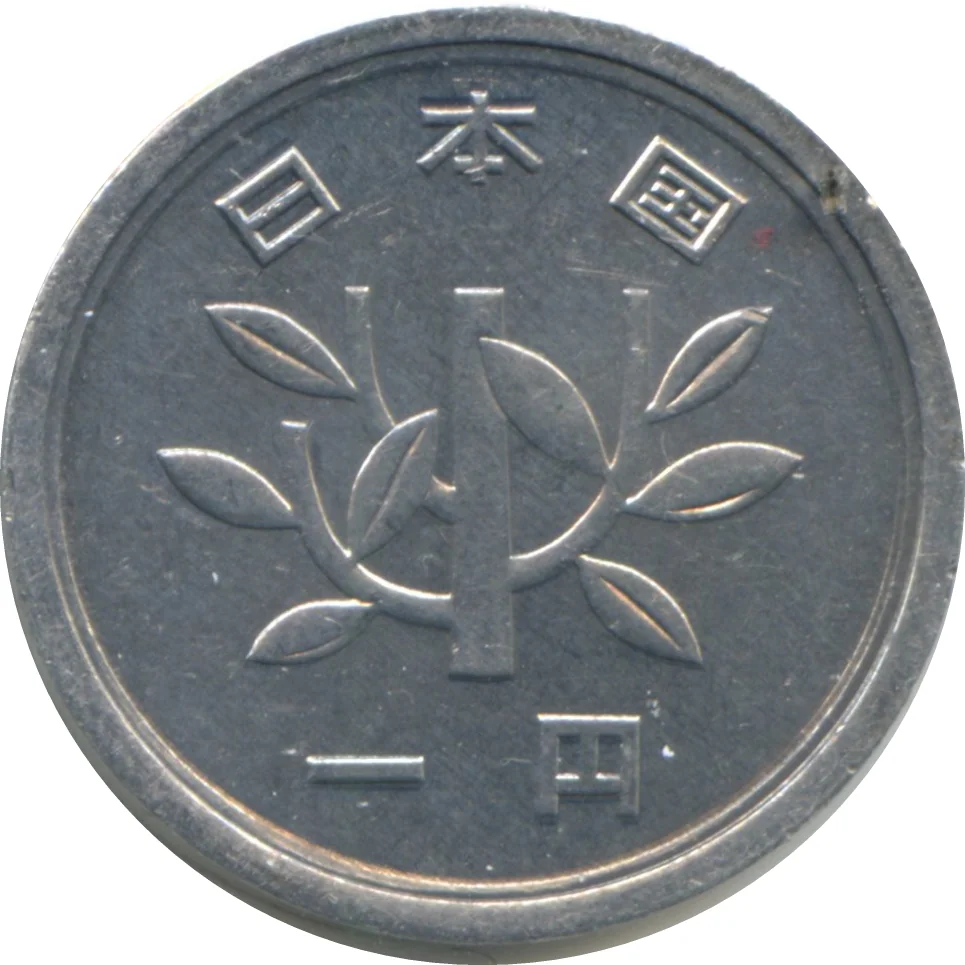
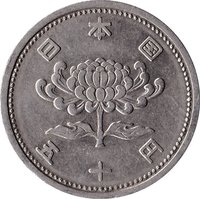
Obverse
Description:
Bamboo sprout center, authority above, value below.
Inscription:
日 本 国
一 円
一 円
Translation:
Japan
One Yen
One Yen
Language: Japanese
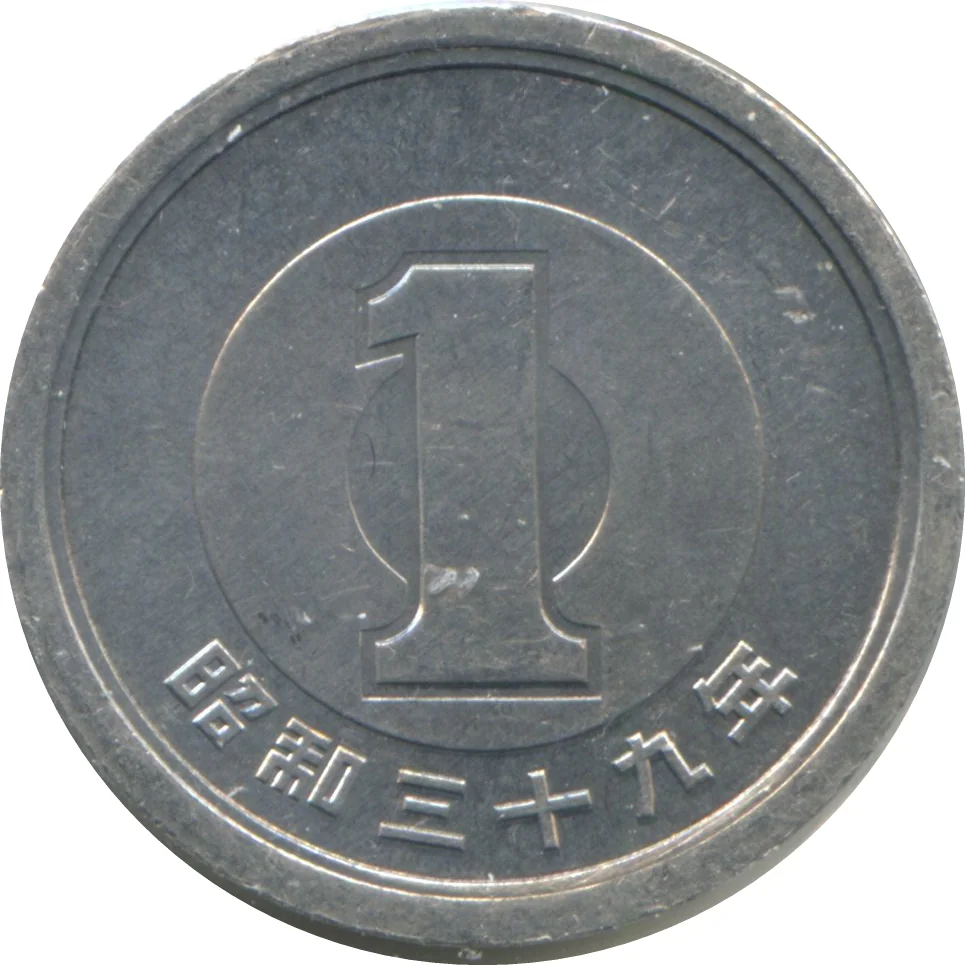
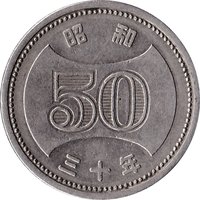
Reverse
Description:
Value in circles, date beneath.
Inscription:
1
昭和三十九年
昭和三十九年
Translation:
1964
Language: Japanese
Edge
Plain
Mints
| Name | Mark |
|---|---|
| Japan Mint | — |
Mintings
| Year | Mint Mark | Mintage | Quality | Collection |
|---|---|---|---|---|
| 1955 | — | 381,700,000 | ||
| 1956 | — | 500,900,000 | ||
| 1957 | — | 492,000,000 | ||
| 1958 | — | 374,900,000 | ||
| 1959 | — | 208,600,000 | ||
| 1960 | — | 300,000,000 | ||
| 1961 | — | 432,400,000 | ||
| 1962 | — | 572,000,000 | ||
| 1963 | — | 788,700,000 | ||
| 1964 | — | 1,665,100,000 | ||
| 1965 | — | 1,743,256,000 | ||
| 1966 | — | 807,344,000 | ||
| 1967 | — | 220,600,000 | ||
| 1969 | — | 184,700,000 | ||
| 1970 | — | 556,400,000 | ||
| 1971 | — | 904,050,000 | ||
| 1972 | — | 1,274,950,000 | ||
| 1973 | — | 1,470,000,000 | ||
| 1974 | — | 1,750,000,000 | ||
| 1975 | — | 1,656,150,000 | ||
| 1976 | — | 928,800,000 | ||
| 1977 | — | 895,000,000 | ||
| 1978 | — | 864,000,000 | ||
| 1979 | — | 1,015,000,000 | ||
| 1980 | — | 1,145,000,000 | ||
| 1981 | — | 1,206,000,000 | ||
| 1982 | — | 1,017,000,000 | ||
| 1983 | — | 1,086,000,000 | ||
| 1984 | — | 981,850,000 | ||
| 1985 | — | 837,150,000 | ||
| 1986 | — | 417,960,000 | ||
| 1987 | — | 958,520,000 | ||
| 1987 | — | 230,000 | Proof | |
| 1988 | — | 1,268,842,000 | ||
| 1988 | — | 200,000 | Proof | |
| 1989 | — | 116,100,000 |
Historical background
In 1955, Japan's currency situation was one of remarkable stability and strength, marking a decisive turning point after a decade of postwar turmoil. This year fell within the "Jimmu Boom," Japan's first major period of sustained economic growth since the war. The yen, which had been radically reformed in 1946 and pegged at 360 yen to 1 US dollar in 1949 under the Bretton Woods system, maintained that fixed exchange rate. This peg, administered by the Bank of Japan and supported by the Dodge Line austerity policies and later U.S. procurement during the Korean War, provided a crucial anchor for export-led industrial recovery.
This stable exchange rate was a cornerstone of Japan's economic strategy, fostering a predictable environment for trade and investment. Major industries like shipbuilding, steel, and textiles were becoming globally competitive, and the fixed yen undervalued their exports, fueling rapid economic expansion. The currency's stability was further bolstered by Japan achieving balance-of-payments equilibrium in the mid-1950s, moving away from chronic deficits and reducing reliance on American aid. Domestically, inflation was finally tamed, with wholesale price inflation near zero, allowing for sound monetary policy and growing public confidence in the yen.
Thus, 1955 represented a moment of consolidated achievement rather than crisis. The yen was not a subject of international speculation or devaluation fears, but a reliable tool for growth. This stable monetary foundation, coupled with rising productivity and political consolidation under the Liberal Democratic Party, set the stage for the "High-Speed Growth" period that would soon follow, transforming Japan into an economic superpower.
This stable exchange rate was a cornerstone of Japan's economic strategy, fostering a predictable environment for trade and investment. Major industries like shipbuilding, steel, and textiles were becoming globally competitive, and the fixed yen undervalued their exports, fueling rapid economic expansion. The currency's stability was further bolstered by Japan achieving balance-of-payments equilibrium in the mid-1950s, moving away from chronic deficits and reducing reliance on American aid. Domestically, inflation was finally tamed, with wholesale price inflation near zero, allowing for sound monetary policy and growing public confidence in the yen.
Thus, 1955 represented a moment of consolidated achievement rather than crisis. The yen was not a subject of international speculation or devaluation fears, but a reliable tool for growth. This stable monetary foundation, coupled with rising productivity and political consolidation under the Liberal Democratic Party, set the stage for the "High-Speed Growth" period that would soon follow, transforming Japan into an economic superpower.
🌱 Very Common