

Obverse
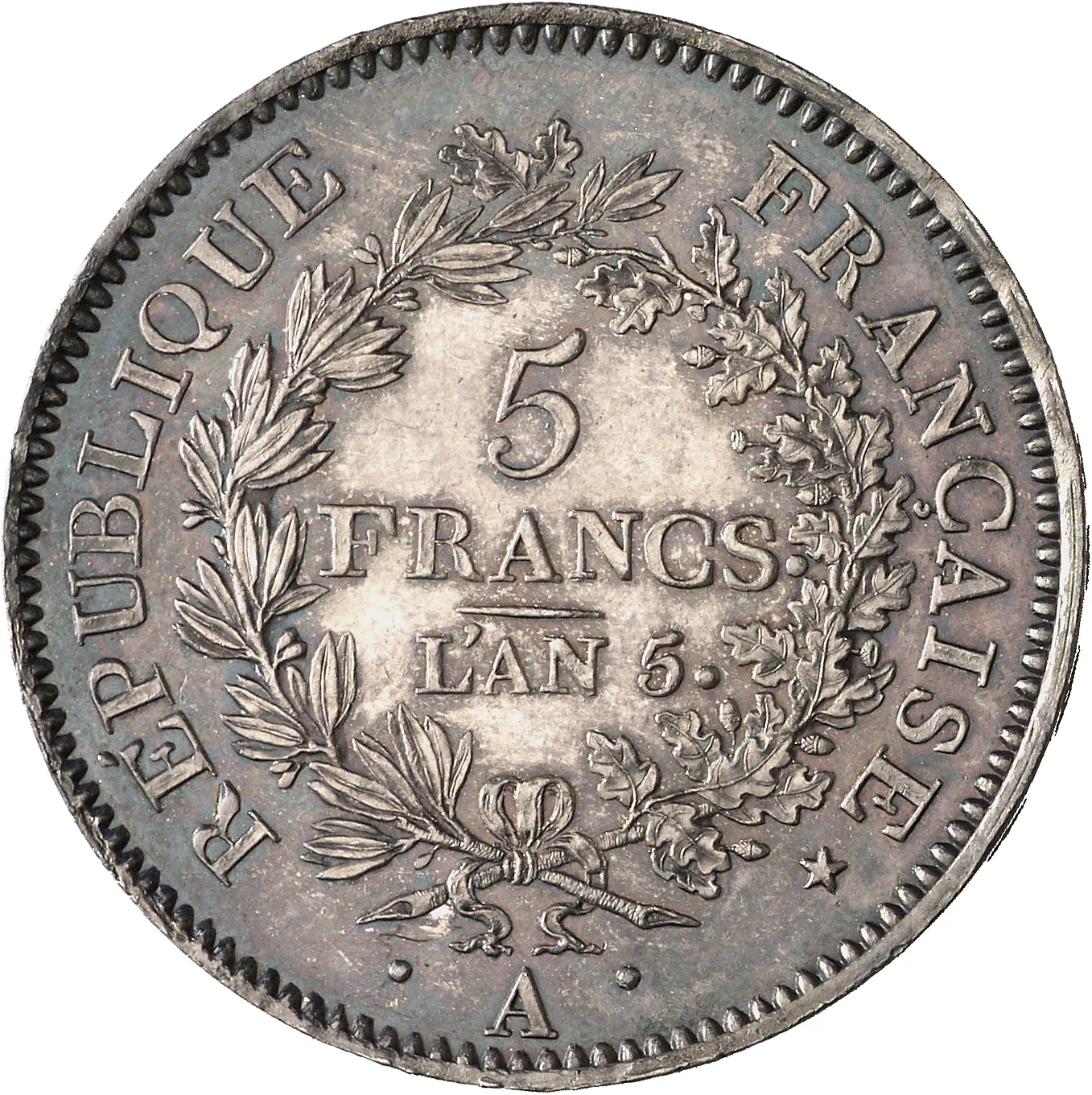
Description:
Crowned, flanked by laurel branches.
Inscription:
RÉPUBLIQUE FRANÇAISE
5
FRANCS
L'AN
5
FRANCS
L'AN
Translation:
FRENCH REPUBLIC
5
FRANCS
THE YEAR
5
FRANCS
THE YEAR
Script: Latin
Language: French
Engraver: Augustin Dupré
Reverse
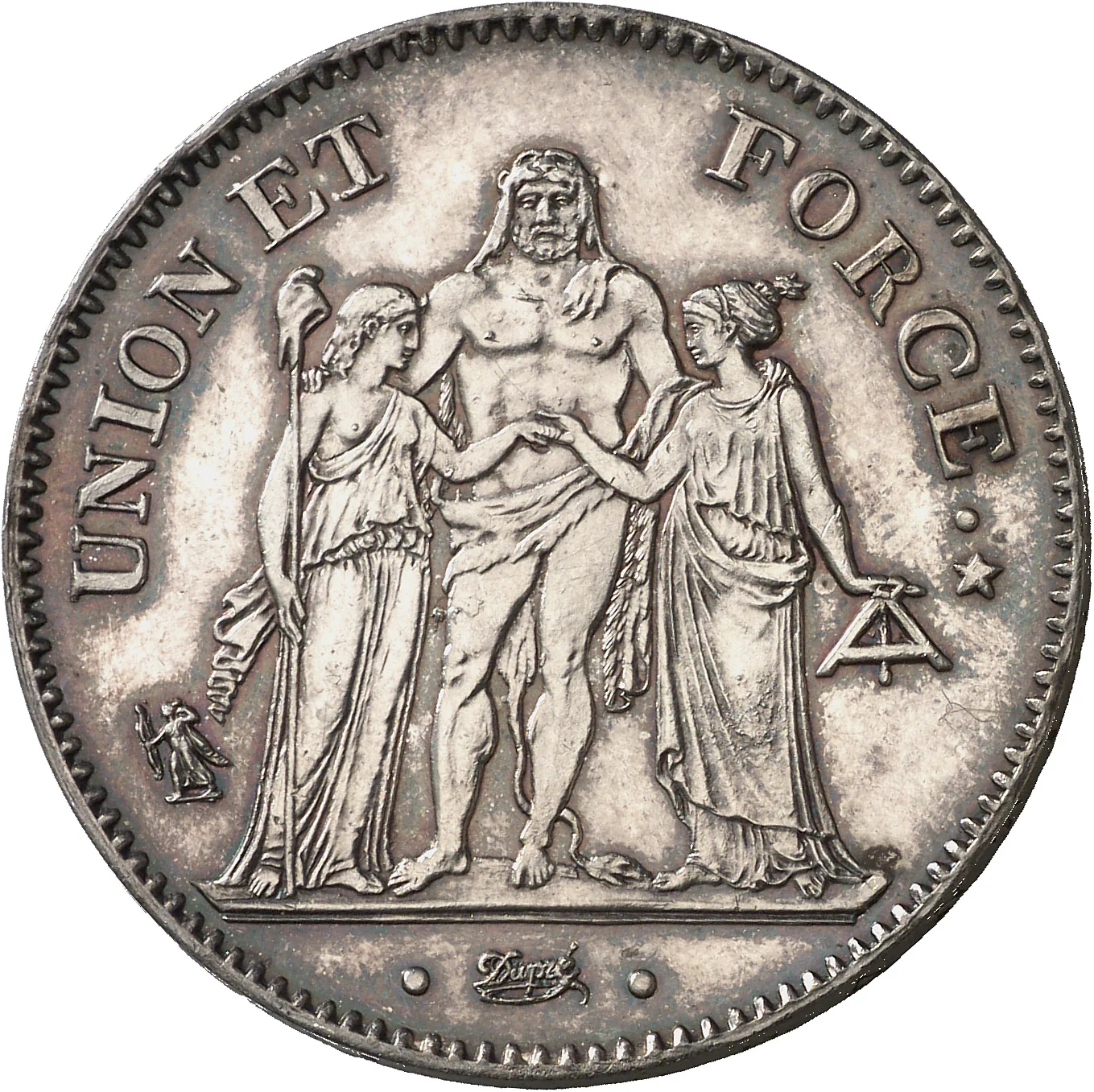
Description:
Hercules, in lion skin, uniting Liberty with cap-topped pike and Equality with a plane.
Inscription:
UNION ET FORCE
· Dupré ·
· Dupré ·
Translation:
Union and Strength
Script: Latin
Language: French
Engraver: Augustin Dupré
Edge
Hollow edge with inscriptions.The edge wasn't made with collar.
Legend:
GARANTIE NATIONALE
Categories
| Symbol> Phrygian cap |
| Mythology |
| Symbol> Allegory |
Mints
| Name | Mark |
|---|---|
| Monnaie de Paris | A |
| Bordeaux | K |
| Bayonne | L |
| Marseille | MA |
| Perpignan | Q |
Mintings
| Year | Mint Mark | Mintage | Quality | Collection |
|---|---|---|---|---|
| 1801 | — | — | ||
| 1802 | — | 1,557,551 |
Historical background
In 1801, France’s currency situation was one of profound instability and transition, a direct legacy of the revolutionary period. The hyperinflation of the assignats (paper money backed by confiscated church lands) had culminated in their collapse by 1796, destroying public trust in paper currency. The Directory attempted a reset with the mandats territoriaux, which also failed spectacularly within months. By the turn of the century, the economy operated largely on a chaotic mixture of metallic coinage—a mix of old royal louis d'or, foreign coins, and various republican issues—and a deeply discounted, discredited paper money, hindering commerce and state finance.
This monetary anarchy was a primary concern for Napoleon Bonaparte, who as First Consul had consolidated power after the 1799 coup d'état. He understood that economic and monetary stability was essential for his political legitimacy, his ambitious reforms, and for funding his military campaigns. Consequently, one of his earliest and most significant priorities was the complete overhaul of the monetary system. He tasked a council with creating a modern, rational, and stable currency based on sound principles, drawing on the decimal system already introduced by the revolutionary government.
The result was the landmark law of 7 Germinal, Year XI (March 28, 1803), which formally established the Franc Germinal. This new currency was defined by a specific weight of fine gold (the 20-franc gold napoléon) and silver, creating an effective bimetallic standard. While officially enacted in 1803, the preparatory work and the drive for this reform defined the currency situation of 1801. It was a year of planning and laying the groundwork, moving decisively away from the paper chaos of the 1790s toward a hard, metallic currency that would bring stability, foster confidence, and underpin French economic strength for decades.
This monetary anarchy was a primary concern for Napoleon Bonaparte, who as First Consul had consolidated power after the 1799 coup d'état. He understood that economic and monetary stability was essential for his political legitimacy, his ambitious reforms, and for funding his military campaigns. Consequently, one of his earliest and most significant priorities was the complete overhaul of the monetary system. He tasked a council with creating a modern, rational, and stable currency based on sound principles, drawing on the decimal system already introduced by the revolutionary government.
The result was the landmark law of 7 Germinal, Year XI (March 28, 1803), which formally established the Franc Germinal. This new currency was defined by a specific weight of fine gold (the 20-franc gold napoléon) and silver, creating an effective bimetallic standard. While officially enacted in 1803, the preparatory work and the drive for this reform defined the currency situation of 1801. It was a year of planning and laying the groundwork, moving decisively away from the paper chaos of the 1790s toward a hard, metallic currency that would bring stability, foster confidence, and underpin French economic strength for decades.
💎 Very Rare