

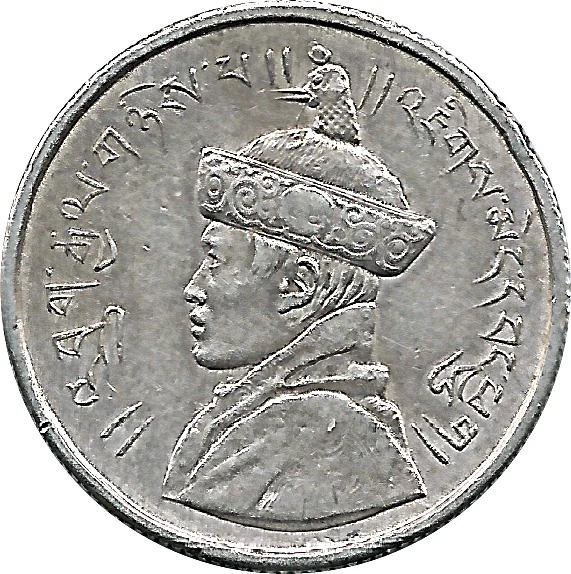
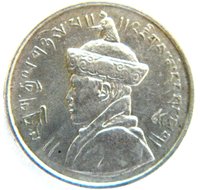
Obverse
Description:
King Jigme Wangchuck left-facing crowned bust.
Script: Tibetan
Engraver: Albert Pearson Spencer
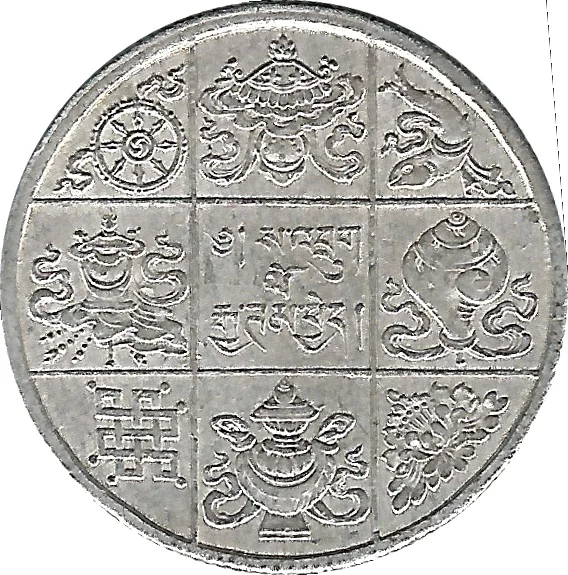
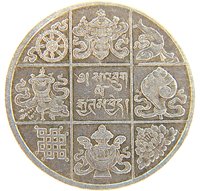
Reverse
Description:
Nine sections: eight outer panels display the Ashtamangala symbols, with a three-line legend in the center. The symbols, clockwise from top left, are: Dharma Wheel, sovereignty umbrella, golden fish, conch shell, lotus, treasure vase, endless knot, and victory banner.
Script: Tibetan
Engraver: Albert Pearson Spencer
Edge
Reeded
Mints
| Name | Mark |
|---|---|
| Kolkata / Calcutta / Murshidabad | — |
Mintings
| Year | Mint Mark | Mintage | Quality | Collection |
|---|---|---|---|---|
| 1929 | — | 20,000 | ||
| 1929 | — | — | Proof |
Historical background
In 1929, Bhutan's currency situation was characterized by a complex duality, with both traditional and introduced systems operating in parallel. The primary medium of exchange for most daily transactions, especially in rural areas, remained commodity-based, relying on barter and the use of grains like rice and maize. Alongside this, the Indian Rupee, linked to the British Raj, was increasingly used for larger transactions and trade, particularly in the southern border regions. However, the most significant and symbolic currency was Bhutan's own silver Chetrum coins, first minted in 1929 under the command of the second King, Jigme Wangchuck.
These first machine-struck coins, denominated in Chetrum (100 Chetrum = 1 Ngultrum), marked a pivotal step toward modern statehood and economic sovereignty. They were minted at the royal mint in Phuntsholing and bore the royal crest, representing a conscious effort to standardize a national currency and reduce reliance on disparate foreign and archaic systems. The introduction of the Chetrum was not just an economic act but a political statement, reinforcing the centralizing authority of the Wangchuck dynasty, which had been established just two decades prior.
Despite this innovation, the new coinage did not immediately displace existing practices. Older, hand-struck silver Maartums and Doths from the reign of the first king remained in circulation, creating a multi-tiered monetary environment. Furthermore, the Indian Rupee's dominance for external trade was undeniable, foreshadowing the fixed 1:1 parity that would formally be established decades later. Thus, 1929 stands as a year of transition, where Bhutan actively minted its future currency while still being practically anchored in the economic realities of barter and regional monetary influence.
These first machine-struck coins, denominated in Chetrum (100 Chetrum = 1 Ngultrum), marked a pivotal step toward modern statehood and economic sovereignty. They were minted at the royal mint in Phuntsholing and bore the royal crest, representing a conscious effort to standardize a national currency and reduce reliance on disparate foreign and archaic systems. The introduction of the Chetrum was not just an economic act but a political statement, reinforcing the centralizing authority of the Wangchuck dynasty, which had been established just two decades prior.
Despite this innovation, the new coinage did not immediately displace existing practices. Older, hand-struck silver Maartums and Doths from the reign of the first king remained in circulation, creating a multi-tiered monetary environment. Furthermore, the Indian Rupee's dominance for external trade was undeniable, foreshadowing the fixed 1:1 parity that would formally be established decades later. Thus, 1929 stands as a year of transition, where Bhutan actively minted its future currency while still being practically anchored in the economic realities of barter and regional monetary influence.
💎 Very Rare