

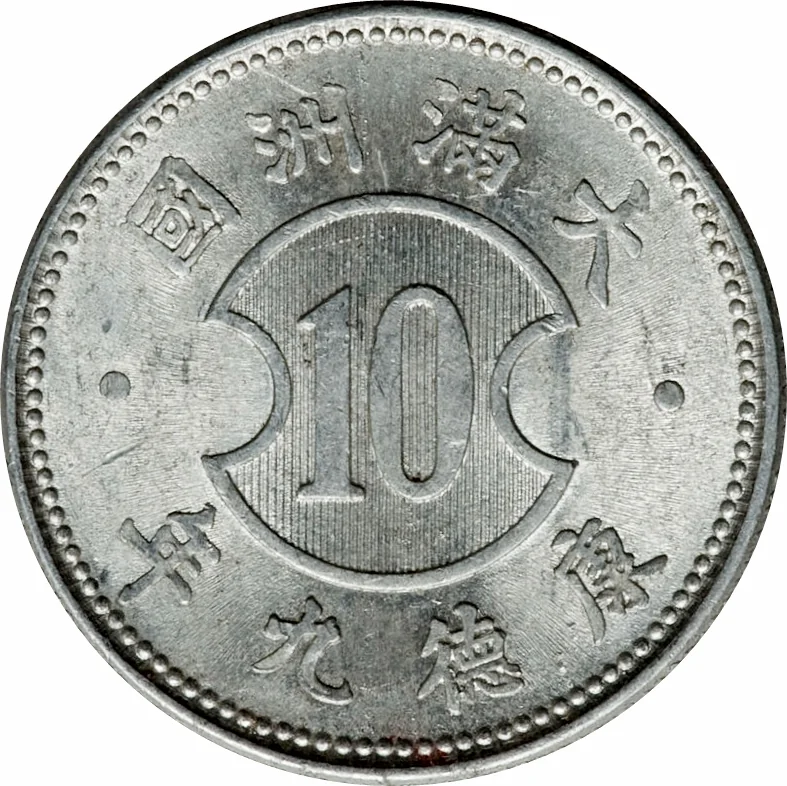
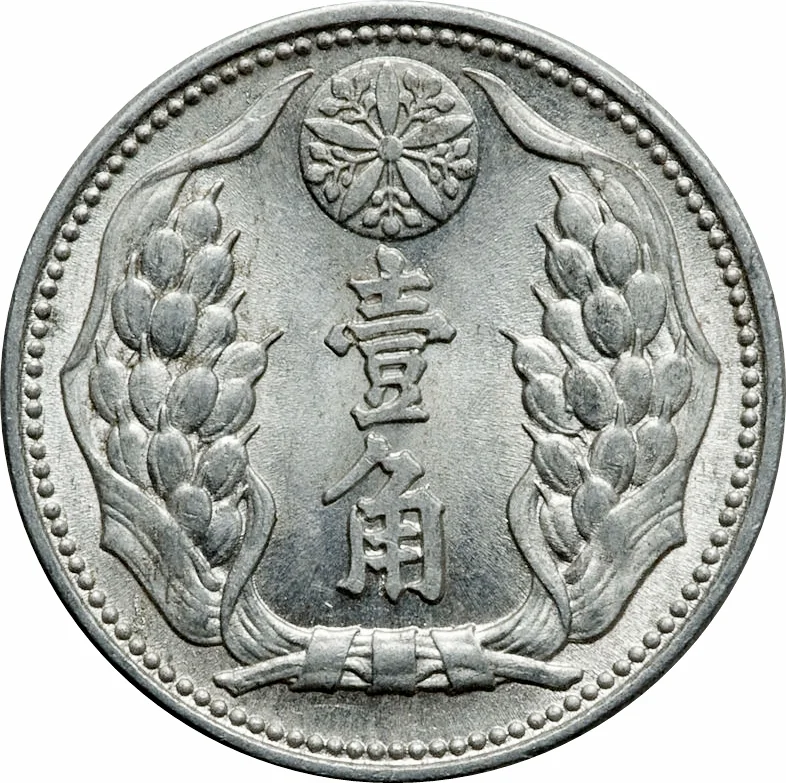
Obverse
Description:
Legend on "Fundo" weight outline
Inscription:
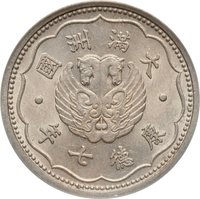
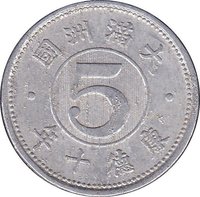
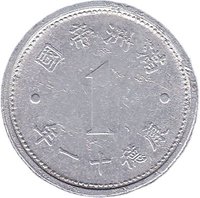
國 洲 滿 大
• 10 •
年 九 德 康
• 10 •
年 九 德 康
Translation:
GREAT QING COINS.
KANGXI TONGBAO.
BOARD OF REVENUE.
TENTH YEAR.
KANGXI TONGBAO.
BOARD OF REVENUE.
TENTH YEAR.
Script: Chinese
Language: Classical Chinese
Reverse
Edge
Reeded
Mintings
| Year | Mint Mark | Mintage | Quality | Collection |
|---|---|---|---|---|
| 1940 | — | — | ||
| 1941 | — | — | ||
| 1942 | — | — | ||
| 1943 | — | — |
Historical background
By 1940, the currency system in Manchukuo, Japan's puppet state in Northeast China, was a tightly controlled instrument of imperial policy and wartime mobilization. The central bank, the Bank of Manchukuo, issued the yuan (or Manchukuo yuan), which was pegged at par to the Japanese yen and formed the core of the "Yen Bloc." This linkage ensured economic integration with Japan, facilitating the extraction of Manchuria's vast industrial and agricultural resources—such as coal, steel, and soybeans—to fuel the Japanese war effort in China and the broader Asia-Pacific theater. The currency was managed not for the benefit of the local populace but to serve as a financial conduit for Japanese conglomerates (zaibatsu) and state-run enterprises developing the region's heavy industry.
The system faced significant underlying pressures, including rampant inflation. This was driven by the Bank of Manchukuo's extensive printing of money to cover government deficits and finance massive industrial projects under Manchurian Heavy Industry Development Corporation (Mangyō). While the official peg to the yen remained stable, the purchasing power of the yuan eroded domestically, leading to rising living costs and a growing black market. Japanese authorities maintained strict exchange controls and outlawed the use of other currencies, like Chinese legal tender, to enforce monetary isolation and prevent capital flight.
Ultimately, the 1940 currency situation reflected Manchukuo's dual reality: a facade of modern statehood with its own central bank and currency, underpinned by a colonial economy entirely subordinated to Japan's wartime needs. The stability of the yuan was artificial, sustained by political fiat and oppressive controls rather than sound fiscal policy. As Japan's war expanded, this fragile financial system became increasingly strained, setting the stage for the hyperinflation and economic collapse that would accompany the empire's defeat in 1945.
The system faced significant underlying pressures, including rampant inflation. This was driven by the Bank of Manchukuo's extensive printing of money to cover government deficits and finance massive industrial projects under Manchurian Heavy Industry Development Corporation (Mangyō). While the official peg to the yen remained stable, the purchasing power of the yuan eroded domestically, leading to rising living costs and a growing black market. Japanese authorities maintained strict exchange controls and outlawed the use of other currencies, like Chinese legal tender, to enforce monetary isolation and prevent capital flight.
Ultimately, the 1940 currency situation reflected Manchukuo's dual reality: a facade of modern statehood with its own central bank and currency, underpinned by a colonial economy entirely subordinated to Japan's wartime needs. The stability of the yuan was artificial, sustained by political fiat and oppressive controls rather than sound fiscal policy. As Japan's war expanded, this fragile financial system became increasingly strained, setting the stage for the hyperinflation and economic collapse that would accompany the empire's defeat in 1945.
🌱 Fairly Common