

Obverse
Description:
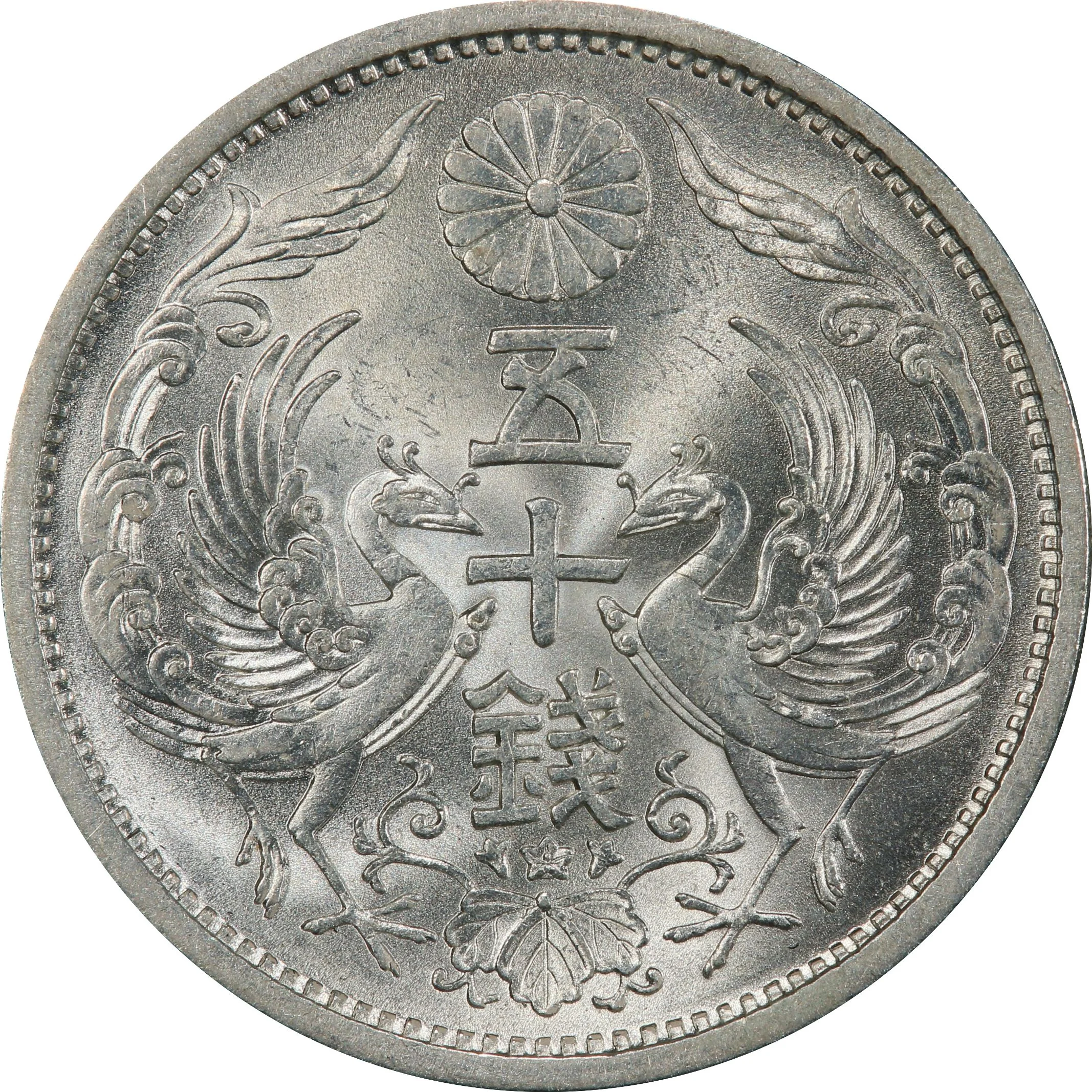
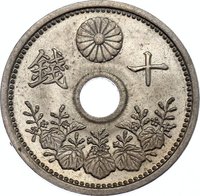
Phoenix flanking value, paulownia crest with karakusa sprigs, chrysanthemum above.
Inscription:
五
十
錢
十
錢
Translation:
Fifty
Cash
Cash
Language: Chinese
Reverse
Description:
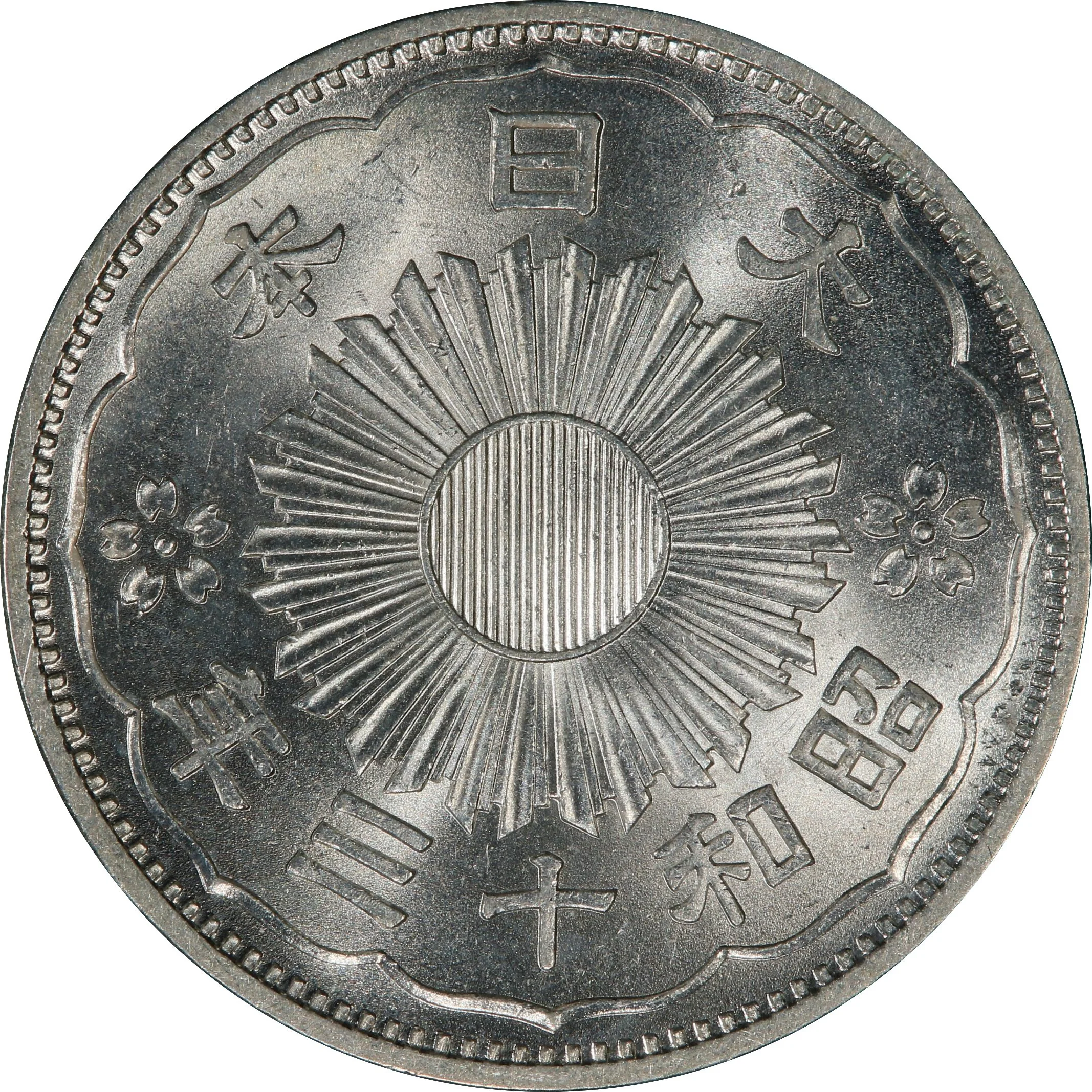
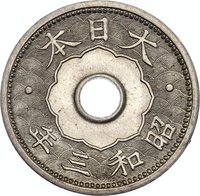
Central sunburst with cherry blossoms, authority above, date below, within a sacred mirror.
Inscription:
❀ 本 日 大 ❀
年 三十 和 昭
年 三十 和 昭
Translation:
On this very day, the thirtieth year of the Heisei era.
Language: Classical Chinese
Edge
Reeded
Categories
| Symbols> Coat of Arms |
| Animal> Bird |
| Mythology> Fantastic animal |
| Plants> Flower |
| Symbol> Sun |
Mintings
| Year | Mint Mark | Mintage | Quality | Collection |
|---|---|---|---|---|
| 1928 | — | 38,592,000 | ||
| 1929 | — | 12,568,000 | ||
| 1930 | — | 10,200,000 | ||
| 1931 | — | 27,677,501 | ||
| 1932 | — | 24,132,795 | ||
| 1933 | — | 10,001,973 | ||
| 1934 | — | 20,003,995 | ||
| 1935 | — | 11,738,334 | ||
| 1936 | — | 44,272,796 | ||
| 1937 | — | 48,000,533 | ||
| 1938 | — | 3,600,717 |
Historical background
In 1928, Japan's currency situation was defined by the pivotal return to the gold standard under the Financial Minister and later Prime Minister, Takahashi Korekiyo. This move, enacted in January 1930 but planned and debated from 1928 onward, was a strategic effort to restore international financial credibility and stabilize the yen after years of volatility. The period followed the devastating 1923 Great Kantō Earthquake, which had forced Japan to suspend gold convertibility and print large sums of money to fund reconstruction, leading to inflation and a weak yen. Policymakers and industrialists, particularly the powerful zaibatsu, believed that rejoining the global gold standard at the pre-war parity would curb inflation, attract foreign investment, and align Japan with the financial orthodoxy of Western powers like Britain and the United States.
However, the decision to return at the pre-1914 parity proved to be a critical and ultimately damaging miscalculation. It significantly overvalued the yen, making Japanese exports—particularly silk and cotton goods—more expensive and less competitive on the world market just as the global economy was entering the Great Depression. This overvaluation triggered severe deflation, falling agricultural prices (especially for silk, devastating rural communities), and a sharp recession. The policy also led to a rapid outflow of gold reserves as investors lost confidence, forcing the government to maintain a tight monetary policy that further strangled the domestic economy.
Thus, while 1928 represented a year of decisive planning toward orthodox financial discipline, the currency situation set the stage for a profound economic crisis. The harsh consequences of the gold standard policy, implemented in 1930, would soon lead to its abrupt abandonment in 1931 under Takahashi's leadership, who then pioneered a revolutionary policy of deficit spending and monetary easing to pull Japan out of depression—a stark reversal from the orthodox foundations laid in the late 1920s.
However, the decision to return at the pre-1914 parity proved to be a critical and ultimately damaging miscalculation. It significantly overvalued the yen, making Japanese exports—particularly silk and cotton goods—more expensive and less competitive on the world market just as the global economy was entering the Great Depression. This overvaluation triggered severe deflation, falling agricultural prices (especially for silk, devastating rural communities), and a sharp recession. The policy also led to a rapid outflow of gold reserves as investors lost confidence, forcing the government to maintain a tight monetary policy that further strangled the domestic economy.
Thus, while 1928 represented a year of decisive planning toward orthodox financial discipline, the currency situation set the stage for a profound economic crisis. The harsh consequences of the gold standard policy, implemented in 1930, would soon lead to its abrupt abandonment in 1931 under Takahashi's leadership, who then pioneered a revolutionary policy of deficit spending and monetary easing to pull Japan out of depression—a stark reversal from the orthodox foundations laid in the late 1920s.
🌱 Common