

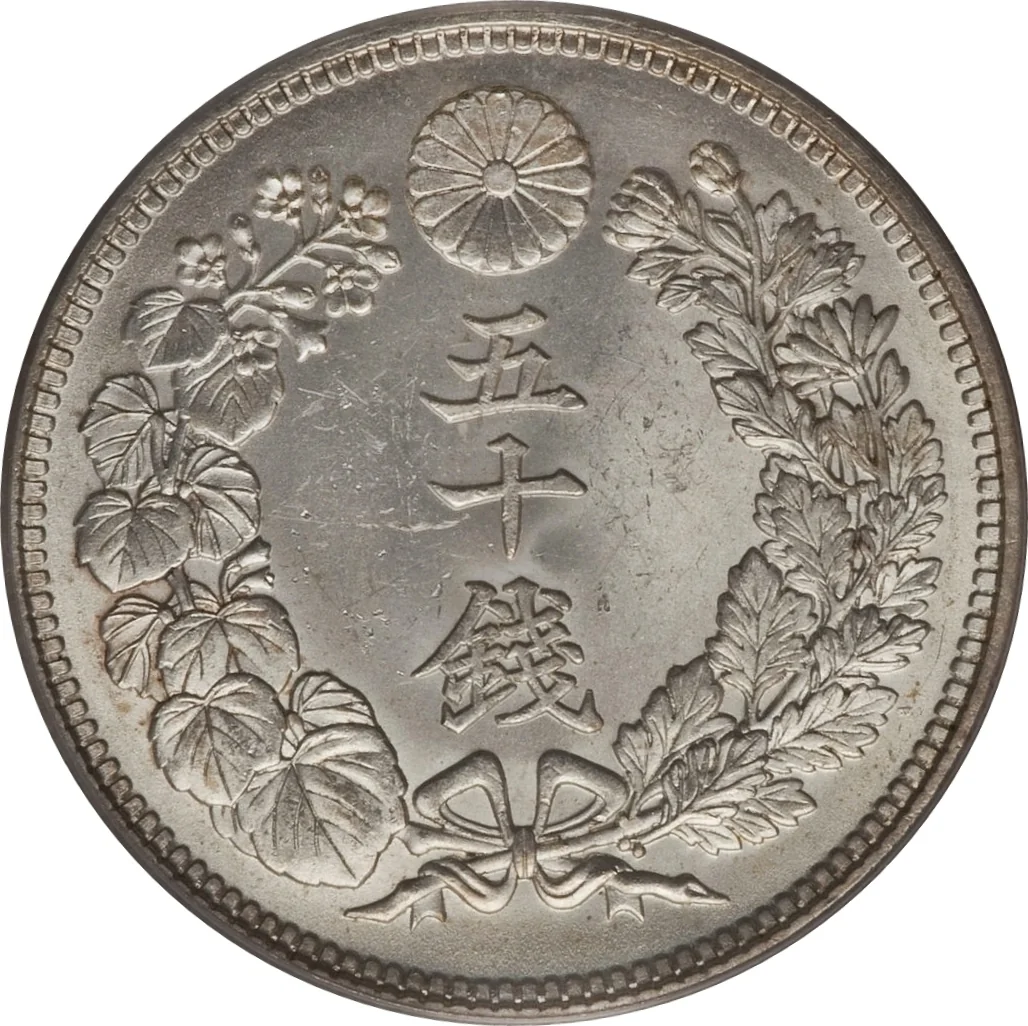
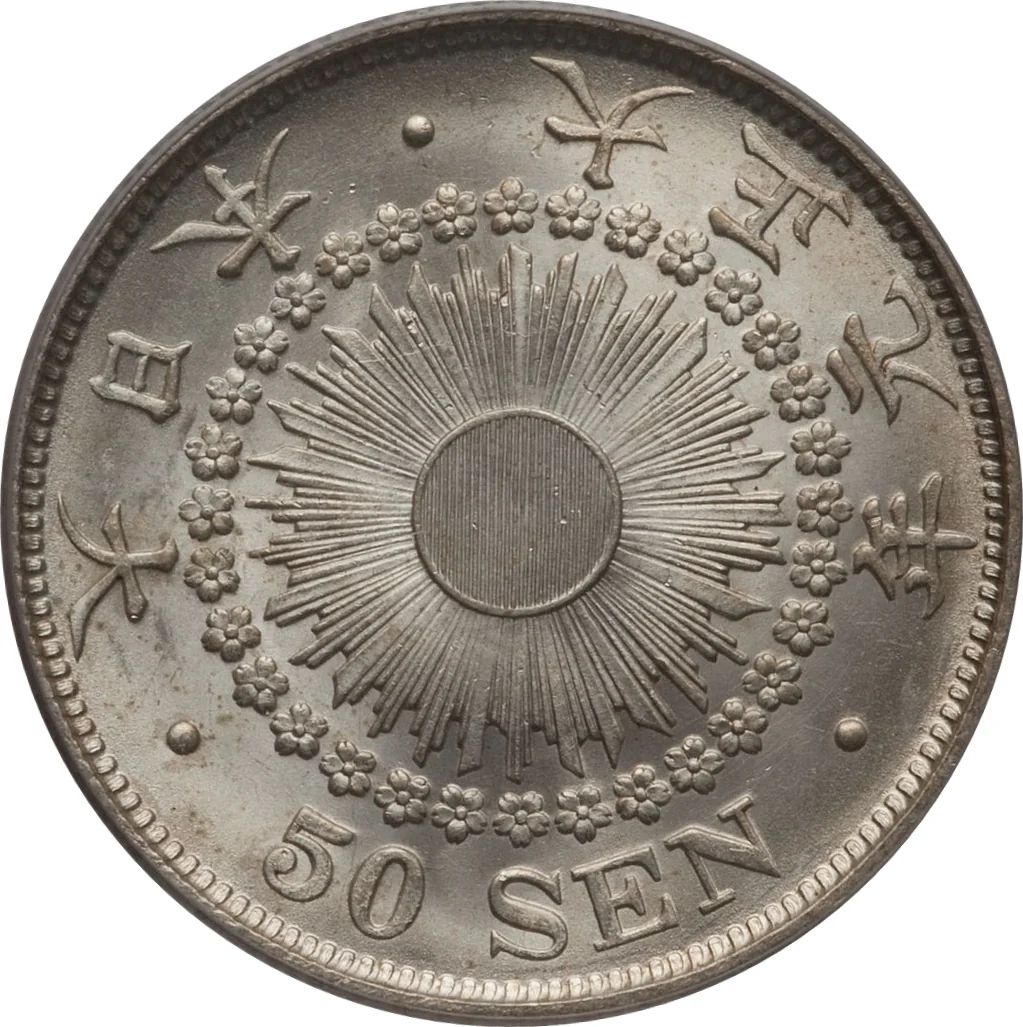
Obverse
Description:
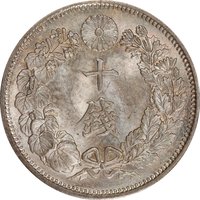
Imperial Seal above, flanked by Paulownia and Chrysanthemum branches.
Inscription:
五
十
錢
十
錢
Translation:
Fifty
Cash
Cash
Language: Chinese
Reverse
Description:
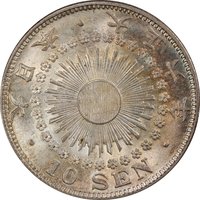
Sun encircled by sakuras and text.
Inscription:
年 元 正 大 · 本 日 大
· 50 SEN ·
· 50 SEN ·
Translation:
Great Era of Enlightened Rule · Base Day Great
· 50 SEN ·
· 50 SEN ·
Language: Japanese
Edge
Reeded
Mintings
| Year | Mint Mark | Mintage | Quality | Collection |
|---|---|---|---|---|
| 1912 | — | 1,928,649 | ||
| 1913 | — | 5,910,063 | ||
| 1914 | — | 1,872,331 | ||
| 1915 | — | 2,011,253 | ||
| 1916 | — | 8,736,768 | ||
| 1917 | — | 9,963,232 |
Historical background
In 1912, Japan's currency system was firmly established on the gold standard, a pivotal policy decision made in 1897 under the leadership of Finance Minister Matsukata Masayoshi. This move, which set the yen's value at approximately 0.75 grams of pure gold, was a cornerstone of Japan's drive for modernization and international economic integration. It stabilized the yen's exchange rate, facilitated foreign trade and investment crucial for industrialization, and signaled Japan's arrival as a credible financial power on the global stage, particularly following its military victory in the First Sino-Japanese War.
Domestically, the currency was a unified and managed system. The Bank of Japan, founded in 1882, held the exclusive monopoly on issuing convertible banknotes, meaning paper money could be exchanged for gold coin on demand. This centralized authority replaced the earlier, chaotic issuance by national and private banks, ensuring uniformity and bolstering public confidence. In circulation alongside these notes were subsidiary silver and copper coins for smaller transactions, but the system's anchor was gold.
However, the year 1912, the final year of the Meiji era, also sat on the precipice of significant change. The costs of rapid industrialization and, more acutely, the immense financial burden of the Russo-Japanese War (1904-1905), had led to substantial foreign borrowing and inflationary pressures. While the gold standard remained formally intact, strains were evident. The system's rigidity would soon be tested by the outbreak of World War I in 1914, which would prompt Japan to suspend gold convertibility, unleashing an export boom and fundamentally altering its financial trajectory in the following decades.
Domestically, the currency was a unified and managed system. The Bank of Japan, founded in 1882, held the exclusive monopoly on issuing convertible banknotes, meaning paper money could be exchanged for gold coin on demand. This centralized authority replaced the earlier, chaotic issuance by national and private banks, ensuring uniformity and bolstering public confidence. In circulation alongside these notes were subsidiary silver and copper coins for smaller transactions, but the system's anchor was gold.
However, the year 1912, the final year of the Meiji era, also sat on the precipice of significant change. The costs of rapid industrialization and, more acutely, the immense financial burden of the Russo-Japanese War (1904-1905), had led to substantial foreign borrowing and inflationary pressures. While the gold standard remained formally intact, strains were evident. The system's rigidity would soon be tested by the outbreak of World War I in 1914, which would prompt Japan to suspend gold convertibility, unleashing an export boom and fundamentally altering its financial trajectory in the following decades.
🌱 Fairly Common