

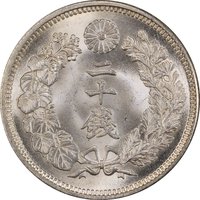
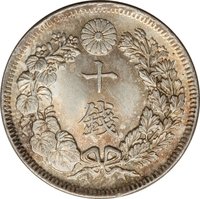
Obverse
Description:
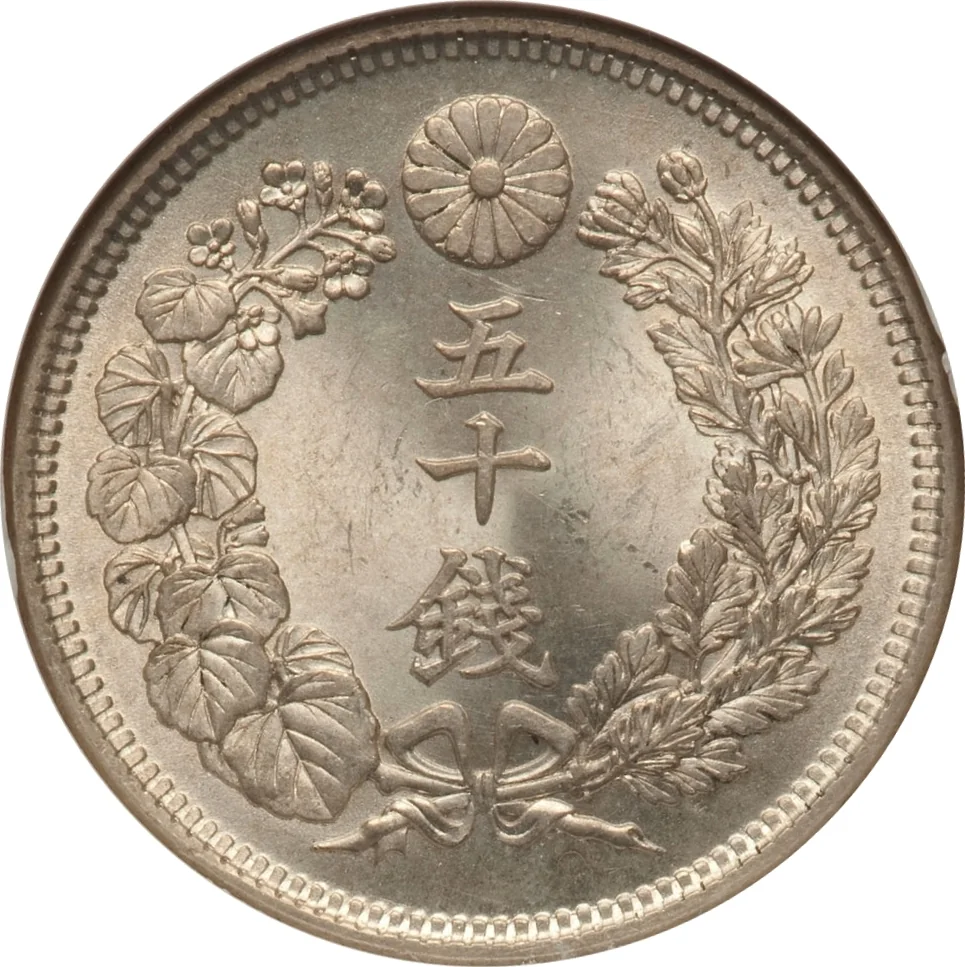
Imperial Seal above, flanked by Paulownia and Chrysanthemum branches.
Inscription:
五
十
錢
十
錢
Translation:
Fifty
Cash
Cash
Language: Chinese
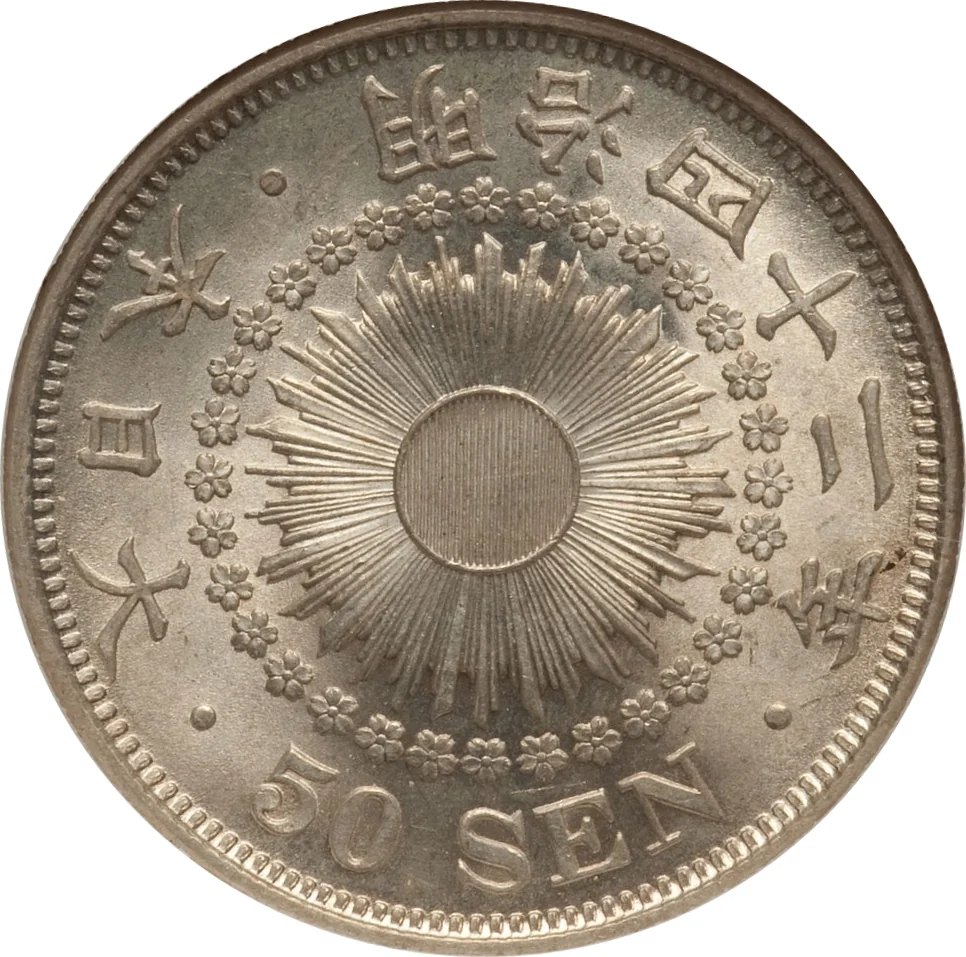
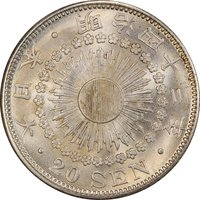
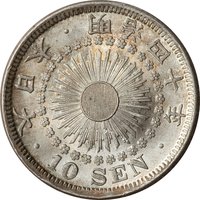
Reverse
Edge
Reeded
Mintings
| Year | Mint Mark | Mintage | Quality | Collection |
|---|---|---|---|---|
| 1906 | — | 12,478,264 | ||
| 1907 | — | 24,062,952 | ||
| 1908 | — | 25,470,371 | ||
| 1909 | — | 21,998,600 | ||
| 1910 | — | 15,323,276 | ||
| 1911 | — | 9,900,437 | ||
| 1912 | — | 3,677,704 |
Historical background
In 1906, Japan's currency system was firmly anchored to the gold standard, a pivotal policy established in 1897 following the Sino-Japanese War. This move, financed by substantial indemnity payments from China, fixed the yen's value at approximately ¥0.50 to the US dollar and aimed to integrate Japan into the global financial system, boosting foreign investment and trade credibility. The system was managed by the Bank of Japan, which issued convertible banknotes backed by gold reserves, creating a period of relative monetary stability and supporting the nation's rapid industrialization during the Meiji era.
However, this stability was maintained under significant strain. The Russo-Japanese War (1904–1905) had just concluded, leaving the government with enormous war debts, both domestically and from foreign loans raised primarily in London and New York. While Japan emerged victorious, the conflict drained its gold reserves and led to a sharp increase in paper currency issuance to cover expenditures, creating inflationary pressures. By 1906, the government was grappling with the delicate task of postwar financial consolidation, needing to restore its gold reserves and manage its balance of payments while servicing its foreign obligations.
Consequently, the currency situation in 1906 was one of cautious transition from wartime finance to peacetime normalization. The gold standard remained formally intact, preserving international confidence, but underlying vulnerabilities were clear. The financial authorities, led by influential figures like financier Takahashi Korekiyo, were actively engaged in efforts to stabilize public finance, attract further foreign capital, and control inflation, setting the stage for the major foreign loan of 1907 to shore up the gold reserve. Thus, the year represented a critical juncture of managing the costs of empire while maintaining the monetary framework essential for Japan's continued economic ascent.
However, this stability was maintained under significant strain. The Russo-Japanese War (1904–1905) had just concluded, leaving the government with enormous war debts, both domestically and from foreign loans raised primarily in London and New York. While Japan emerged victorious, the conflict drained its gold reserves and led to a sharp increase in paper currency issuance to cover expenditures, creating inflationary pressures. By 1906, the government was grappling with the delicate task of postwar financial consolidation, needing to restore its gold reserves and manage its balance of payments while servicing its foreign obligations.
Consequently, the currency situation in 1906 was one of cautious transition from wartime finance to peacetime normalization. The gold standard remained formally intact, preserving international confidence, but underlying vulnerabilities were clear. The financial authorities, led by influential figures like financier Takahashi Korekiyo, were actively engaged in efforts to stabilize public finance, attract further foreign capital, and control inflation, setting the stage for the major foreign loan of 1907 to shore up the gold reserve. Thus, the year represented a critical juncture of managing the costs of empire while maintaining the monetary framework essential for Japan's continued economic ascent.
🌱 Common