

Obverse
Description:
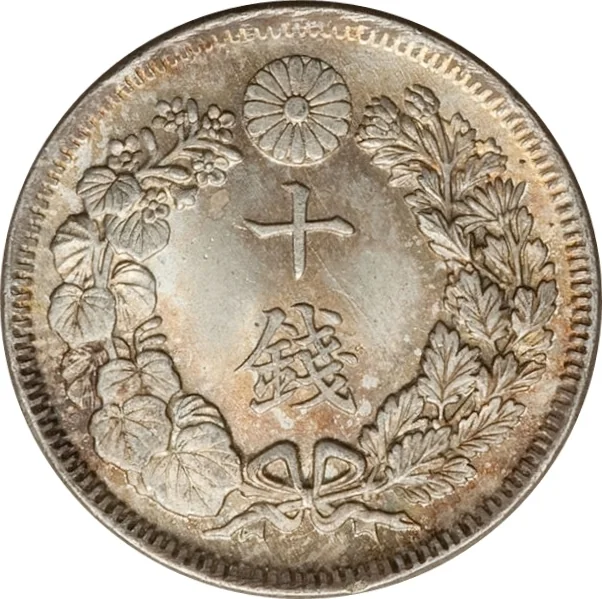
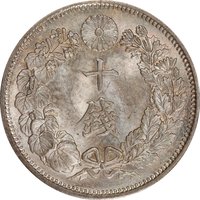
Chrysanthemum and paulownia branches encircle the rim, with chrysanthemums flanking the value.
Inscription:
十
錢
錢
Translation:
Ten Cash.
Language: Chinese
Reverse
Description:
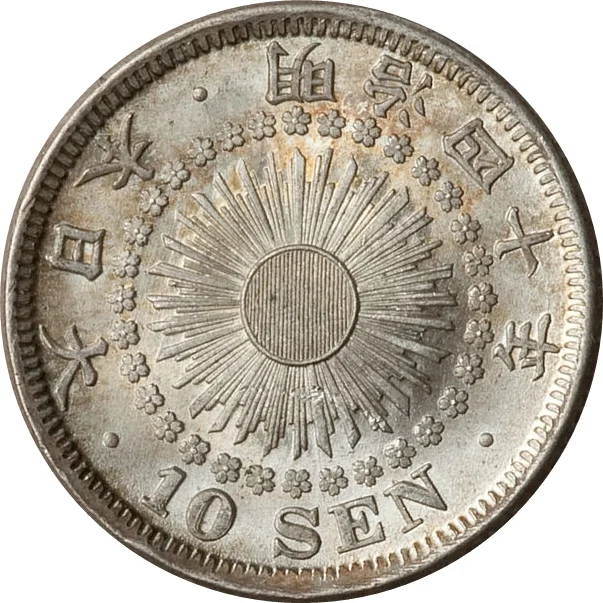
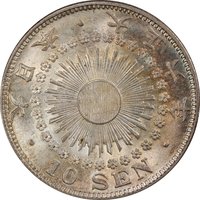
Radiant sun ringed by sakuras and text, denomination below.
Inscription:
年十四治明 · 本 日 大 ·
· 10 SEN ·
· 10 SEN ·
Translation:
Fourteenth year of Meiji; Large 1; 10 Sen.
Language: Japanese
Edge
Reeded
Mints
| Name | Mark |
|---|---|
| Japan Mint | — |
Mintings
| Year | Mint Mark | Mintage | Quality | Collection |
|---|---|---|---|---|
| 1907 | — | 12,000,000 | ||
| 1908 | — | 12,273,239 | ||
| 1909 | — | 20,279,846 | ||
| 1910 | — | 20,339,816 | ||
| 1911 | — | 38,729,680 | ||
| 1912 | — | 10,755,009 |
Historical background
In 1907, Japan's currency system was in a transitional phase, firmly on the gold standard but facing significant domestic strain. The nation had formally adopted the gold standard in 1897, following the Sino-Japanese War indemnity, which provided the necessary bullion reserves. This move stabilized the yen's international value and facilitated foreign investment, crucial for Japan's rapid industrialization and military expansion, notably during the ongoing Russo-Japanese War (1904-1905). The currency in circulation was a mix of Bank of Japan convertible notes (backed by gold) and subsidiary silver coinage, with the yen as the unitary unit.
However, the financial aftermath of the Russo-Japanese War placed the system under severe pressure. The conflict, while a military victory, was economically exhausting, funded heavily by foreign loans and domestic war bonds. By 1907, Japan was grappling with a large foreign debt, a post-war recession, and a worrying outflow of gold to settle international accounts. To conserve its gold reserves, the government and the Bank of Japan began employing restrictive financial policies, effectively limiting the convertibility of notes in practice and moving toward a "managed" gold standard. This period saw the beginnings of a credit crunch.
Consequently, 1907 was a year of financial vulnerability, marking the end of the immediate post-war boom. The strain contributed to a major banking crisis later in the year, triggered by a stock market crash and the failure of several prominent banks. While the gold standard remained legally intact, the pressures of 1907 revealed its fragility in the face of Japan's fiscal burdens and set the stage for future financial challenges, ultimately leading to the embargo on gold exports in 1917 during World War I. The currency situation thus reflected a nation navigating its new role as an imperial power while managing underlying economic weaknesses.
However, the financial aftermath of the Russo-Japanese War placed the system under severe pressure. The conflict, while a military victory, was economically exhausting, funded heavily by foreign loans and domestic war bonds. By 1907, Japan was grappling with a large foreign debt, a post-war recession, and a worrying outflow of gold to settle international accounts. To conserve its gold reserves, the government and the Bank of Japan began employing restrictive financial policies, effectively limiting the convertibility of notes in practice and moving toward a "managed" gold standard. This period saw the beginnings of a credit crunch.
Consequently, 1907 was a year of financial vulnerability, marking the end of the immediate post-war boom. The strain contributed to a major banking crisis later in the year, triggered by a stock market crash and the failure of several prominent banks. While the gold standard remained legally intact, the pressures of 1907 revealed its fragility in the face of Japan's fiscal burdens and set the stage for future financial challenges, ultimately leading to the embargo on gold exports in 1917 during World War I. The currency situation thus reflected a nation navigating its new role as an imperial power while managing underlying economic weaknesses.
🌱 Common