

1 Sen – Japan
Japan
Context
Year: 1938
Japanese - Shōwa era Year: 13
Issuer: Japan 
Ruler: Shōwa
Currency:
(since 1871)
Demonetized: Yes
Total mintage: 113,600,000
Material
References
Y: #Click to copy to clipboard55
Numista: #13957
Value
Exchange value: 0.01 JPY = $0.00
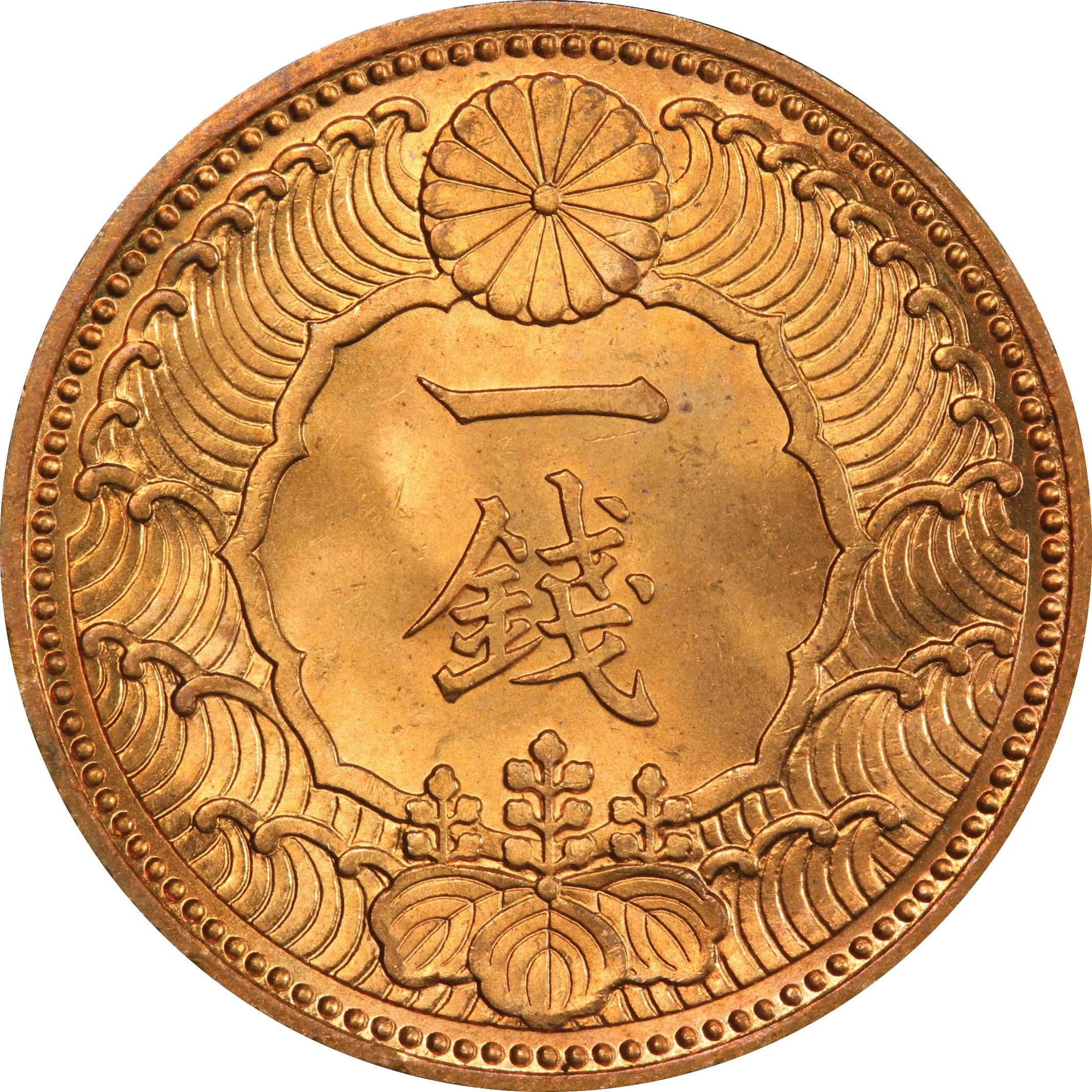
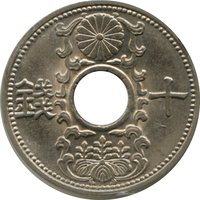
Obverse
Description:
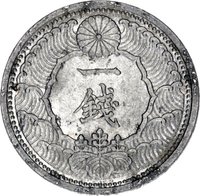
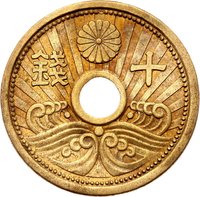
Top: Chrysanthemum Seal (Imperial)
Centre: Value in Floral Design
Bottom: Paulownia Seal (Government)
Centre: Value in Floral Design
Bottom: Paulownia Seal (Government)
Inscription:
一
錢
錢
Translation:
One coin.
Language: Classical Chinese
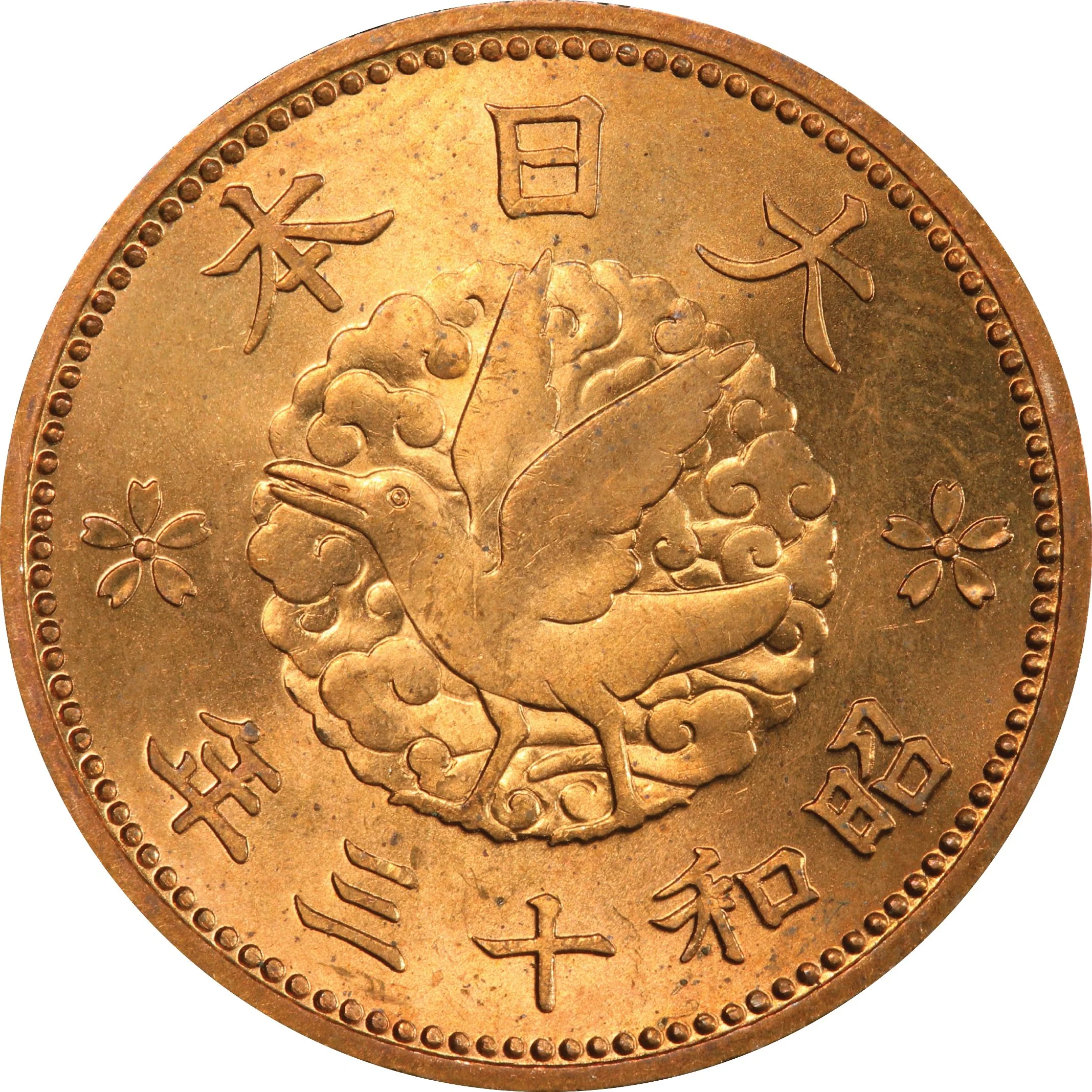
Reverse
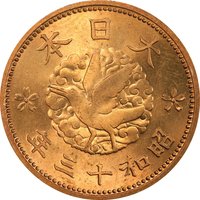
Description:
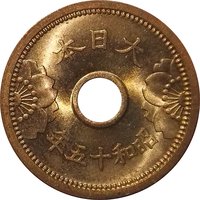
Crow on cloud, facing left.
Inscription:
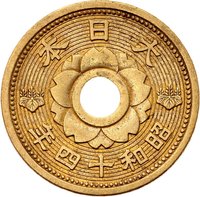
❀ 本 日 大 ❀
年 三 十 和 昭
年 三 十 和 昭
Translation:
❀ This day, great ❀
Year thirty, Shōwa
Year thirty, Shōwa
Language: Japanese
Edge
Plain
Mints
| Name | Mark |
|---|---|
| Japan Mint | — |
Mintings
| Year | Mint Mark | Mintage | Quality | Collection |
|---|---|---|---|---|
| 1938 | — | 113,600,000 |
Historical background
By 1938, Japan's currency situation was fundamentally shaped by the demands of its expanding war in China, which began in earnest in 1937. The national economy was being rapidly transitioned to a fully mobilized wartime system, severing the yen from its traditional foundations. The government, operating under the National Mobilization Law, abandoned the gold standard de facto and began financing its military campaigns through massive deficit spending and bond issuance by the Bank of Japan. This direct monetization of debt, while providing immediate funds, initiated a dangerous cycle of inflationary pressure, though strict price controls and rationing on essential goods attempted to mask its full effects.
Internationally, the yen's position had deteriorated significantly. The fixed exchange rate of approximately ¥4.25 to one US dollar was maintained by law, but it became increasingly artificial and unsustainable. To conserve vital foreign exchange for purchasing strategic resources like oil, steel, and machinery from abroad, Japan imposed severe capital controls and created a complex system of blocked yen accounts. Foreign businesses could not freely convert their yen earnings into dollars or sterling, effectively isolating Japan's financial system from global markets. This financial autarky was deemed necessary to support the war effort but came at the cost of crippling normal international trade and investment.
Domestically, the government launched pervasive propaganda campaigns, such as "Save and Contribute," to compel citizens to purchase war bonds and deposit savings into postal and banking systems, channeling private wealth directly to the state. The physical currency, Bank of Japan notes, remained in circulation, but the economy was increasingly characterized by a dual structure: a controlled official market for basic necessities and a burgeoning black market where prices reflected the true inflationary decay of the yen's value. Thus, by 1938, the yen was no longer a stable store of value or a freely convertible international currency, but rather a tool of state policy, manipulated to extract maximum resources for a conflict that was steadily eroding Japan's economic stability.
Internationally, the yen's position had deteriorated significantly. The fixed exchange rate of approximately ¥4.25 to one US dollar was maintained by law, but it became increasingly artificial and unsustainable. To conserve vital foreign exchange for purchasing strategic resources like oil, steel, and machinery from abroad, Japan imposed severe capital controls and created a complex system of blocked yen accounts. Foreign businesses could not freely convert their yen earnings into dollars or sterling, effectively isolating Japan's financial system from global markets. This financial autarky was deemed necessary to support the war effort but came at the cost of crippling normal international trade and investment.
Domestically, the government launched pervasive propaganda campaigns, such as "Save and Contribute," to compel citizens to purchase war bonds and deposit savings into postal and banking systems, channeling private wealth directly to the state. The physical currency, Bank of Japan notes, remained in circulation, but the economy was increasingly characterized by a dual structure: a controlled official market for basic necessities and a burgeoning black market where prices reflected the true inflationary decay of the yen's value. Thus, by 1938, the yen was no longer a stable store of value or a freely convertible international currency, but rather a tool of state policy, manipulated to extract maximum resources for a conflict that was steadily eroding Japan's economic stability.
🌱 Common