

5 Sen – Japan
Japan
Context
Material
Diameter: 19 mm
Weight: 2.8 g
Thickness: 1.35 mm
Shape: Round with a round hole
Composition: Nickel
Magnetic: Yes
Technique: Milled
Alignment: Medal alignment
flip
References
Y: #Click to copy to clipboard53
Numista: #13956
Value
Exchange value: 0.05 JPY = $0.00
Obverse
Description:
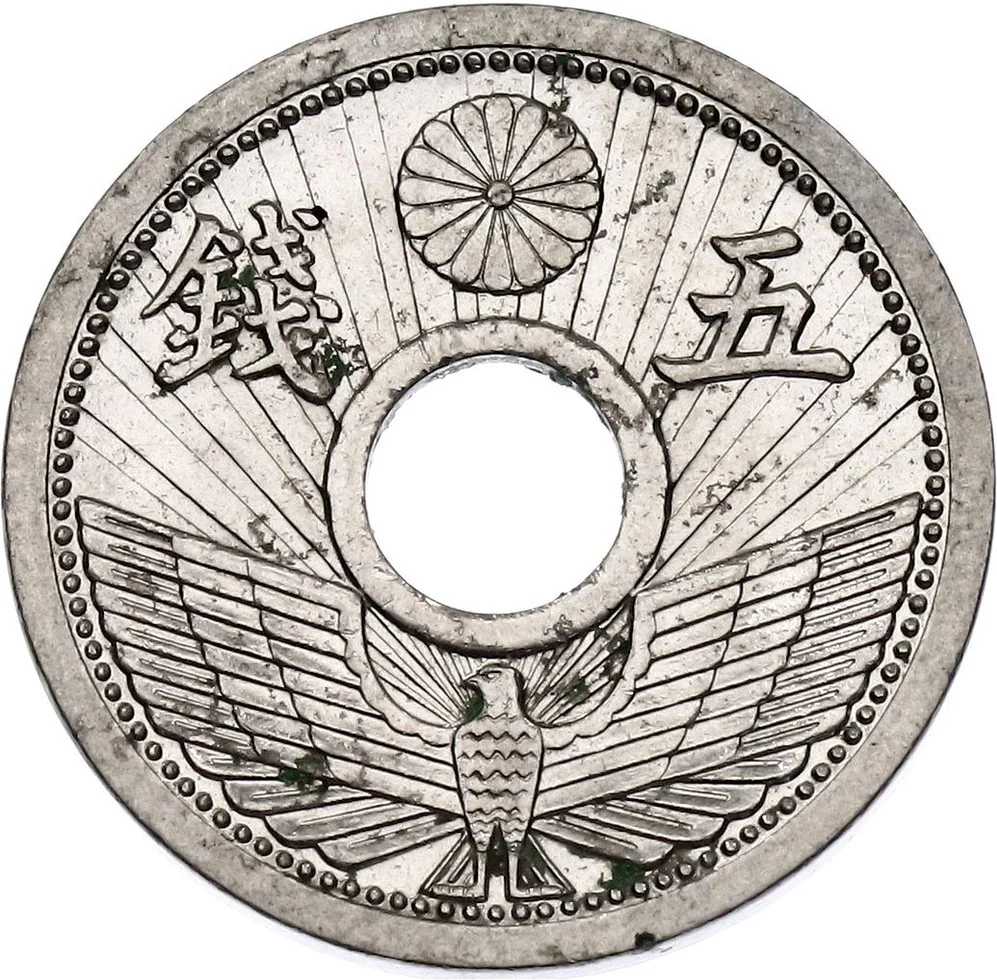
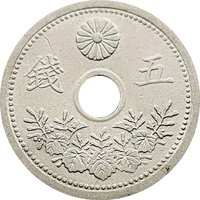
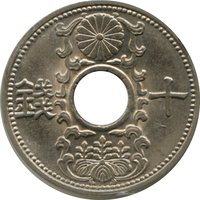
Chrysanthemum crest, imperial seal, and value around center hole. Stylized eagle with spread wings over rays below.
Inscription:
錢 五
Translation:
Five Cash
Language: Chinese
Reverse
Description:
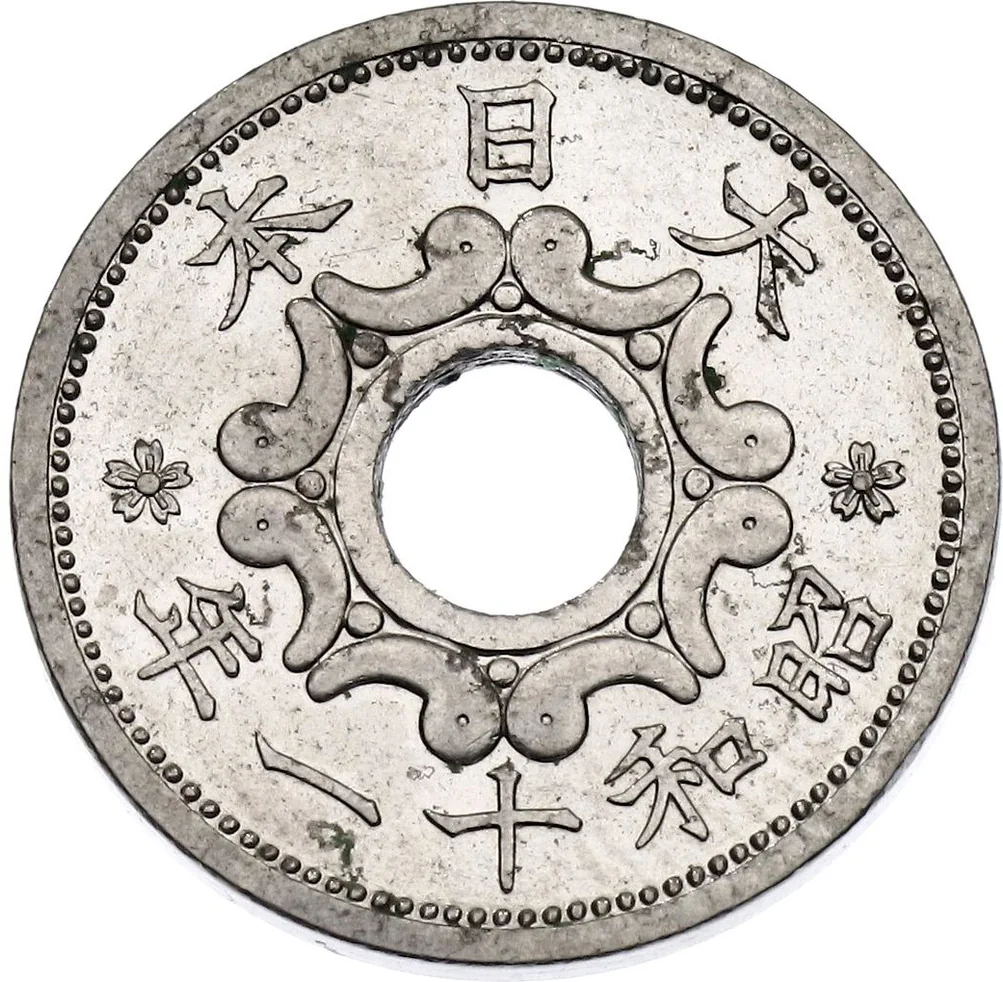
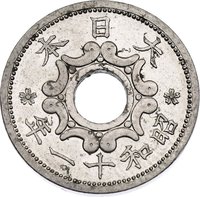
Issuing authority above, date below, hole encircled by magatamas.
Inscription:
❀ 本 日 大 ❀
年 一 十 和 昭
年 一 十 和 昭
Translation:
❀ Showa 11th Year ❀
❀ Hon Nichi Dai ❀
❀ Hon Nichi Dai ❀
Language: Japanese
Edge
Plain
Mints
| Name | Mark |
|---|---|
| Japan Mint | — |
Mintings
| Year | Mint Mark | Mintage | Quality | Collection |
|---|---|---|---|---|
| 1933 | — | 16,150,806 | ||
| 1934 | — | 33,851,607 | ||
| 1935 | — | 13,680,677 | ||
| 1936 | — | 36,321,796 | ||
| 1937 | — | 44,402,201 | ||
| 1938 | — | 10,000,000 |
Historical background
In 1933, Japan's currency situation was defined by its departure from the gold standard and the subsequent management of the yen to support militarization and economic recovery. The government, led by Prime Minister Korekiyo Takahashi, had taken the decisive step to abandon the gold standard in December 1931, a move that triggered an immediate and sharp devaluation of the yen. This deliberate devaluation, with the yen falling roughly 60% against the U.S. dollar by 1933, provided a powerful boost to Japanese exports, particularly in key industries like textiles, helping to alleviate the severe deflation and economic distress of the Great Depression.
This "Takahashi Finance" policy mix combined loose monetary policy with significant fiscal spending, primarily directed toward the military in the aftermath of the 1931 Manchurian Incident. The Bank of Japan facilitated this by underwriting government bonds, effectively monetizing the debt to fund expansion. Consequently, while the cheap yen stimulated export-led growth and began to pull Japan out of depression, it also fueled inflation and entrenched the political power of the military, setting the nation on a path of fiscal indiscipline and imperial ambition.
Internationally, the yen's managed devaluation led to accusations of "economic dumping" and trade friction, especially with the United Kingdom and the United States, which were also grappling with economic turmoil. By 1933, Japan's currency was no longer anchored to gold but was instead a flexible instrument of state policy, consciously manipulated to generate industrial profits and fund military expansion. This financial strategy proved economically effective in the short term but contributed to the isolation of Japan from the Western economic order and deepened its commitment to an autarkic empire in Asia.
This "Takahashi Finance" policy mix combined loose monetary policy with significant fiscal spending, primarily directed toward the military in the aftermath of the 1931 Manchurian Incident. The Bank of Japan facilitated this by underwriting government bonds, effectively monetizing the debt to fund expansion. Consequently, while the cheap yen stimulated export-led growth and began to pull Japan out of depression, it also fueled inflation and entrenched the political power of the military, setting the nation on a path of fiscal indiscipline and imperial ambition.
Internationally, the yen's managed devaluation led to accusations of "economic dumping" and trade friction, especially with the United Kingdom and the United States, which were also grappling with economic turmoil. By 1933, Japan's currency was no longer anchored to gold but was instead a flexible instrument of state policy, consciously manipulated to generate industrial profits and fund military expansion. This financial strategy proved economically effective in the short term but contributed to the isolation of Japan from the Western economic order and deepened its commitment to an autarkic empire in Asia.
🌱 Common