

5 sen – Japan
Add to wishlist
Japan
Context
Year: 1932
Japanese - Shōwa era Year:: 7
Issuer: Japan
Ruler: Shōwa
Currency:
(since 1871)
Demonetized: Yes
Total mintage: 8,000,394
Material
Diameter: 19.1 mm
Weight: 2.63 g
Shape: Round with a round hole
Composition: Copper-nickel
Technique: Milled
Alignment: Medal alignment
flip
References
Y: #
Numista: #13955
Value
Exchange value: 0.05 JPY
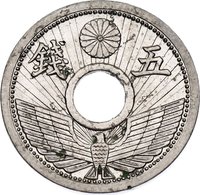
Obverse
Description:
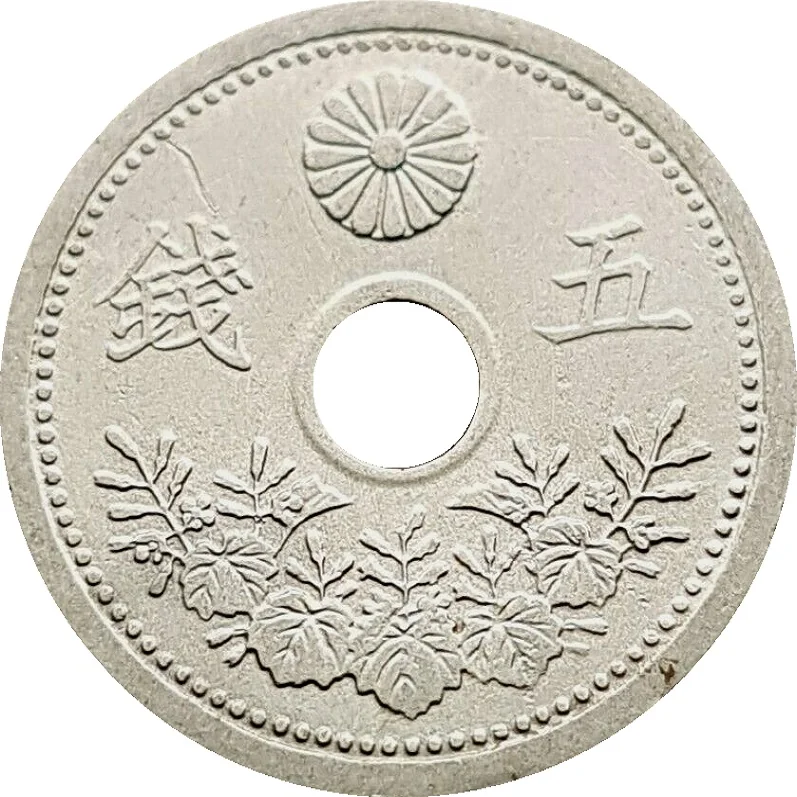
Chrysanthemum and Paulownia seals, divided by a hole.
Inscription:
錢 五
Translation:
Five Cash
Language: Chinese
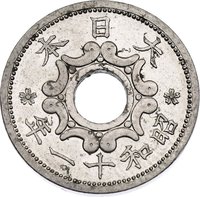
Reverse
Description:
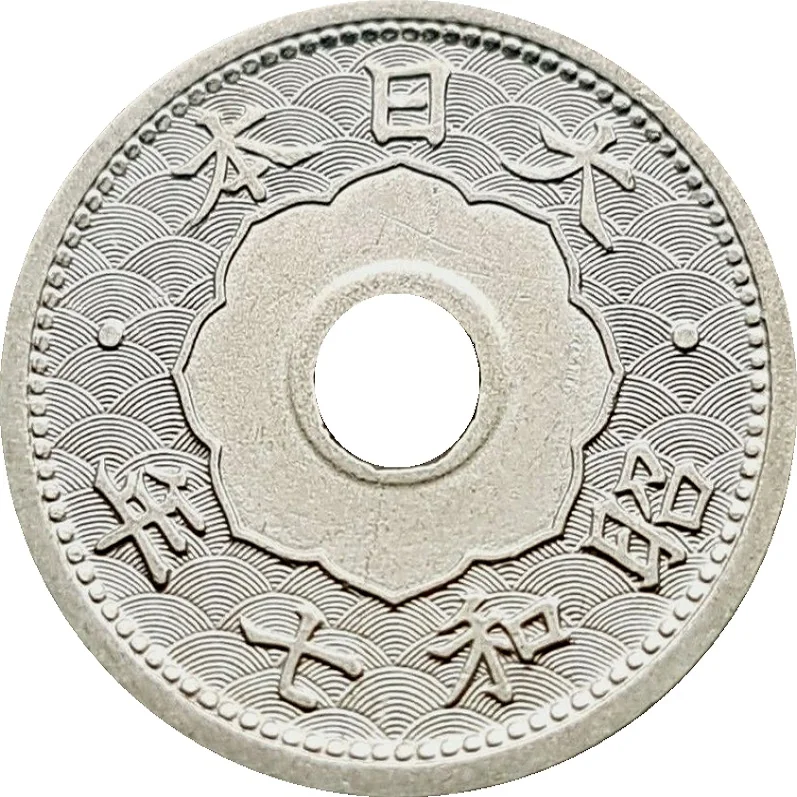
Floral frame encircling text over waves.
Inscription:
· 本 日 大 ·
年 七 和 昭
年 七 和 昭
Translation:
Shōwa 7 nen
Hinomaru
Hinomaru
Language: Japanese
Edge
Plain
Categories
| Plants> Flower |
| Symbols> Coat of Arms |
Mints
| Name | Mark |
|---|---|
| Japan Mint | — |
Mintings
| Year | Mint Mark | Mintage | Quality | Collection |
|---|---|---|---|---|
| 1932 | — | 8,000,394 |
Historical background
In 1932, Japan’s currency situation was defined by its adherence to the gold standard, a system it had returned to in January 1930 at the pre-World War I parity. This move, championed by Finance Minister Junnosuke Inoue, proved disastrously deflationary. The overvalued yen made Japanese exports uncompetitive just as the Great Depression crushed global demand, causing a sharp fall in prices, widespread business failures, and severe rural poverty. The economic strain fueled social unrest and weakened faith in parliamentary government, creating a crisis that culminated in Inoue's assassination in February 1932 by ultranationalist militants.
Following the political turmoil and recognizing the economic catastrophe, Japan dramatically shifted course. In December 1931, the new Finance Minister, Korekiyo Takahashi, took Japan off the gold standard and implemented a bold policy package known as the "Takahashi Financial Policy." He allowed the yen to depreciate, which provided a powerful, immediate boost to exports, particularly for the key textile and heavy industries. Concurrently, he launched a decisive program of deficit-financed government spending, primarily directed toward military expansion and rural relief, to stimulate domestic demand.
Thus, by the close of 1932, Japan had transitioned from a deflationary gold-standard regime to a managed, inflationary currency system aimed at recovery and expansion. The yen's devaluation and aggressive fiscal stimulus successfully sparked an early economic rebound, distinguishing Japan from Western nations still mired in depression. However, this financial mobilization also set a precedent for military-dominated budgets, embedding the armed forces deeply into the economy and setting the nation on a path of militarization that would define the subsequent decade.
Following the political turmoil and recognizing the economic catastrophe, Japan dramatically shifted course. In December 1931, the new Finance Minister, Korekiyo Takahashi, took Japan off the gold standard and implemented a bold policy package known as the "Takahashi Financial Policy." He allowed the yen to depreciate, which provided a powerful, immediate boost to exports, particularly for the key textile and heavy industries. Concurrently, he launched a decisive program of deficit-financed government spending, primarily directed toward military expansion and rural relief, to stimulate domestic demand.
Thus, by the close of 1932, Japan had transitioned from a deflationary gold-standard regime to a managed, inflationary currency system aimed at recovery and expansion. The yen's devaluation and aggressive fiscal stimulus successfully sparked an early economic rebound, distinguishing Japan from Western nations still mired in depression. However, this financial mobilization also set a precedent for military-dominated budgets, embedding the armed forces deeply into the economy and setting the nation on a path of militarization that would define the subsequent decade.
🌟 Uncommon