

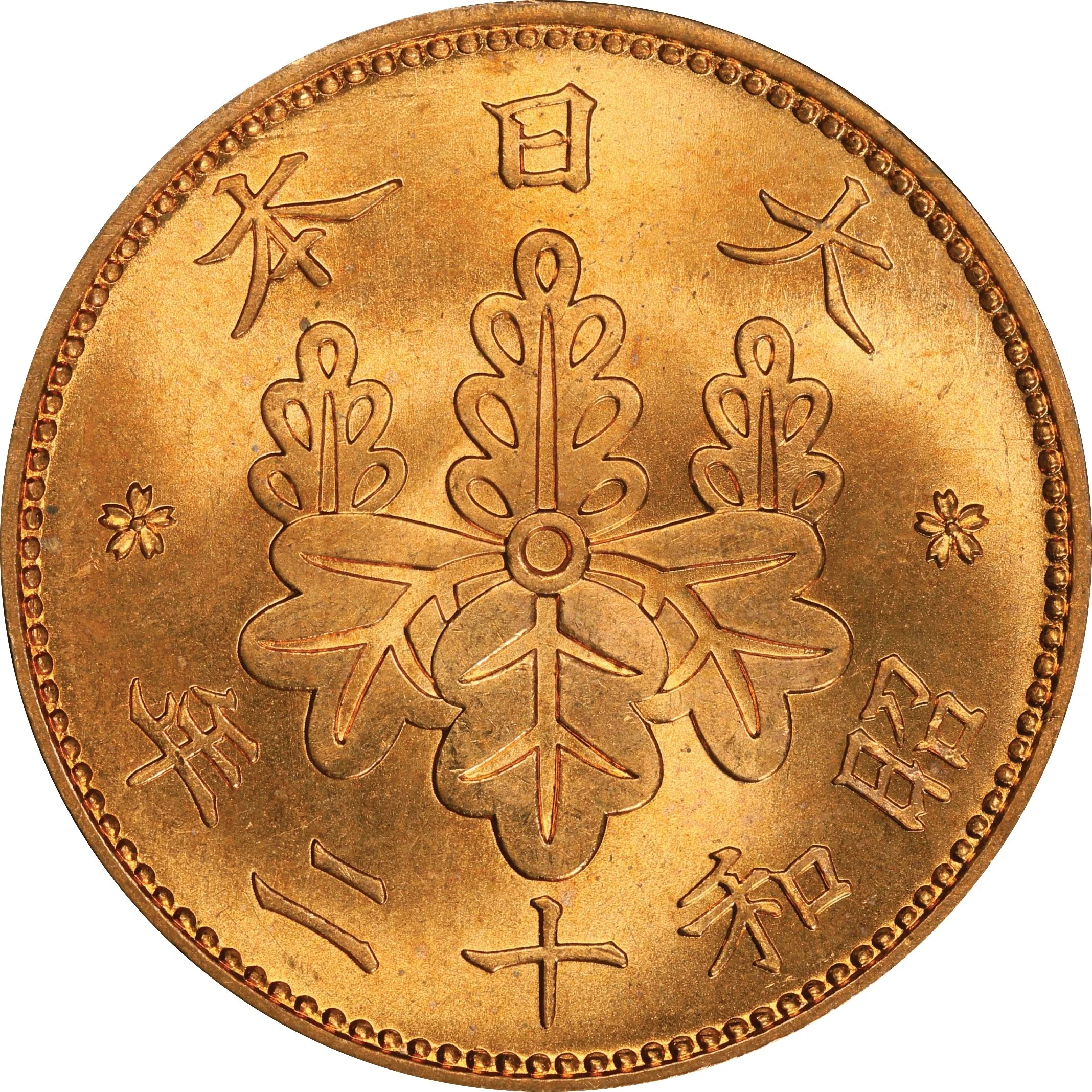
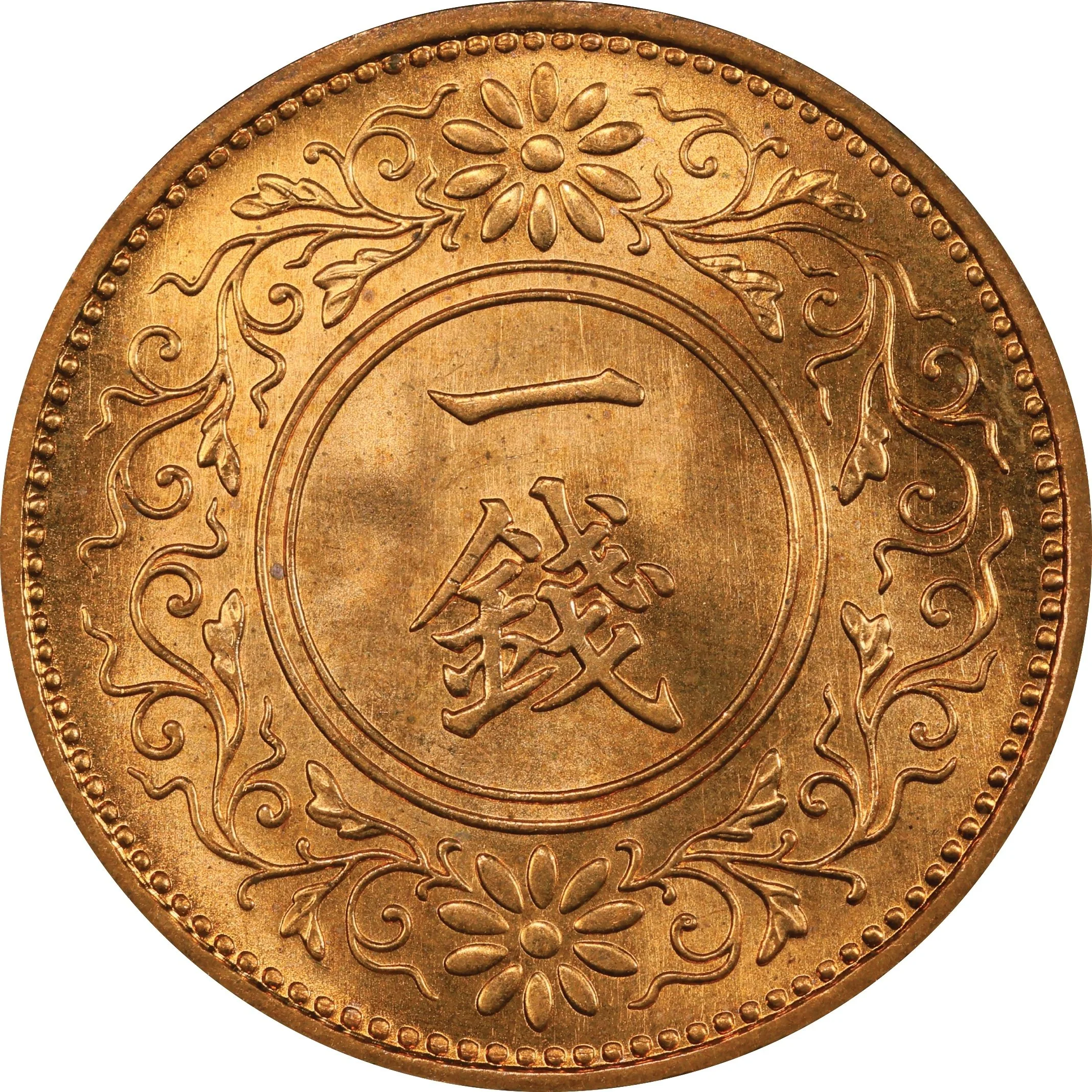
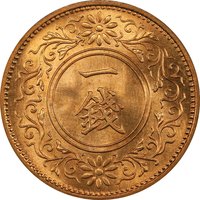
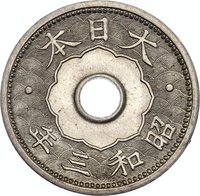
Obverse
Description:
Japanese Imperial Seal
Inscription:
❀ 本 日 大 ❀
年 二十 和 昭
年 二十 和 昭
Translation:
Flower, Era of Showa 20th Year
Language: Japanese
Reverse
Edge
Plain
Mints
| Name | Mark |
|---|---|
| Japan Mint | — |
Mintings
| Year | Mint Mark | Mintage | Quality | Collection |
|---|---|---|---|---|
| 1927 | — | 26,500,000 | ||
| 1929 | — | 3,000,000 | ||
| 1930 | — | 5,000,000 | ||
| 1931 | — | 25,001,222 | ||
| 1932 | — | 35,066,715 | ||
| 1933 | — | 38,936,907 | ||
| 1934 | — | 100,004,950 | ||
| 1935 | — | 200,009,912 | ||
| 1936 | — | 109,170,428 | ||
| 1937 | — | 133,196,568 | ||
| 1938 | — | 87,649,338 |
Historical background
The Japanese financial crisis of 1927 (the Shōwa Financial Crisis) was the culmination of a decade of underlying economic fragility, rooted in the aftermath of World War I. During the war, Japan experienced a boom, but the post-war recession left banks heavily exposed to struggling industrial firms, particularly in the textile and commodity sectors. A critical and unresolved issue was the proliferation of "earthquake bills"—unredeemable promissory notes issued by the Bank of Japan following the devastating 1923 Great Kantō earthquake to help businesses recover. These bad debts festered within the banking system, creating a widespread but hidden insolvency problem that undermined confidence.
The immediate trigger occurred in March 1927 when the Diet debated a proposed solution to liquidate the earthquake bills. During the debate, Finance Minister Naoharu Kataoka inadvertently revealed that the prominent Suzuki trading company was on the verge of collapse, which in turn threatened the solvency of its main bank, the Bank of Taiwan. This disclosure sparked a nationwide bank run. Panicked depositors rushed to withdraw savings, leading to a cascade of bank failures. Within weeks, dozens of banks, including major institutions like the Watanabe and the Fifteenth Bank, suspended operations, causing a severe credit crunch that paralyzed commerce.
The crisis forced a fundamental restructuring of Japan's financial system. The government declared a three-week bank moratorium in April to halt the runs and passed the Bank of Japan Special Loans and Compensation Act to provide emergency funds. The aftermath saw a dramatic consolidation of the banking sector, with the number of banks falling from over 1,400 to just 65 by 1932. While the immediate panic was contained, the crisis deepened Japan's economic distress, eroded public trust in financial institutions, and contributed to a shift toward more state-controlled finance and militaristic expansionism in the 1930s as a perceived path to economic stability.
The immediate trigger occurred in March 1927 when the Diet debated a proposed solution to liquidate the earthquake bills. During the debate, Finance Minister Naoharu Kataoka inadvertently revealed that the prominent Suzuki trading company was on the verge of collapse, which in turn threatened the solvency of its main bank, the Bank of Taiwan. This disclosure sparked a nationwide bank run. Panicked depositors rushed to withdraw savings, leading to a cascade of bank failures. Within weeks, dozens of banks, including major institutions like the Watanabe and the Fifteenth Bank, suspended operations, causing a severe credit crunch that paralyzed commerce.
The crisis forced a fundamental restructuring of Japan's financial system. The government declared a three-week bank moratorium in April to halt the runs and passed the Bank of Japan Special Loans and Compensation Act to provide emergency funds. The aftermath saw a dramatic consolidation of the banking sector, with the number of banks falling from over 1,400 to just 65 by 1932. While the immediate panic was contained, the crisis deepened Japan's economic distress, eroded public trust in financial institutions, and contributed to a shift toward more state-controlled finance and militaristic expansionism in the 1930s as a perceived path to economic stability.
🌱 Very Common