

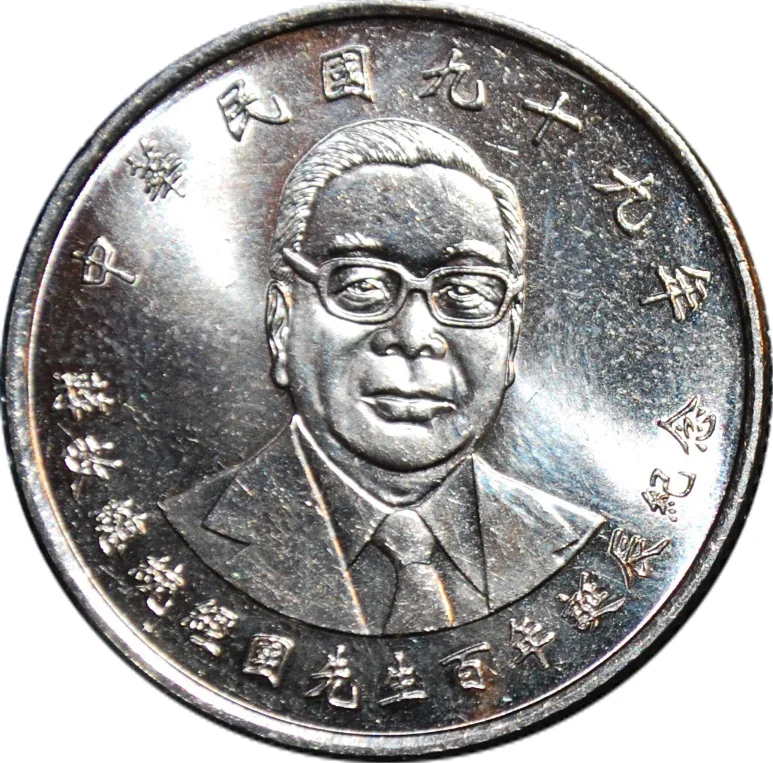
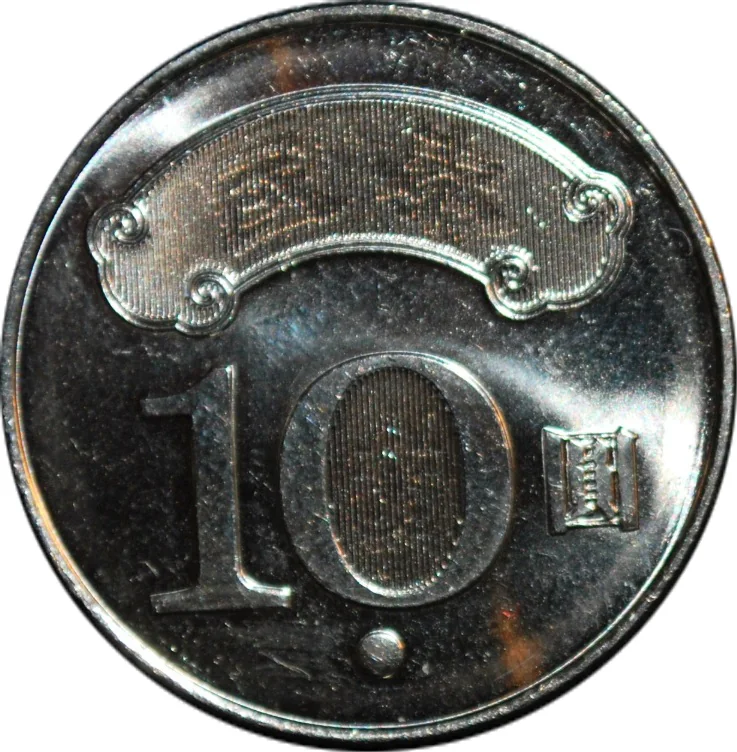
10 yuan (Chiang Ching-kuo) – Taiwan
Add to wishlist
Circulating commemorative coins
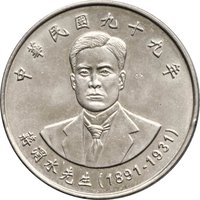
Commemoration: Chiang Ching-kuo - Kuomintang leader; 100th anniversary of his birth
China
Context
Year: 2010
Chinese republican Year:: 99
Country: China
Issuer: Taiwan
Period:
(since 1949)
Currency:
(since 1949)
Material
Diameter: 26 mm
Weight: 7.5 g
Thickness: 1.83 mm
Shape: Round
Techniques: Latent image, Milled
Alignment: Medal alignment
flip
References
Y: #
Numista: #13334
Value
Exchange value: 10 TWD
Inflation-adjusted value: 13.59 TWD
Obverse
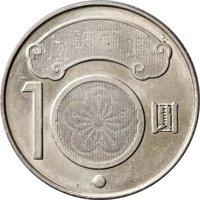
Reverse
Edge
Reeded
Categories
| Event> Birth anniversary |
| Person> Politician |
Mints
| Name | Mark |
|---|---|
| Central Mint of Taiwan | — |
Mintings
| Year | Mint Mark | Mintage | Quality | Collection |
|---|---|---|---|---|
| 2010 | — | — |
Historical background
In 2010, Taiwan's currency, the New Taiwan Dollar (NTD or TWD), operated within a managed float system overseen by the Central Bank of the Republic of China (Taiwan). The primary focus of monetary policy was on maintaining relative stability and controlling inflation, rather than targeting a specific exchange rate. This period followed the global financial crisis, and Taiwan's economy was in a strong recovery phase, driven by robust exports, particularly in the electronics and semiconductor sectors, to mainland China and other global markets. Consequently, the central bank faced persistent upward pressure on the NTD as foreign capital flowed into Taiwanese assets and the trade surplus remained substantial.
A key dynamic of the 2010 currency situation was Taiwan's complex economic relationship with mainland China. The landmark Economic Cooperation Framework Agreement (ECFA), signed in June 2010, significantly reduced tariffs and aimed to deepen cross-strait economic ties. This agreement boosted market confidence and attracted further investment, reinforcing the NTD's strength. However, the central bank was widely observed by international markets to be intervening regularly in the foreign exchange market to slow the pace of appreciation. This was done to protect the competitiveness of Taiwan's crucial export industries, which were sensitive to exchange rate fluctuations, and to ensure a stable economic environment.
Overall, the year 2010 saw the NTD on a gradual appreciating trend against the US dollar, but within a tightly managed band. The central bank's interventions were a defining feature, balancing the goals of controlling imported inflation, supporting exporters, and preventing disruptive hot money inflows. The policy reflected a cautious approach, prioritizing economic stability while navigating the opportunities and interdependencies of deepening cross-strait economic integration following the ECFA.
A key dynamic of the 2010 currency situation was Taiwan's complex economic relationship with mainland China. The landmark Economic Cooperation Framework Agreement (ECFA), signed in June 2010, significantly reduced tariffs and aimed to deepen cross-strait economic ties. This agreement boosted market confidence and attracted further investment, reinforcing the NTD's strength. However, the central bank was widely observed by international markets to be intervening regularly in the foreign exchange market to slow the pace of appreciation. This was done to protect the competitiveness of Taiwan's crucial export industries, which were sensitive to exchange rate fluctuations, and to ensure a stable economic environment.
Overall, the year 2010 saw the NTD on a gradual appreciating trend against the US dollar, but within a tightly managed band. The central bank's interventions were a defining feature, balancing the goals of controlling imported inflation, supporting exporters, and preventing disruptive hot money inflows. The policy reflected a cautious approach, prioritizing economic stability while navigating the opportunities and interdependencies of deepening cross-strait economic integration following the ECFA.
🌱 Common