

100 yen – Japan
Add to wishlist
Circulating commemorative coins
Commemoration: 1970 Expo, Osaka
Japan
Context
Year: 1970
Japanese - Shōwa era Year:: 45
Issuer: Japan
Ruler: Shōwa
Currency:
(since 1871)
Total mintage: 40,000,000
Material
References
Y: #
Numista: #9585
Value
Exchange value: 100 JPY
Inflation-adjusted value: 374.88 JPY
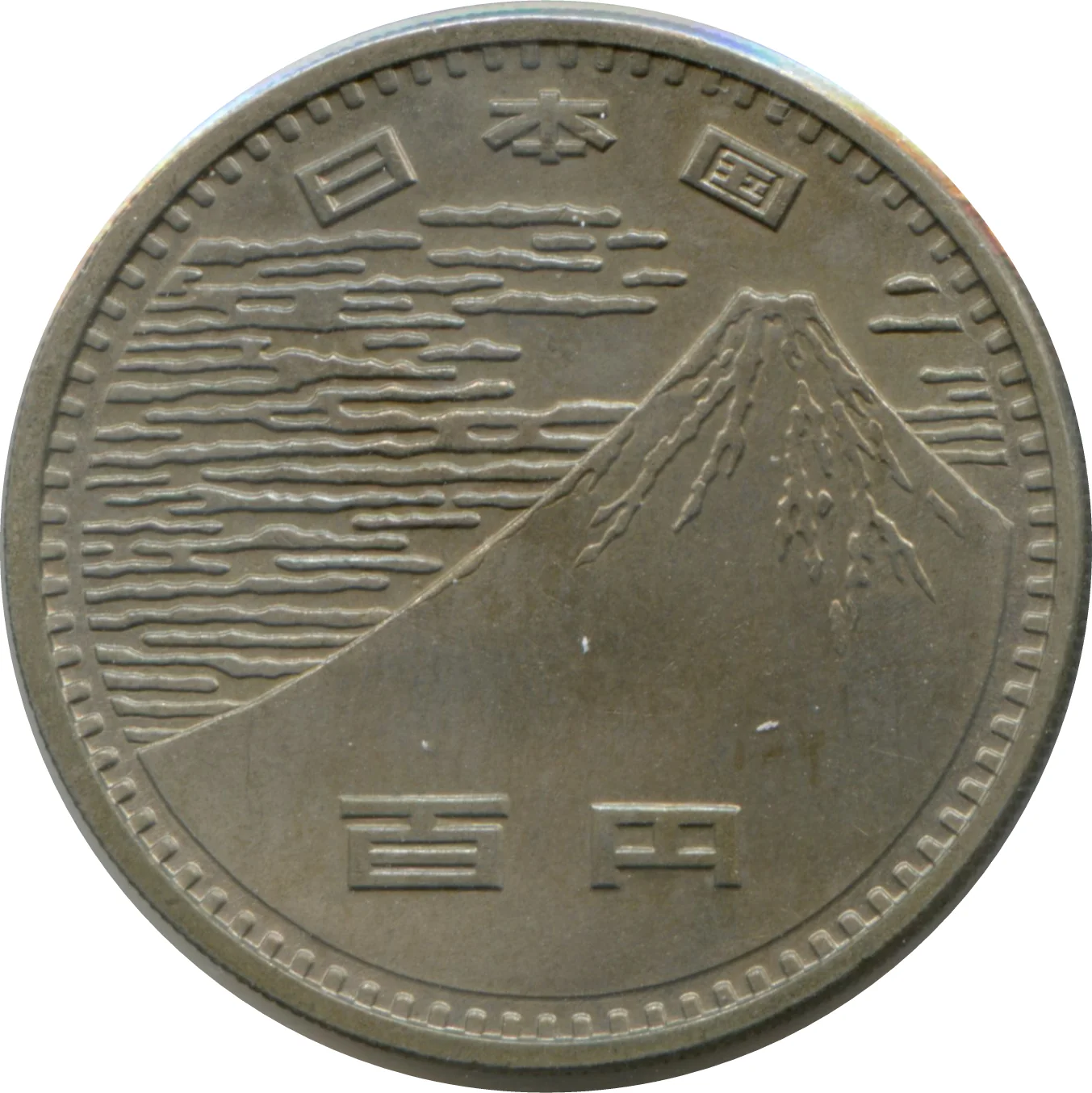
Obverse
Description:
Mt. Fuji above clouds, echoing Hokusai's "Fine Wind, Clear Morning": authority above, value below.
Inscription:
日 本 国
百 円
百 円
Translation:
Japan
100 Yen
100 Yen
Scripts: Chinese (traditional, regular script)
Language: Japanese
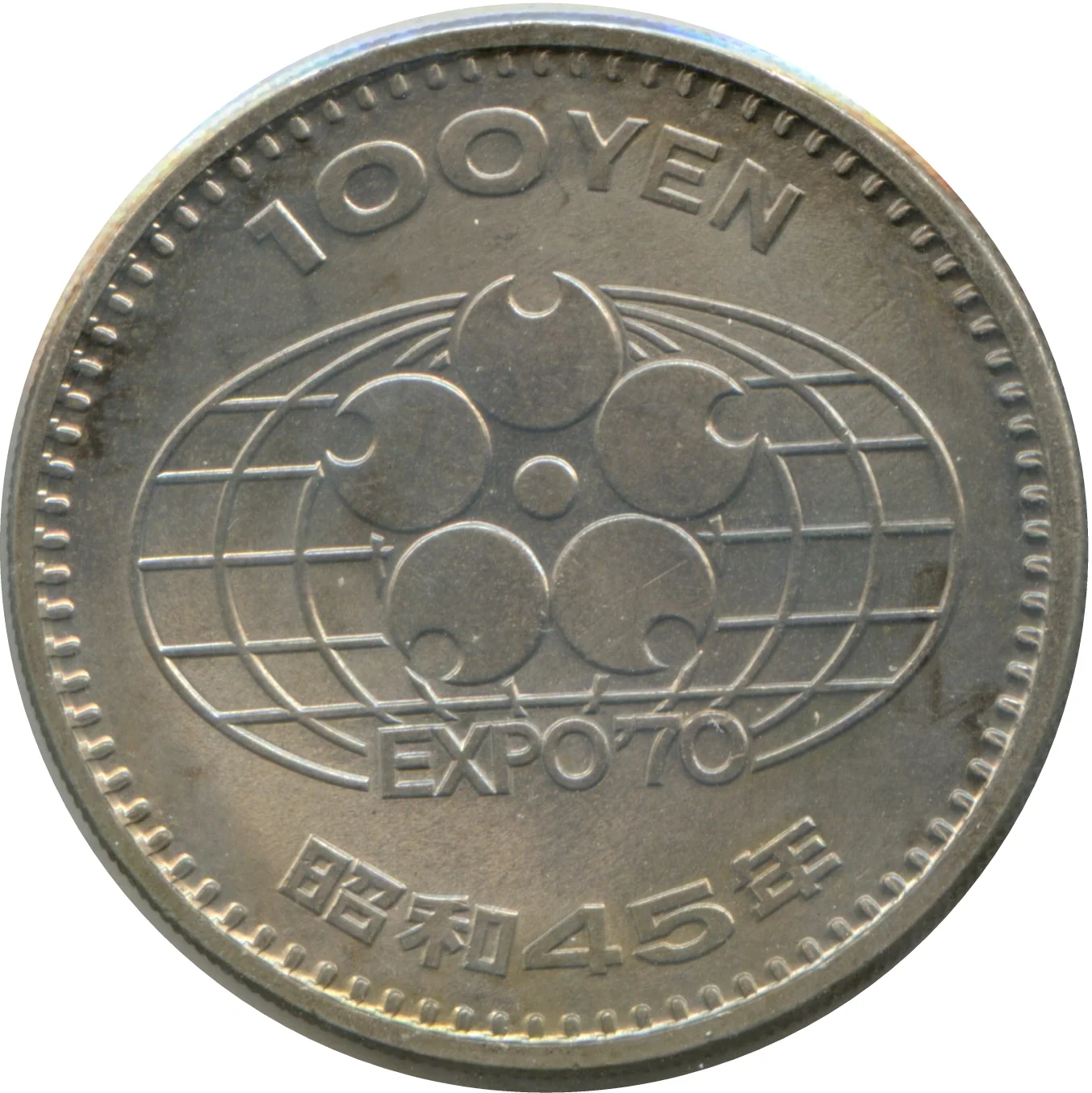
Reverse
Description:
Expo emblem centered, value above, date below.
Inscription:
100 YEN
EXPO 70
昭和45年
EXPO 70
昭和45年
Translation:
100 YEN
EXPO 70
1970
EXPO 70
1970
Edge
Reeded
Mints
| Name | Mark |
|---|---|
| Japan Mint | — |
Mintings
| Year | Mint Mark | Mintage | Quality | Collection |
|---|---|---|---|---|
| 1970 | — | 40,000,000 |
Historical background
By 1970, Japan's currency situation was defined by the Bretton Woods system, under which the yen was pegged at a fixed rate of 360 yen to the US dollar since 1949. This undervalued exchange rate, maintained during Japan's period of rapid postwar reconstruction and export-led growth, provided a crucial competitive advantage. Japanese industries, from steel and shipbuilding to emerging electronics and automobiles, flooded international markets, generating massive trade surpluses and fueling an economic "miracle." However, this very success began to strain the fixed-rate system, as Japan's growing surplus contrasted sharply with the United States' mounting trade deficits and inflation.
Internationally, pressure mounted on the United States to address its balance of payments problems, casting doubt on the dollar's convertibility to gold—the cornerstone of Bretton Woods. For Japan, the fixed, cheap yen was becoming a source of both domestic and foreign friction. Domestically, the influx of export earnings contributed to rising liquidity and asset inflation. Externally, Japan faced increasing accusations of "dumping" and unfair trade practices from Western competitors, particularly the United States, which demanded yen revaluation to correct the trade imbalance.
Thus, 1970 stood on the precipice of monumental change. While the yen's official parity remained at 360, speculative capital flows anticipating a revaluation intensified. The year was marked by a tense holding pattern, with Japanese authorities fiercely defending the fixed rate through heavy market intervention, viewing a strong, stable yen as vital for continued growth. This defensive stance could not last, and the events of 1970 set the stage for the collapse of the Bretton Woods system in 1971, leading to the Smithsonian Agreement and the eventual shift to a floating exchange rate regime for the yen.
Internationally, pressure mounted on the United States to address its balance of payments problems, casting doubt on the dollar's convertibility to gold—the cornerstone of Bretton Woods. For Japan, the fixed, cheap yen was becoming a source of both domestic and foreign friction. Domestically, the influx of export earnings contributed to rising liquidity and asset inflation. Externally, Japan faced increasing accusations of "dumping" and unfair trade practices from Western competitors, particularly the United States, which demanded yen revaluation to correct the trade imbalance.
Thus, 1970 stood on the precipice of monumental change. While the yen's official parity remained at 360, speculative capital flows anticipating a revaluation intensified. The year was marked by a tense holding pattern, with Japanese authorities fiercely defending the fixed rate through heavy market intervention, viewing a strong, stable yen as vital for continued growth. This defensive stance could not last, and the events of 1970 set the stage for the collapse of the Bretton Woods system in 1971, leading to the Smithsonian Agreement and the eventual shift to a floating exchange rate regime for the yen.
🌱 Common