

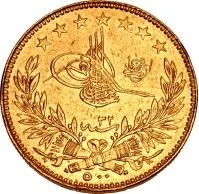
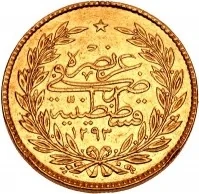
500 kurush – Ottoman Empire
Add to wishlist
Turkey
Context
Years: 1886–1908
Islamic (Hijri) Year:: 1293
Country: Turkey
Issuer: Ottoman Empire
Ruler: Abdul Hamid II
Currency:
(1844—1923)
Demonetized: Yes
Total mintage: 280,380
Material
References
KM: #
Numista: #91223
Value
Bullion value: $5133.82
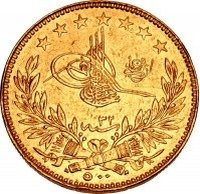
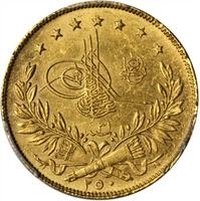
Obverse
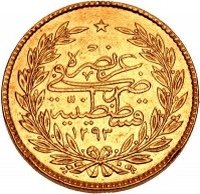
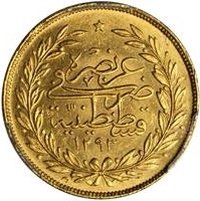
Reverse
Edge
Mintings
| Year | Mint Mark | Mintage | Quality | Collection |
|---|---|---|---|---|
| 1886 | — | 200 | ||
| 1887 | — | 200 | ||
| 1888 | — | 200 | ||
| 1889 | — | 200 | ||
| 1890 | — | 200 | ||
| 1891 | — | 15,000 | ||
| 1892 | — | 200 | ||
| 1893 | — | 200 | ||
| 1894 | — | 200 | ||
| 1895 | — | 200 | ||
| 1896 | — | 200 | ||
| 1897 | — | 200 | ||
| 1898 | — | 15,000 | ||
| 1899 | — | 8,048 | ||
| 1900 | — | 11,000 | ||
| 1901 | — | 8,735 | ||
| 1902 | — | 22,450 | ||
| 1903 | — | 35,918 | ||
| 1904 | — | 33,129 | ||
| 1905 | — | 40,953 | ||
| 1906 | — | 32,516 | ||
| 1907 | — | 16,403 | ||
| 1908 | — | 39,028 |
Historical background
By 1886, the Ottoman Empire's currency situation was one of profound crisis and complexity, emblematic of its broader financial and political decline. The empire operated on a bimetallic system in theory, but in practice it was overwhelmed by a chaotic multiplicity of coins. Alongside the official gold lira and silver kuruş, a vast array of foreign coins (especially British sovereigns, French francs, and Austrian thalers) circulated freely, while debased and counterfeit coins were rampant. This disorder was a direct result of chronic budget deficits, excessive foreign borrowing, and the loss of monetary sovereignty, culminating in the default of 1875 and the establishment of the Ottoman Public Debt Administration (OPDA) in 1881, which placed a large portion of state revenue under foreign creditor control.
The core of the problem was the drastic devaluation of the primary unit of account, the silver kuruş. As the global price of silver plummeted in the late 19th century, the Ottoman silver coinage lost value against gold-based currencies, leading to a severe exchange rate instability. Internally, this created a "bad money drives out good" scenario, where full-weight coins were hoarded or melted down, leaving only the debased currency in circulation. The government, desperate for seigniorage revenue, repeatedly issued heavily alloyed coinage, further eroding public trust and causing price confusion and inflation that disproportionately harmed wage earners and the poor.
Consequently, 1886 fell within a period of tense transition and attempted reform. The state was essentially preparing for a monumental shift, which would culminate five years later in the currency reform of 1891-92. The plan, heavily influenced by the OPDA, was to move toward a de facto gold standard and simplify the system. Therefore, in 1886, Ottoman financial authorities were likely engaged in the difficult groundwork for this change: negotiating with foreign powers, attempting to stabilize finances, and managing a daily economic reality where the value of money was unreliable, undermining both commerce and the state's own fiscal authority.
The core of the problem was the drastic devaluation of the primary unit of account, the silver kuruş. As the global price of silver plummeted in the late 19th century, the Ottoman silver coinage lost value against gold-based currencies, leading to a severe exchange rate instability. Internally, this created a "bad money drives out good" scenario, where full-weight coins were hoarded or melted down, leaving only the debased currency in circulation. The government, desperate for seigniorage revenue, repeatedly issued heavily alloyed coinage, further eroding public trust and causing price confusion and inflation that disproportionately harmed wage earners and the poor.
Consequently, 1886 fell within a period of tense transition and attempted reform. The state was essentially preparing for a monumental shift, which would culminate five years later in the currency reform of 1891-92. The plan, heavily influenced by the OPDA, was to move toward a de facto gold standard and simplify the system. Therefore, in 1886, Ottoman financial authorities were likely engaged in the difficult groundwork for this change: negotiating with foreign powers, attempting to stabilize finances, and managing a daily economic reality where the value of money was unreliable, undermining both commerce and the state's own fiscal authority.
💎 Extremely Rare