

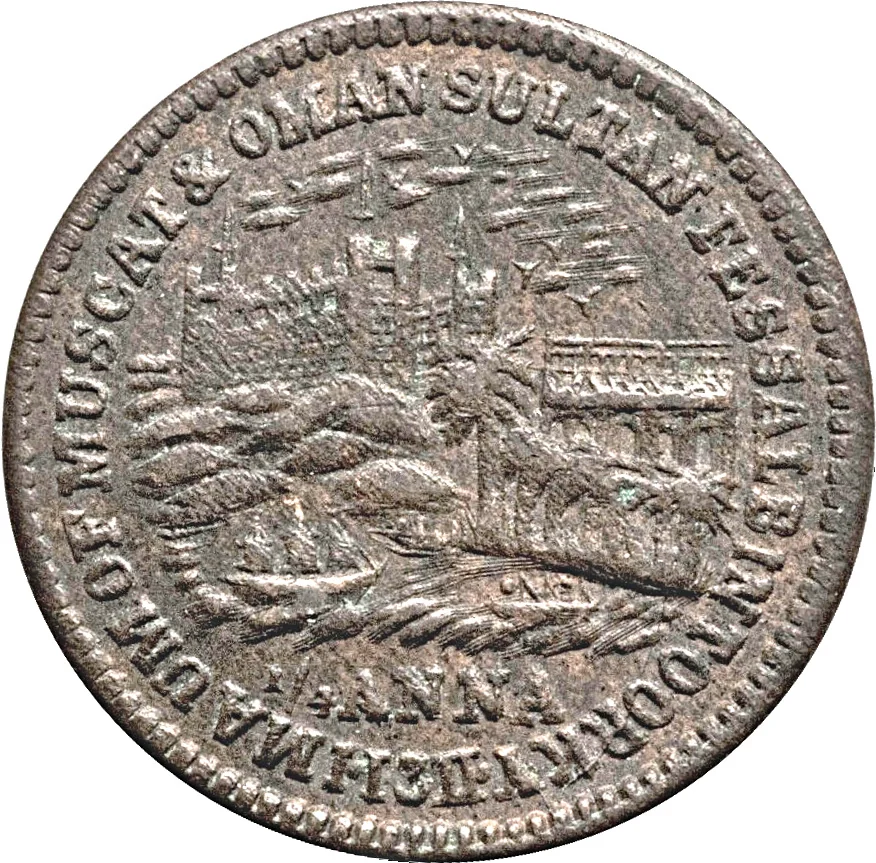
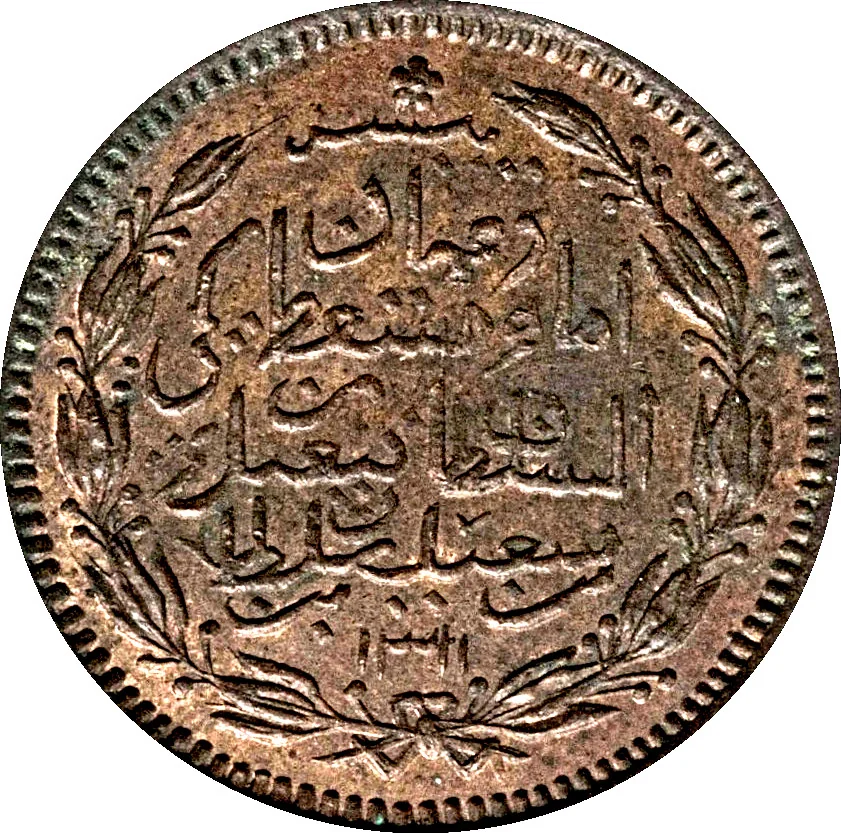
¼ anna – Muscat and Oman
Add to wishlist
Oman
Context
Years: 1893–1894
Islamic (Hijri) Year:: 1311
Country: Oman
Issuer: Muscat and Oman
Ruler: Faisal bin Turki
Currency:
(1891—1959)
Demonetized: Yes
Material
References
KM: #
Numista: #50119
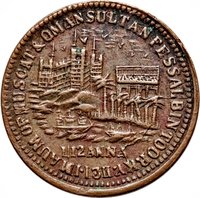
Obverse
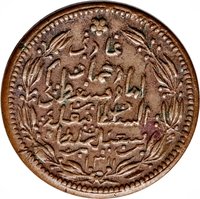
Reverse
Edge
Plain
Categories
| Transportation> Watercraft |
| Plant> Tree |
| Symbol> Wreath |
| Building> Castle or fortification |
| Building> Palace |
| Geography> Sea |
Mints
| Name | Mark |
|---|---|
| Muscat | — |
Mintings
| Year | Mint Mark | Mintage | Quality | Collection |
|---|---|---|---|---|
| 1893 | — | — | ||
| 1894 | — | — |
Historical background
In 1893, the currency situation in Muscat and Oman was complex and fragmented, reflecting the Sultanate's position as a major trading hub in the Indian Ocean. The primary currency in circulation was the Maria Theresa thaler (MT$), a silver Austrian coin minted with a fixed 1780 date, which was valued globally for its consistent silver content. Alongside these, a multitude of other silver coins circulated, including British Indian rupees, French 5-franc pieces, and various regional Arab and Persian coins. This created a chaotic monetary environment where exchange rates fluctuated based on weight, fineness, and local demand, complicating both daily trade and government revenue collection.
The situation was further strained by the declining value of silver relative to gold on the world market, a global phenomenon of the late 19th century. As the Indian rupee (also silver) depreciated, it affected the relative value of the thaler, causing economic instability. Sultan Faisal bin Turki, whose authority was largely confined to the coastal area around Muscat, had limited capacity to impose a unified currency. Internal trade, particularly with the interior under the de facto control of the Imam of Oman, often relied on simpler barter or payment in kind, while external trade with British India, Zanzibar, and the Gulf required the more widely accepted silver thalers and rupees.
This monetary disarray underscored Muscat's economic vulnerability and its dependence on foreign, particularly British, financial systems. The British Political Agent in Muscat often acted as a de facto banker, and transactions with the British Indian government were increasingly conducted in rupees. The lack of a sovereign currency not only hindered economic development but also symbolized the Sultanate's weakened political state, caught between the pressures of global economic forces and its own internal divisions. The currency chaos of 1893 thus set the stage for the eventual adoption of the Indian rupee as the official currency in Muscat in the early 20th century, formally tying the Sultanate's economy to the British Indian monetary sphere.
The situation was further strained by the declining value of silver relative to gold on the world market, a global phenomenon of the late 19th century. As the Indian rupee (also silver) depreciated, it affected the relative value of the thaler, causing economic instability. Sultan Faisal bin Turki, whose authority was largely confined to the coastal area around Muscat, had limited capacity to impose a unified currency. Internal trade, particularly with the interior under the de facto control of the Imam of Oman, often relied on simpler barter or payment in kind, while external trade with British India, Zanzibar, and the Gulf required the more widely accepted silver thalers and rupees.
This monetary disarray underscored Muscat's economic vulnerability and its dependence on foreign, particularly British, financial systems. The British Political Agent in Muscat often acted as a de facto banker, and transactions with the British Indian government were increasingly conducted in rupees. The lack of a sovereign currency not only hindered economic development but also symbolized the Sultanate's weakened political state, caught between the pressures of global economic forces and its own internal divisions. The currency chaos of 1893 thus set the stage for the eventual adoption of the Indian rupee as the official currency in Muscat in the early 20th century, formally tying the Sultanate's economy to the British Indian monetary sphere.
💎 Very Rare