

1 likuta – Republic of the Congo
Add to wishlist
Context
Years: 1966–1969
Year:: 1967
Issuer: Republic of the Congo
Issuing organization: National Bank of the Congo
Period:
(1964—1971)
Currency:
(1967—1993)
Demonetized: Yes
Total mintage: 196,800,025
Material
References
KM: #
Numista: #4389
Value
Exchange value: 0.01 ZRZ
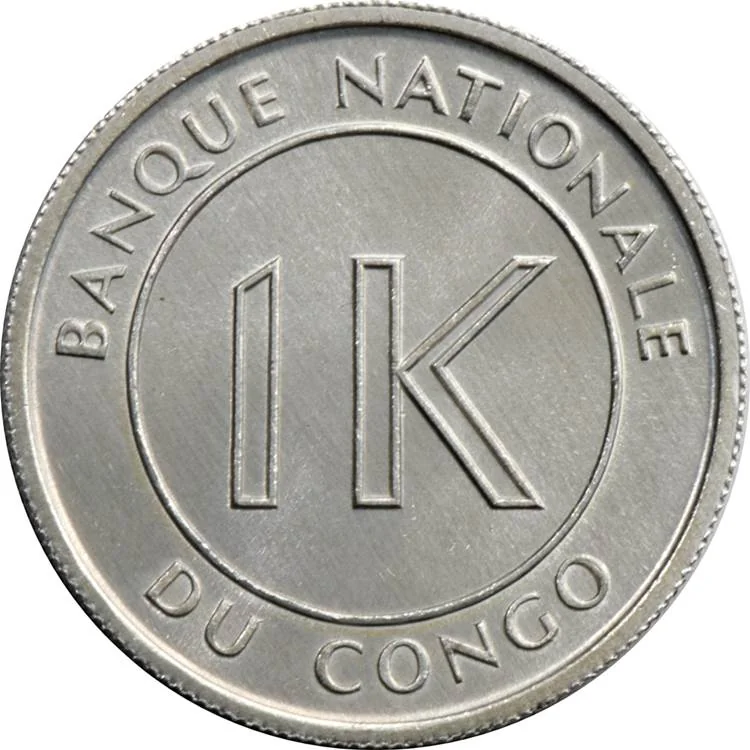
Obverse
Description:
Circle denomination.
Inscription:
BANQUE NATIONALE
DU CONGO
1K
DU CONGO
1K
Translation:
National Bank
of the Congo
1K
of the Congo
1K
Script: Latin
Language: French
Engraver: Michael Rizzello
Reverse
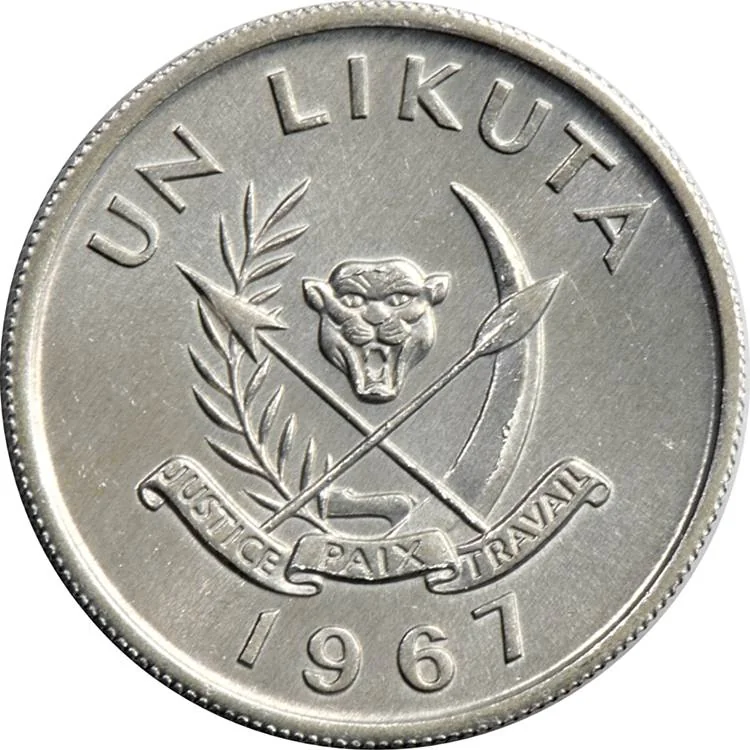
Description:
Coat of arms of the Democratic Republic of the Congo with its motto.
Inscription:
UN LIKUTA
JUSTICE PAIX TRAVAIL
1967
JUSTICE PAIX TRAVAIL
1967
Translation:
One Likuta
Justice Peace Work
1967
Justice Peace Work
1967
Script: Latin
Engraver: Michael Rizzello
Edge
Reeded
Categories
| Symbols> Coat of Arms |
Mints
| Name | Mark |
|---|---|
| Kings Norton Metal Company | — |
Mintings
| Year | Mint Mark | Mintage | Quality | Collection |
|---|---|---|---|---|
| 1967 | 1966-1969 | 196,800,000 | ||
| 1967 | — | 25 |
Historical background
In 1966, the Republic of the Congo (often called Congo-Brazzaville to distinguish it from its larger neighbor, the Democratic Republic of the Congo) was navigating its early post-independence economic landscape within the framework of the Communauté Financière Africaine (CFA). The CFA franc, created in 1945, was the shared currency for former French colonies in West and Central Africa. Congo-Brazzaville was part of the Central African branch, using the CFA franc issued by the Banque Centrale des États de l'Afrique Équatoriale (BCEAO). This arrangement provided monetary stability through a fixed peg to the French franc and guaranteed convertibility, backed by the French Treasury. For a young nation, this meant imported price stability and access to external finance, but it also meant ceding direct control over its monetary policy to a supranational authority heavily influenced by France.
Politically and economically, the year 1966 fell within the transformative and turbulent first decade of independence. The country was under the left-leaning, Marxist-oriented leadership of President Alphonse Massamba-Débat, who had come to power in 1963. His government was pursuing a path of "scientific socialism," which included nationalizing key sectors and establishing state-run enterprises. However, this ideological shift did not extend to leaving the CFA franc zone. The currency's stability was likely seen as a crucial anchor, especially as the state-driven economic model and reliance on volatile commodity exports (primarily timber and some oil, though the oil boom was still a few years away) created fiscal pressures.
Therefore, the currency situation in 1966 was characterized by a notable duality: a radicalizing political economy at the domestic level, seeking to break from colonial structures, coexisted with a conservative and externally anchored monetary system. The CFA franc provided a technical buffer against hyperinflation and currency crisis, but it also symbolized continued economic integration with the former colonial power. This setup deferred immediate monetary challenges but would later fuel debates about economic sovereignty as the country's ideological direction and its monetary framework existed in a state of inherent tension.
Politically and economically, the year 1966 fell within the transformative and turbulent first decade of independence. The country was under the left-leaning, Marxist-oriented leadership of President Alphonse Massamba-Débat, who had come to power in 1963. His government was pursuing a path of "scientific socialism," which included nationalizing key sectors and establishing state-run enterprises. However, this ideological shift did not extend to leaving the CFA franc zone. The currency's stability was likely seen as a crucial anchor, especially as the state-driven economic model and reliance on volatile commodity exports (primarily timber and some oil, though the oil boom was still a few years away) created fiscal pressures.
Therefore, the currency situation in 1966 was characterized by a notable duality: a radicalizing political economy at the domestic level, seeking to break from colonial structures, coexisted with a conservative and externally anchored monetary system. The CFA franc provided a technical buffer against hyperinflation and currency crisis, but it also symbolized continued economic integration with the former colonial power. This setup deferred immediate monetary challenges but would later fuel debates about economic sovereignty as the country's ideological direction and its monetary framework existed in a state of inherent tension.
🌱 Very Common