

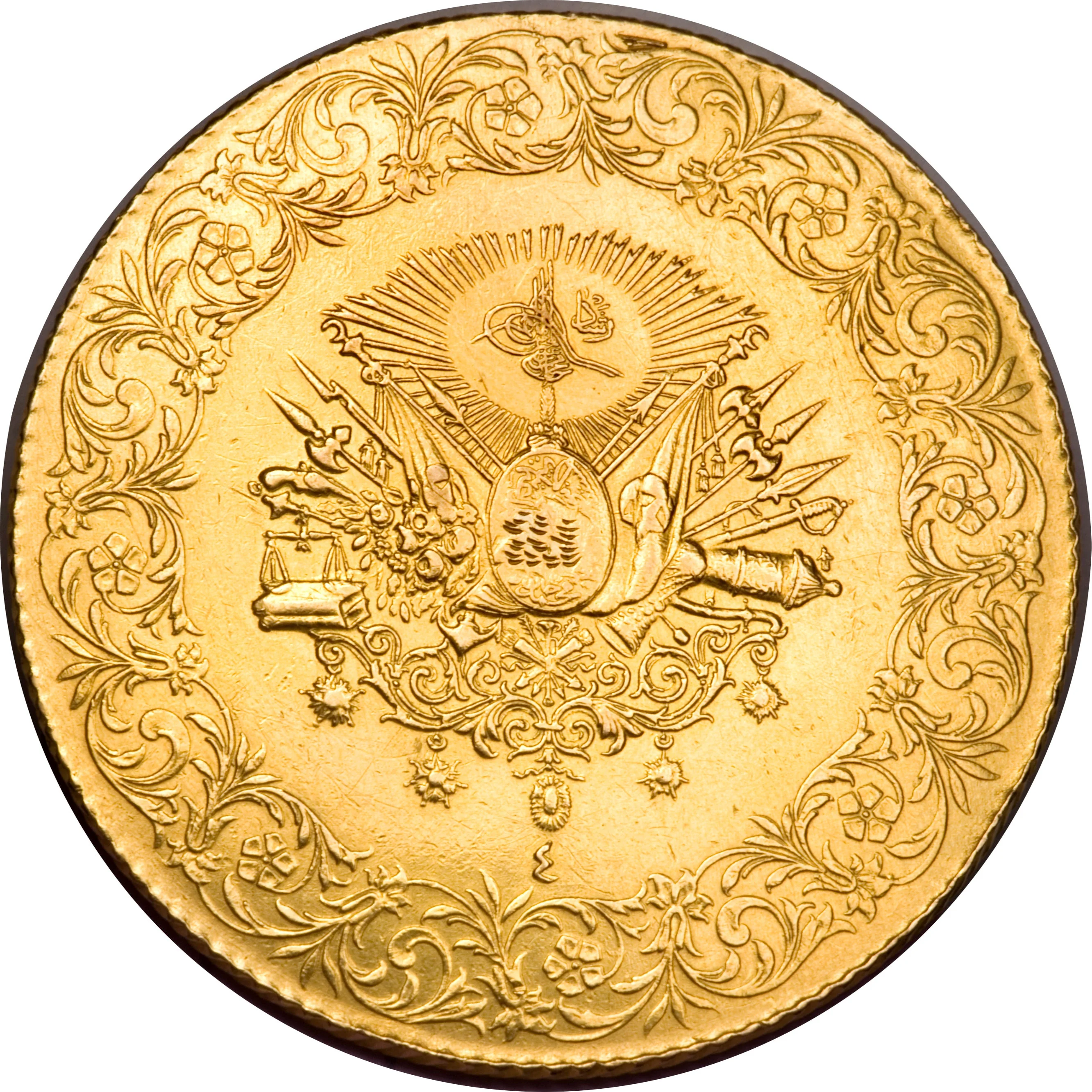
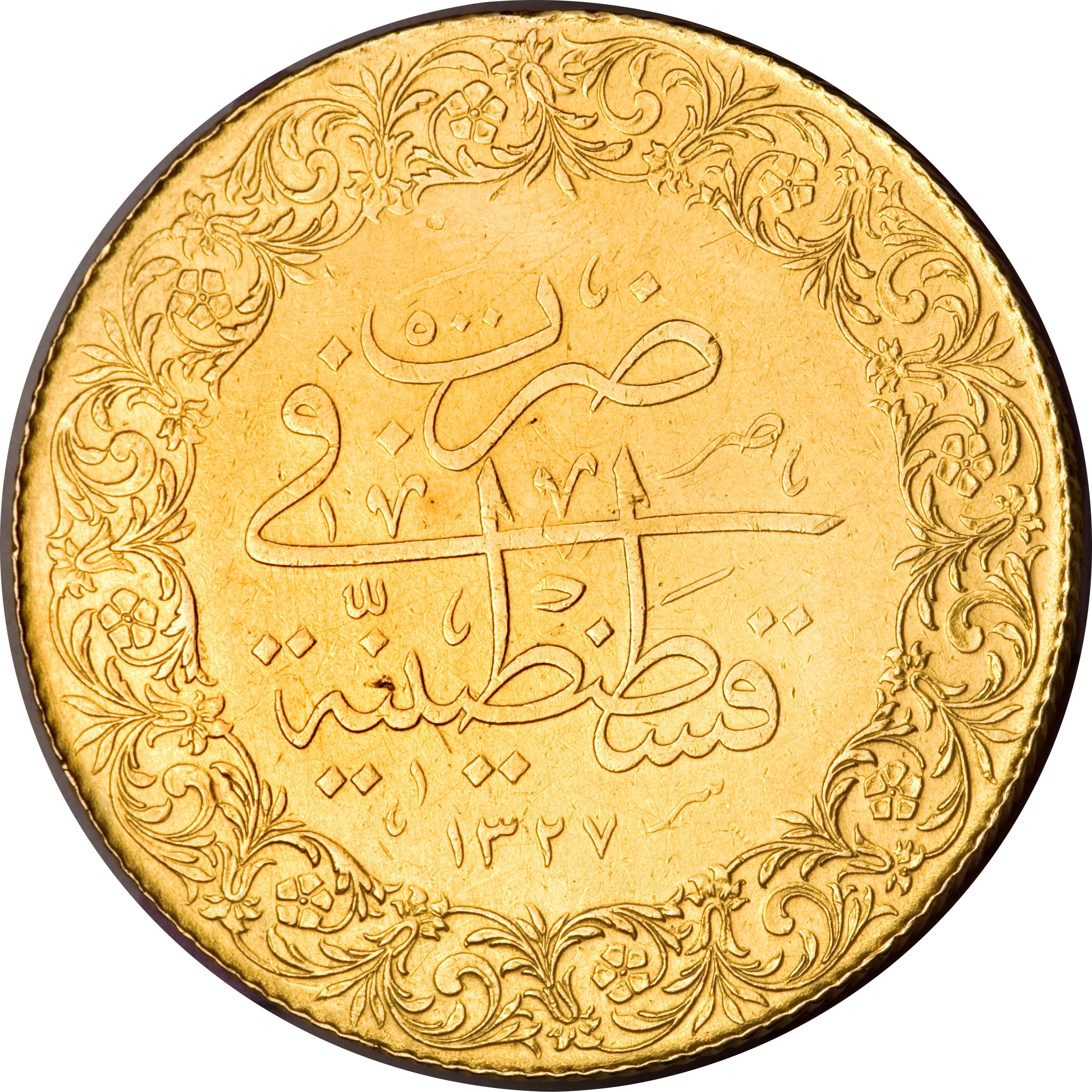
500 Kurush – Ottoman Empire
Turkey
Context
Years: 1910–1914
Islamic (Hijri) Year: 1327
Country: Turkey 
Issuer: Ottoman Empire
Ruler: Mehmed V Reşâd
Currency:
(1844—1923)
Demonetized: Yes
Total mintage: 17,782
Material
References
KM: #Click to copy to clipboard765
Numista: #34990
Value
Bullion value: $5348.24
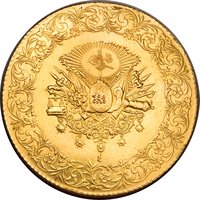
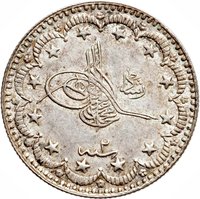
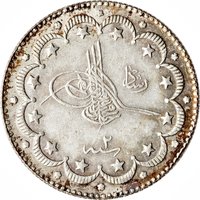
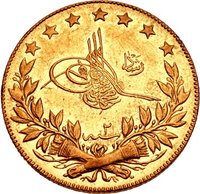
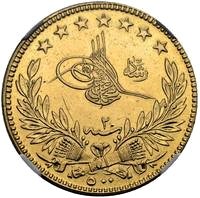
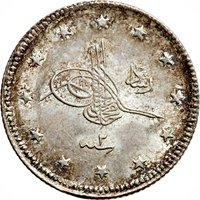
Obverse
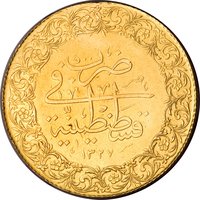
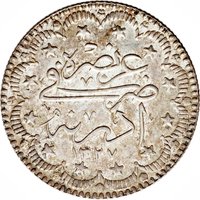
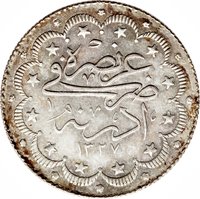
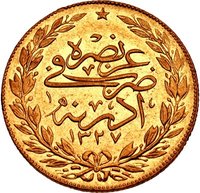
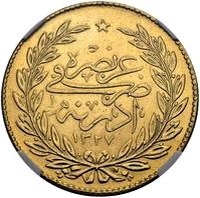
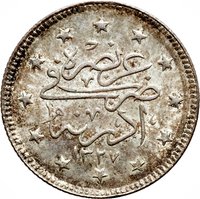
Reverse
Edge
Mintings
| Year | Mint Mark | Mintage | Quality | Collection |
|---|---|---|---|---|
| 1910 | — | 1,718 | ||
| 1911 | — | 4,631 | ||
| 1912 | — | 3,887 | ||
| 1913 | — | 5,145 | ||
| 1914 | — | 2,401 |
Historical background
By 1910, the Ottoman Empire’s currency system was a complex and fragile reflection of its broader financial and geopolitical decline. The empire operated on a bimetallic standard in theory, but in practice its finances were dominated by the Ottoman Lira (also known as the Livre or Mecidiye), which was backed by substantial foreign debt rather than robust domestic reserves. The empire had declared bankruptcy in 1875, leading to the establishment of the Ottoman Public Debt Administration (OPDA) in 1881, a consortium of European creditors that controlled key state revenues. This foreign financial control severely limited the Porte's monetary sovereignty, as the OPDA ensured debt repayments were prioritized, leaving little room for independent economic policy.
The currency landscape was further complicated by the widespread circulation of foreign gold coins, particularly British sovereigns and French francs, which were often preferred over Ottoman coinage for major transactions due to their stable international value. Alongside this, a plethora of paper money (kaime) issued by the state treasury since the Crimean War suffered from frequent depreciation and lack of public trust. Consequently, a dual system existed: gold-based transactions for international trade and state finances, and a unstable silver and paper currency for everyday domestic use, leading to chronic inflation and exchange rate instability.
This monetary fragmentation mirrored the empire's political fragmentation. Attempts at reform, such as the establishment of the Imperial Ottoman Bank (a Franco-British entity that acted as a central bank) in 1863, did not create a unified national currency. By 1910, the system was under increasing strain from the costs of military mobilization, ongoing deficits, and the looming threat of further wars in the Balkans. The currency situation thus stood as a critical weakness, symbolizing the empire's semi-colonial economic status and its precarious path toward the financial collapses that would accompany the Balkan Wars and World War I.
The currency landscape was further complicated by the widespread circulation of foreign gold coins, particularly British sovereigns and French francs, which were often preferred over Ottoman coinage for major transactions due to their stable international value. Alongside this, a plethora of paper money (kaime) issued by the state treasury since the Crimean War suffered from frequent depreciation and lack of public trust. Consequently, a dual system existed: gold-based transactions for international trade and state finances, and a unstable silver and paper currency for everyday domestic use, leading to chronic inflation and exchange rate instability.
This monetary fragmentation mirrored the empire's political fragmentation. Attempts at reform, such as the establishment of the Imperial Ottoman Bank (a Franco-British entity that acted as a central bank) in 1863, did not create a unified national currency. By 1910, the system was under increasing strain from the costs of military mobilization, ongoing deficits, and the looming threat of further wars in the Balkans. The currency situation thus stood as a critical weakness, symbolizing the empire's semi-colonial economic status and its precarious path toward the financial collapses that would accompany the Balkan Wars and World War I.
✨ Legendary