

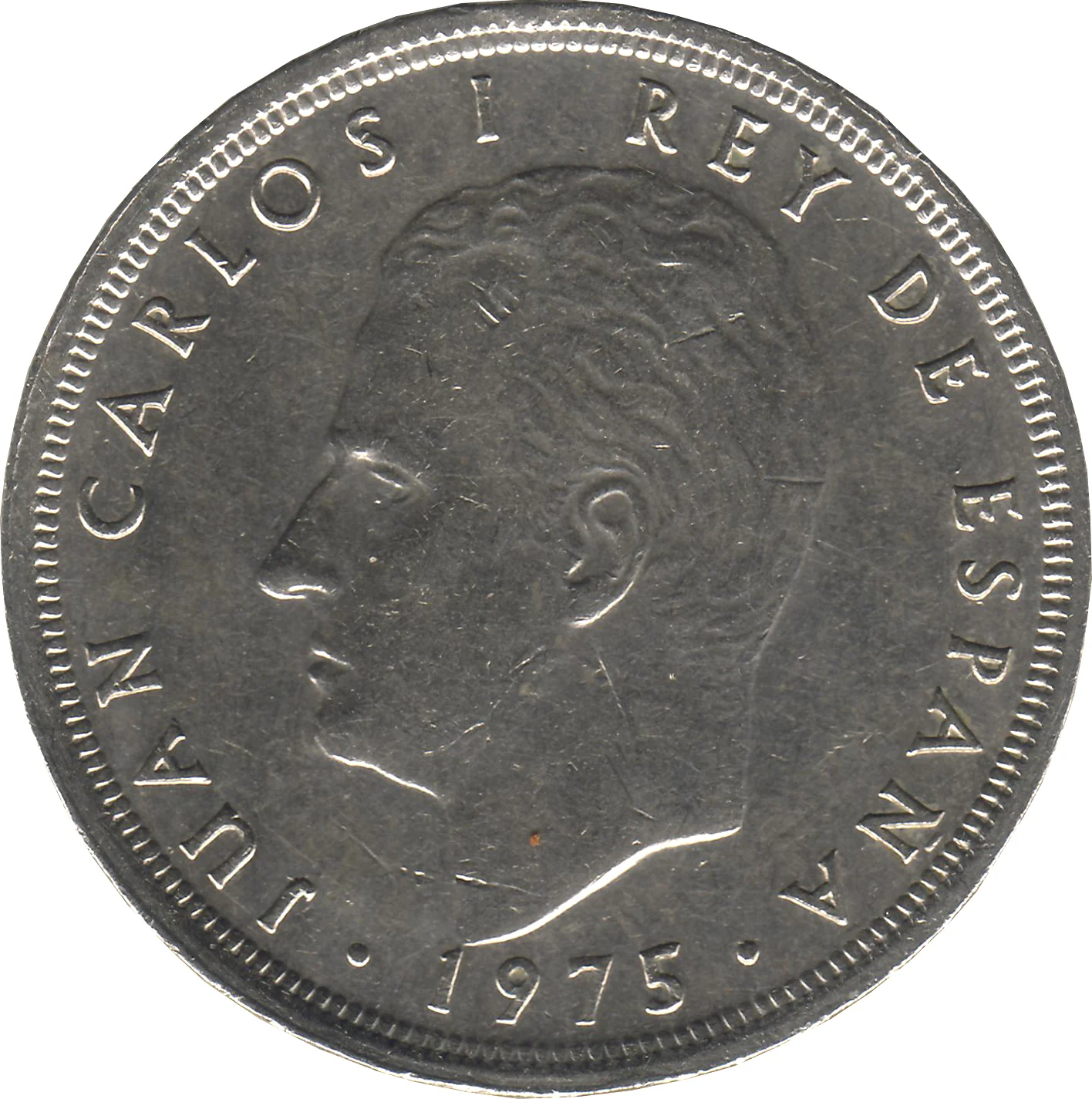
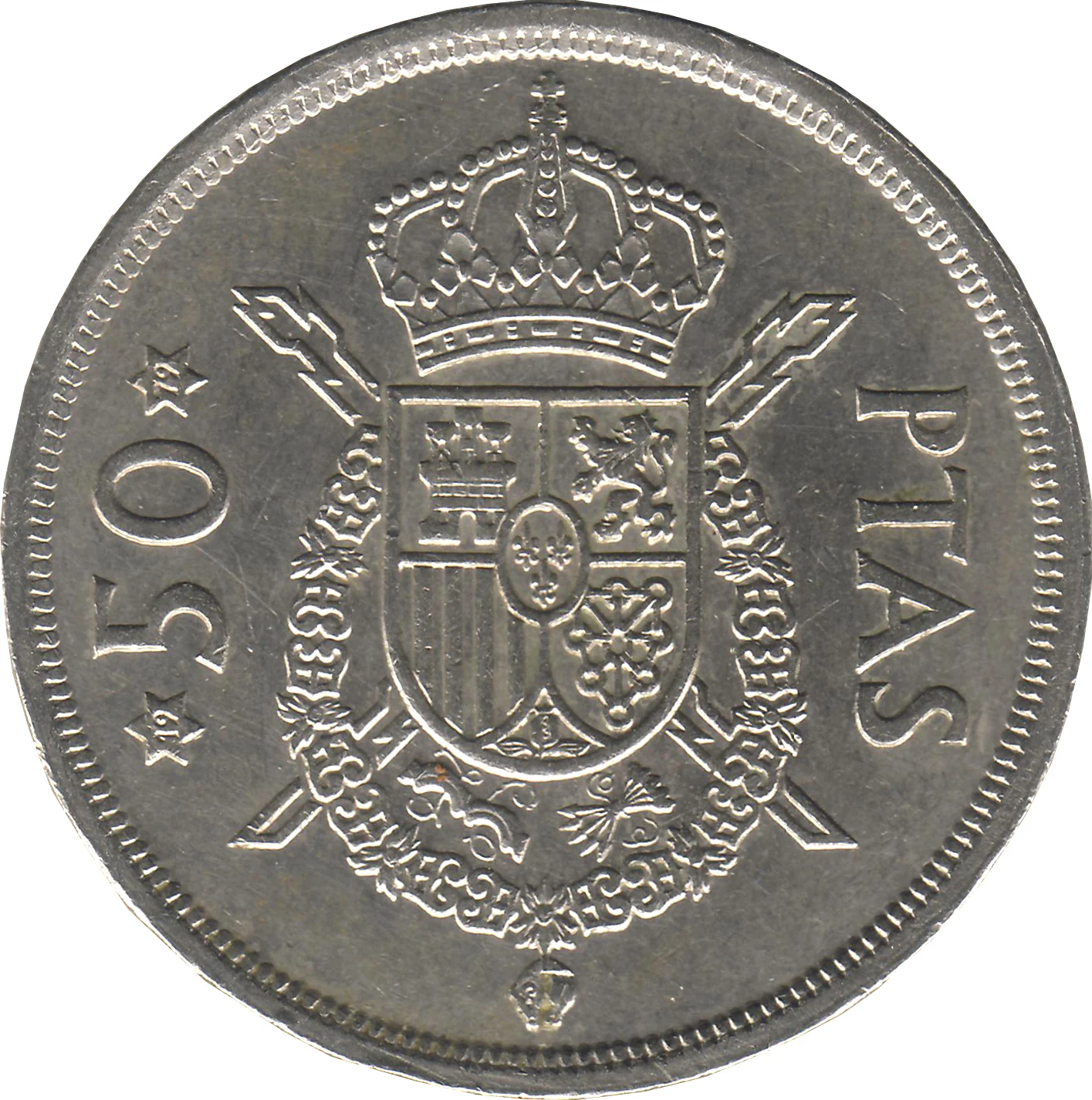
50 pesetas – Spain
Add to wishlist
Spain
Context
Years: 1975–1980
Year:: 1975
Issuer: Spain
Ruler: Juan Carlos I
Currency:
(1868—2001)
Demonetization: 1 January 1997
Total mintage: 89,705,000
Material
References
KM: #
Numista: #3200
Value
Exchange value: 50 ESP
Inflation-adjusted value: 856.17 ESP
Obverse
Description:
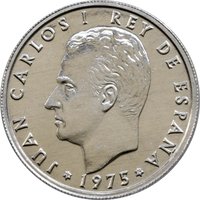
King Juan Carlos I facing left.
Inscription:
JUAN CARLOS I REY DE ESPAÑA
· 1975 ·
· 1975 ·
Translation:
JUAN CARLOS I KING OF SPAIN
· 1975 ·
· 1975 ·
Script: Latin
Language: Spanish
Engraver: Manuel Marín Jimeno
Reverse
Description:
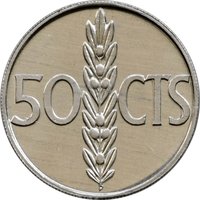
Juan Carlos I's personal coat of arms.
Inscription:
50 PTAS
19 78
19 78
Script: Latin
Engraver: Francisco Martínez Tornero
Edge
Categories
| Symbols> Coat of Arms |
Mints
| Name | Mark |
|---|---|
| Royal Mint of Madrid | — |
Mintings
| Year | Mint Mark | Mintage | Quality | Collection |
|---|---|---|---|---|
| 1975 | — | — | ||
| 1976 | — | 400,000 | Proof | |
| 1976 | — | 4,400,000 | ||
| 1978 | — | 17,555,000 | ||
| 1979 | — | 350,000 | Proof | |
| 1979 | — | 33,000,000 | ||
| 1980 | — | 34,000,000 |
Historical background
In 1975, Spain's currency situation was a reflection of the country's profound political and economic transition. The peseta, the national currency since 1868, was under the managed control of the Francoist regime, which was in its final days as General Francisco Franco died in November of that year. The economy was still grappling with the aftereffects of the 1973 oil crisis, which had triggered stagflation—a combination of high inflation (running at nearly 17% in 1975) and stagnant economic growth. This inflationary pressure severely eroded the peseta's purchasing power and placed it under strain within the European "snake in the tunnel" exchange rate mechanism, which Spain had joined in an effort to foster stability and European integration.
The currency regime was characterized by heavy state intervention. The Bank of Spain, not yet independent, maintained a fixed but adjustable exchange rate system with periodic devaluations used as a tool to address trade imbalances. These devaluations, however, were often delayed for political reasons, leading to periods of overvaluation followed by sharp corrections that disrupted business planning. Furthermore, Spain maintained strict capital controls, limiting the flow of money in and out of the country to defend the peseta's value and the nation's foreign reserves, which created a gap between the official exchange rate and a less favorable black-market rate.
Ultimately, the currency scenario of 1975 was one of vulnerability and controlled instability, emblematic of an isolated economy beginning to open up. The imminent political shift from dictatorship to democracy would set the stage for critical economic reforms. In the coming years, these would include a major devaluation in 1977, gradual liberalization of capital controls, and a concerted push toward modern economic policies, all paving the way for Spain's eventual entry into the European Economic Community and the adoption of the euro decades later.
The currency regime was characterized by heavy state intervention. The Bank of Spain, not yet independent, maintained a fixed but adjustable exchange rate system with periodic devaluations used as a tool to address trade imbalances. These devaluations, however, were often delayed for political reasons, leading to periods of overvaluation followed by sharp corrections that disrupted business planning. Furthermore, Spain maintained strict capital controls, limiting the flow of money in and out of the country to defend the peseta's value and the nation's foreign reserves, which created a gap between the official exchange rate and a less favorable black-market rate.
Ultimately, the currency scenario of 1975 was one of vulnerability and controlled instability, emblematic of an isolated economy beginning to open up. The imminent political shift from dictatorship to democracy would set the stage for critical economic reforms. In the coming years, these would include a major devaluation in 1977, gradual liberalization of capital controls, and a concerted push toward modern economic policies, all paving the way for Spain's eventual entry into the European Economic Community and the adoption of the euro decades later.
🌱 Very Common