

5 Đồng – South Vietnam
Vietnam
Context
Years: 1966–1970
Year: 1966
Country: Vietnam 
Issuer: South Vietnam
Issuing organization: National Bank of Vietnam
Currency:
(1953—1975)
Demonetized: Yes
Total mintage: 100,000,000
Material
References
KM: #Click to copy to clipboard9
Numista: #3180
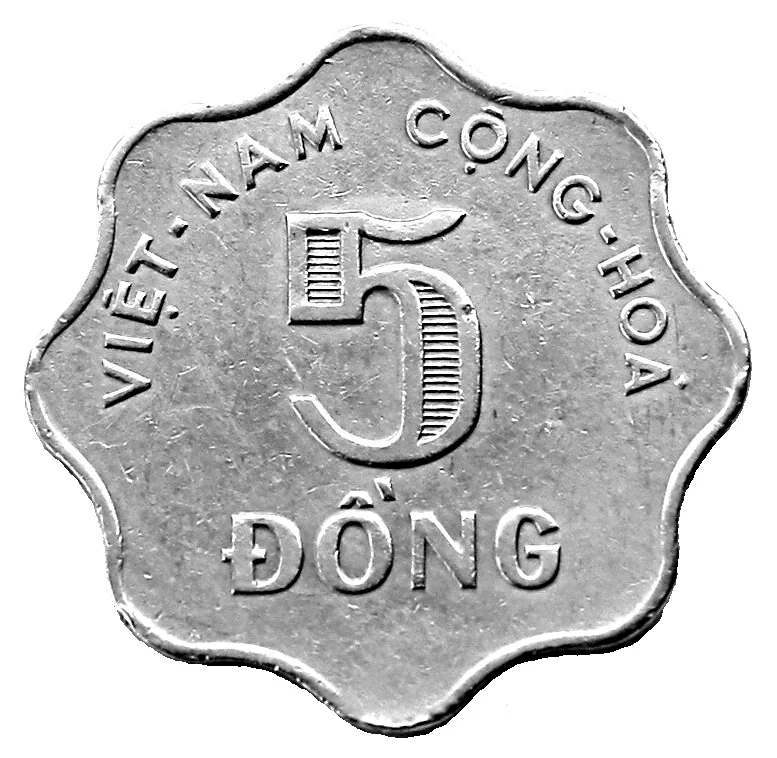
Obverse
Description:
Value legend
Inscription:
VIỆT-NAM CỘNG-HOÀ
5
ĐỒNG
5
ĐỒNG
Translation:
VIETNAM REPUBLIC
5
DONG
5
DONG
Script: Latin
Language: Vietnamese
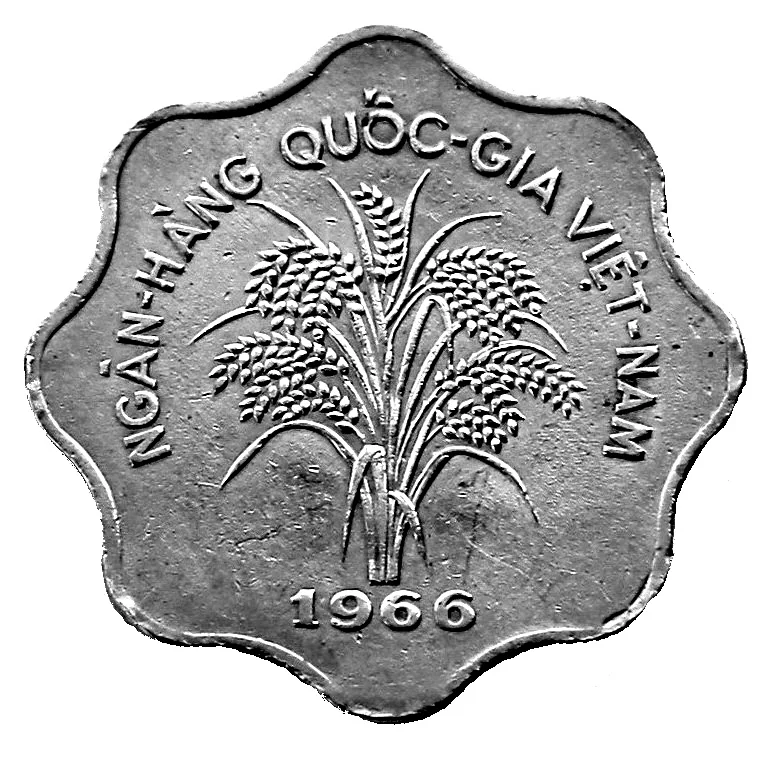
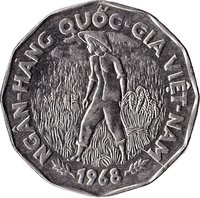
Reverse
Description:
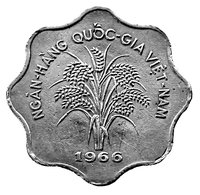
Rice plant
Inscription:
NGÂN-HÀNG QUỐC-GIA VIỆT-NAM
1966
1966
Translation:
NATIONAL BANK OF VIETNAM
1966
1966
Script: Latin
Language: Vietnamese
Edge
Plain
Mints
| Name | Mark |
|---|---|
| Royal Mint (Tower Hill) | — |
Mintings
| Year | Mint Mark | Mintage | Quality | Collection |
|---|---|---|---|---|
| 1966 | — | — | ||
| 1966 | 1966-1970 | 100,000,000 |
Historical background
By 1966, South Vietnam's currency, the piastre, was under severe strain due to the escalating Vietnam War. The South Vietnamese government, heavily dependent on massive U.S. economic and military aid, was financing a vast portion of its budget through the simple printing of money. This rapid expansion of the money supply, not matched by economic growth, fueled rampant inflation. The situation was exacerbated by a thriving black market, where U.S. dollars and piastres traded at rates far exceeding the official fixed exchange rate, undermining confidence in the currency and distorting the entire economy.
The United States, recognizing that economic instability threatened the war effort, implemented a joint financial stabilization program with the Saigon government. A key component was the establishment of a "Commercial Import Program," which injected U.S. dollars to finance essential imports of consumer goods. The intent was to increase the supply of goods, soak up excess piastres, and stabilize prices. Crucially, the U.S. also insisted on devaluing the piastre and unifying multiple exchange rates to curb the black market and make Vietnamese exports more competitive.
Despite these efforts, the underlying pressures were overwhelming. Wartime destruction, displacement of refugees, and the diversion of resources to the military crippled domestic production. Corruption and inefficiency within the South Vietnamese state apparatus further leaked value from the system. Consequently, inflation persisted throughout 1966 and beyond, eroding the living standards of urban civilians and soldiers alike. The currency crisis became a symbol of the broader fragility of the South Vietnamese state, which struggled to maintain economic legitimacy even as it fought for military survival.
The United States, recognizing that economic instability threatened the war effort, implemented a joint financial stabilization program with the Saigon government. A key component was the establishment of a "Commercial Import Program," which injected U.S. dollars to finance essential imports of consumer goods. The intent was to increase the supply of goods, soak up excess piastres, and stabilize prices. Crucially, the U.S. also insisted on devaluing the piastre and unifying multiple exchange rates to curb the black market and make Vietnamese exports more competitive.
Despite these efforts, the underlying pressures were overwhelming. Wartime destruction, displacement of refugees, and the diversion of resources to the military crippled domestic production. Corruption and inefficiency within the South Vietnamese state apparatus further leaked value from the system. Consequently, inflation persisted throughout 1966 and beyond, eroding the living standards of urban civilians and soldiers alike. The currency crisis became a symbol of the broader fragility of the South Vietnamese state, which struggled to maintain economic legitimacy even as it fought for military survival.
🌱 Very Common