

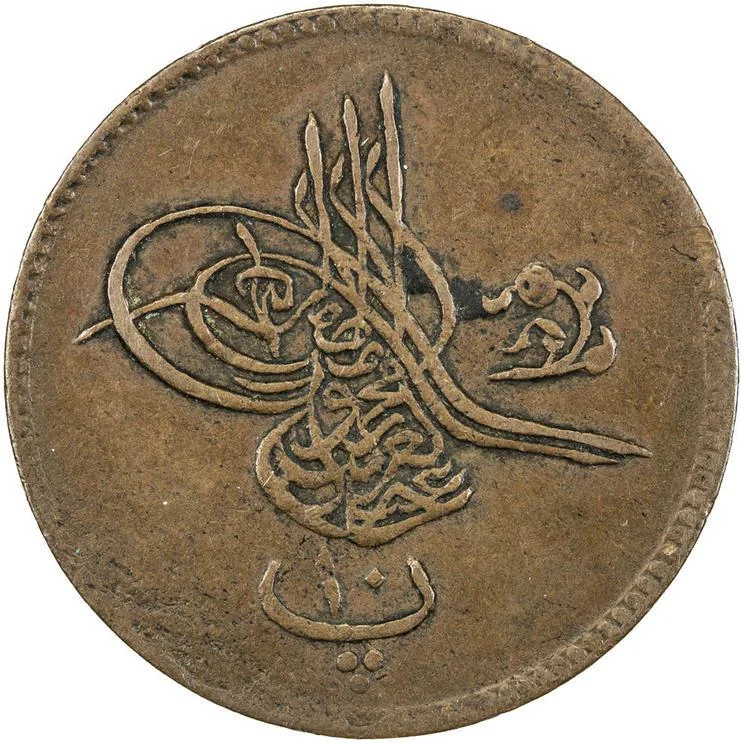
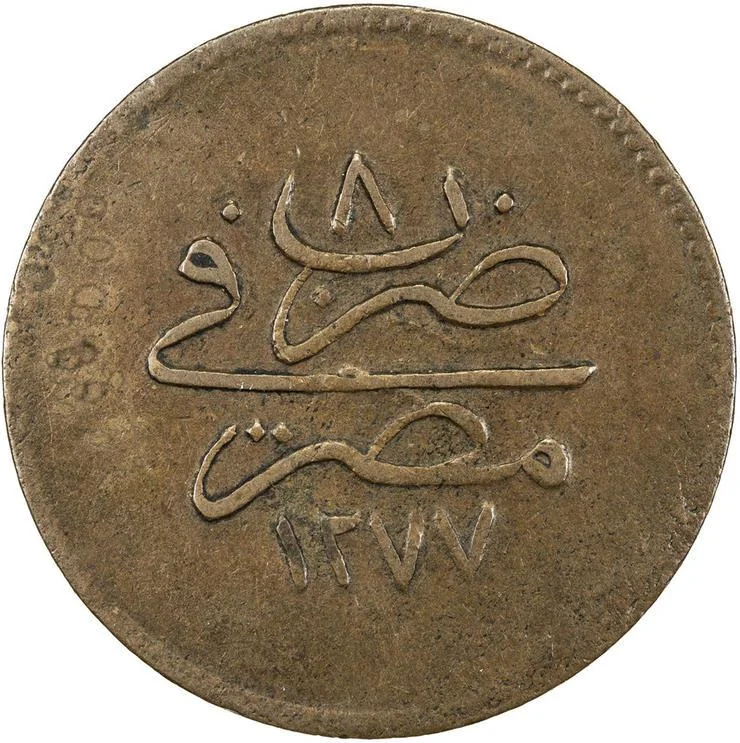
10 para – Egypt
Add to wishlist
Egypt
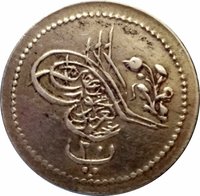
Obverse
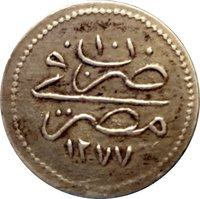
Reverse
Edge
Mintings
| Year | Mint Mark | Mintage | Quality | Collection |
|---|---|---|---|---|
| 1867 | — | 204,000 | ||
| 1868 | — | — | ||
| 1870 | — | 200 |
Historical background
In 1867, Egypt operated under a complex and strained monetary system, a legacy of the ambitious modernization projects of Khedive Ismail. The official currency was the Egyptian pound (guinea), which was pegged to and equivalent to the British gold sovereign. However, the state's finances were under severe pressure due to extravagant spending on infrastructure, the Suez Canal, and the cotton boom's collapse following the end of the American Civil War. This led to a chronic shortage of specie (gold and silver coin), forcing the government to rely heavily on printing paper money and issuing copper coins to facilitate everyday transactions.
The currency landscape was a confusing mosaic for the average Egyptian. Alongside the gold pound, various foreign silver coins—particularly Austrian thalers (Maria Theresa thalers), Ottoman piastres, and French francs—circulated widely at fluctuating values. The government's own paper currency, the qanun, was not fully trusted by the public and often traded at a significant discount to its face value, especially outside major cities. This created a multi-tiered system where gold was for international trade and state finance, silver for larger domestic transactions, and copper fils and devalued paper for daily wages and market purchases.
This monetary instability was a clear symptom of Egypt's deepening debt crisis. By 1867, the Khedive was already seeking his first major foreign loan, marking the beginning of a dependence on European creditors that would culminate in state bankruptcy a decade later. The currency confusion hindered internal trade, eroded public confidence, and provided European powers, particularly Britain and France, with a financial pretext for increasing their oversight, which would eventually lead to the establishment of the Caisse de la Dette Publique in 1876 and the British occupation in 1882.
The currency landscape was a confusing mosaic for the average Egyptian. Alongside the gold pound, various foreign silver coins—particularly Austrian thalers (Maria Theresa thalers), Ottoman piastres, and French francs—circulated widely at fluctuating values. The government's own paper currency, the qanun, was not fully trusted by the public and often traded at a significant discount to its face value, especially outside major cities. This created a multi-tiered system where gold was for international trade and state finance, silver for larger domestic transactions, and copper fils and devalued paper for daily wages and market purchases.
This monetary instability was a clear symptom of Egypt's deepening debt crisis. By 1867, the Khedive was already seeking his first major foreign loan, marking the beginning of a dependence on European creditors that would culminate in state bankruptcy a decade later. The currency confusion hindered internal trade, eroded public confidence, and provided European powers, particularly Britain and France, with a financial pretext for increasing their oversight, which would eventually lead to the establishment of the Caisse de la Dette Publique in 1876 and the British occupation in 1882.
💎 Very Rare