

50 pennia – Finland
Add to wishlist
Finland
Context
Years: 1864–1871
Issuer: Finland
Ruler: Alexander II
Currency:
(1860—1963)
Demonetized: Yes
Total mintage: 2,255,000
Material
References
KM: #
Numista: #96973
Value
Bullion value: $4.65
Obverse
Description:
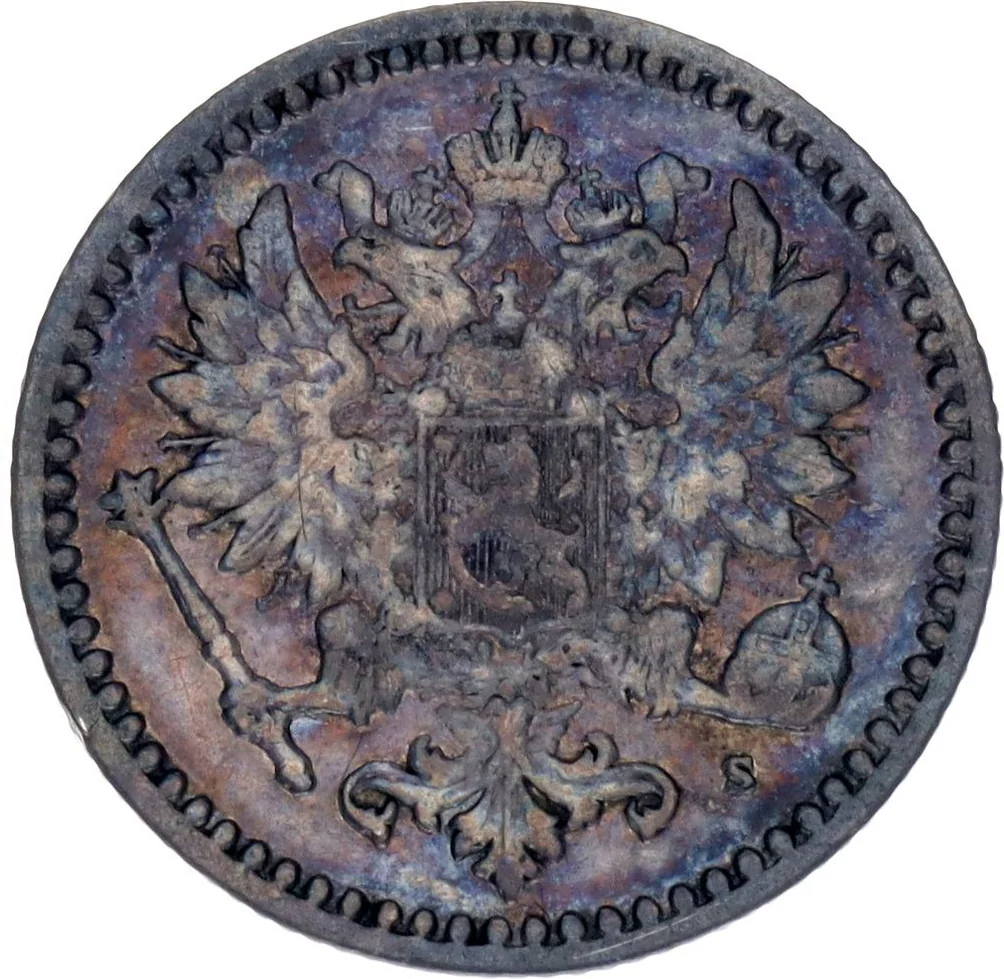
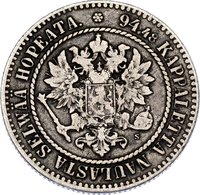
Russian imperial eagle with Finnish coat of arms, dotted border.
Inscription:
S
Script: Latin
Engraver: Aleksander Fadejev
Reverse
Description:
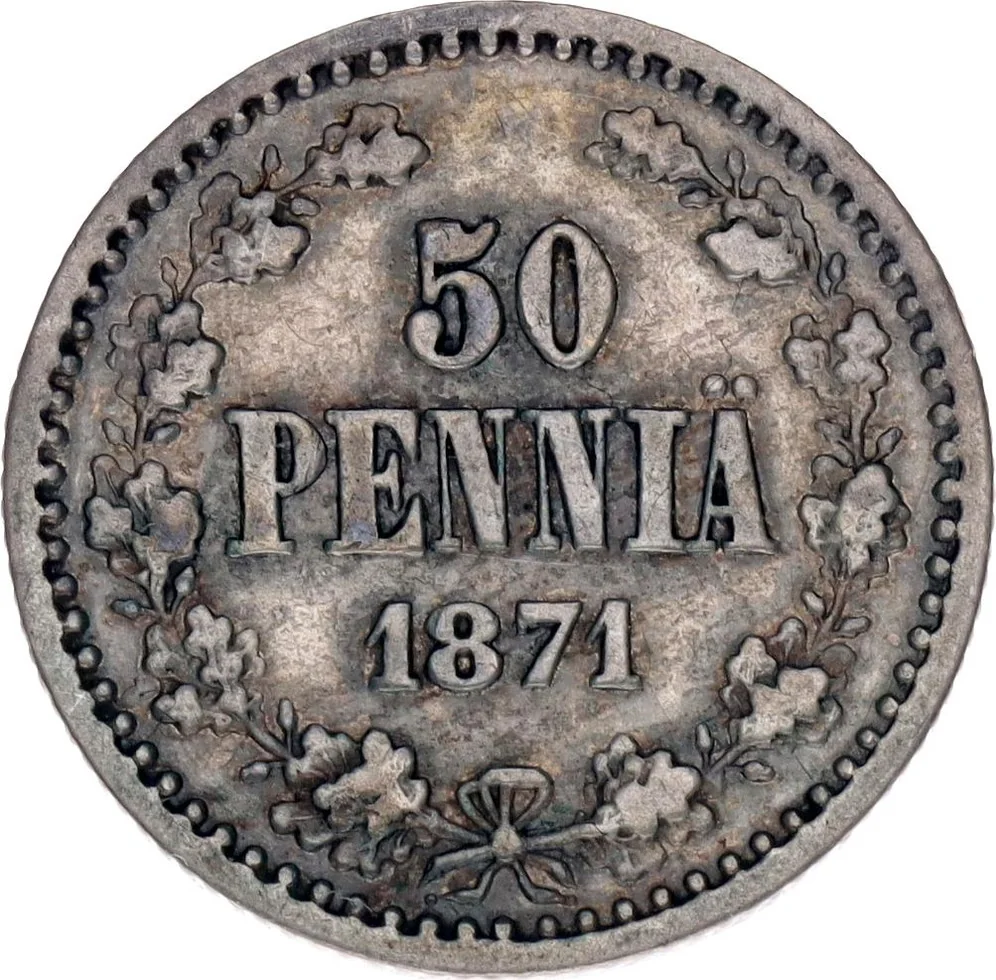
Dotted outline.
Inscription:
50
PENNIÄ
1871
PENNIÄ
1871
Translation:
50 PENNIES
1871
1871
Script: Latin
Language: Finnish
Engraver: Aleksander Fadejev
Edge
Reeded
Categories
| Symbols> Coat of Arms |
| Symbol> Double-headed eagle |
| Object> Globus cruciger |
| Animal> Bird |
| Symbol> Crown |
| Symbol> Wreath |
Mintings
| Year | Mint Mark | Mintage | Quality | Collection |
|---|---|---|---|---|
| 1864 | S | 104,000 | ||
| 1865 | S | 1,184,000 | ||
| 1866 | S | 363,000 | ||
| 1868 | S | 140,000 | ||
| 1869 | S | 144,000 | ||
| 1871 | S | 320,000 |
Historical background
In 1864, Finland, then an autonomous Grand Duchy within the Russian Empire, operated under a complex monetary system that was a legacy of its previous union with Sweden. The official currency was the Russian ruble, mandated after the Russian annexation in 1809. However, the pre-existing Swedish riksdaler specie, divided into 48 skilling, remained deeply entrenched in everyday commerce and accounting, creating a cumbersome dual-currency reality. This situation caused significant practical difficulties for trade, banking, and public administration, as constant conversions between the two systems were required.
The year 1864 itself was a pivotal turning point, marked by the preparation and anticipation of major reform. Under the leadership of Senator Johan Vilhelm Snellman, a passionate advocate for Finnish economic autonomy, the Senate had drafted a proposal for a new, distinct Finnish currency. The plan was to introduce the markka, a decimal currency divided into 100 penni, aligning with international monetary trends and simplifying calculations. This reform was not merely practical but also symbolic, intended to strengthen Finnish national identity within the imperial framework.
Consequently, the currency situation in 1864 was one of transition. While daily transactions still grappled with the old Swedish system and the imperial ruble, the legal and administrative groundwork for change was being finalized. The reform would be enacted the following year, with the Markka Act formally proclaimed in April 1865 and the new coins entering circulation in 1866. Thus, 1864 represents the final year of an outdated monetary order, with Finland on the cusp of establishing a modern, national currency that would endure for over a century.
The year 1864 itself was a pivotal turning point, marked by the preparation and anticipation of major reform. Under the leadership of Senator Johan Vilhelm Snellman, a passionate advocate for Finnish economic autonomy, the Senate had drafted a proposal for a new, distinct Finnish currency. The plan was to introduce the markka, a decimal currency divided into 100 penni, aligning with international monetary trends and simplifying calculations. This reform was not merely practical but also symbolic, intended to strengthen Finnish national identity within the imperial framework.
Consequently, the currency situation in 1864 was one of transition. While daily transactions still grappled with the old Swedish system and the imperial ruble, the legal and administrative groundwork for change was being finalized. The reform would be enacted the following year, with the Markka Act formally proclaimed in April 1865 and the new coins entering circulation in 1866. Thus, 1864 represents the final year of an outdated monetary order, with Finland on the cusp of establishing a modern, national currency that would endure for over a century.
🌟 Uncommon