

50 paisa – Nepal
Add to wishlist
Nepal
Context
Years: 1971–1982
Issuer: Nepal
Ruler: Birendra Bir Bikram Shah
Currency:
(since 1932)
Total mintage: 22,177,720
Material
References
KM: #
Numista: #9687
Value
Exchange value: 0.50 NPR
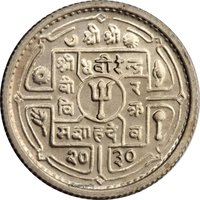
Obverse
Description:
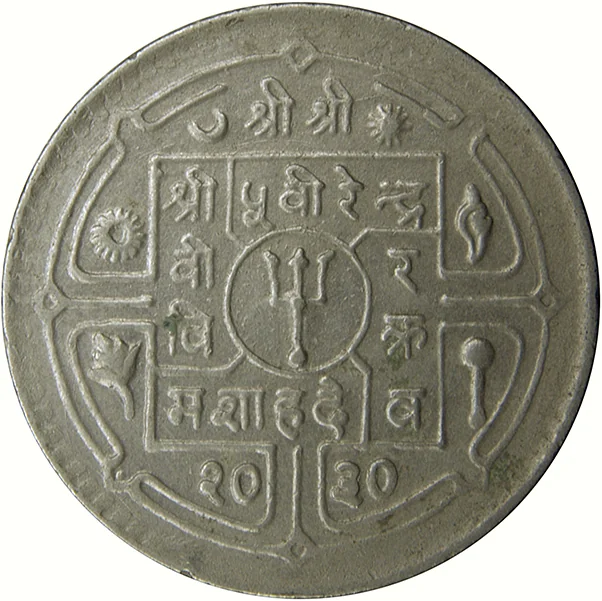
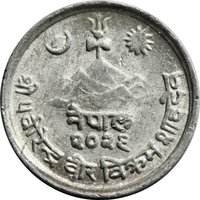
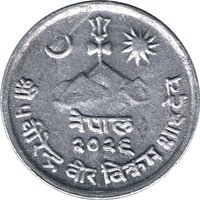
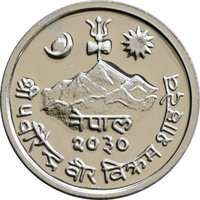
Trident centered, encircled by the King of Nepal's name with the year below.
Inscription:
श्री श्री
श्री ५ वीरेन्द्र
वी र
वि क्र
म शाहदे व
२० ३०
श्री ५ वीरेन्द्र
वी र
वि क्र
म शाहदे व
२० ३०
Translation:
Shri Shri
Shri 5 Virendra
Ve Ra
Vi Kra
Ma Shahadeva
20 30
Shri 5 Virendra
Ve Ra
Vi Kra
Ma Shahadeva
20 30
Script: Devanagari
Reverse
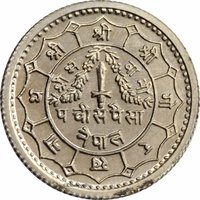
Description:
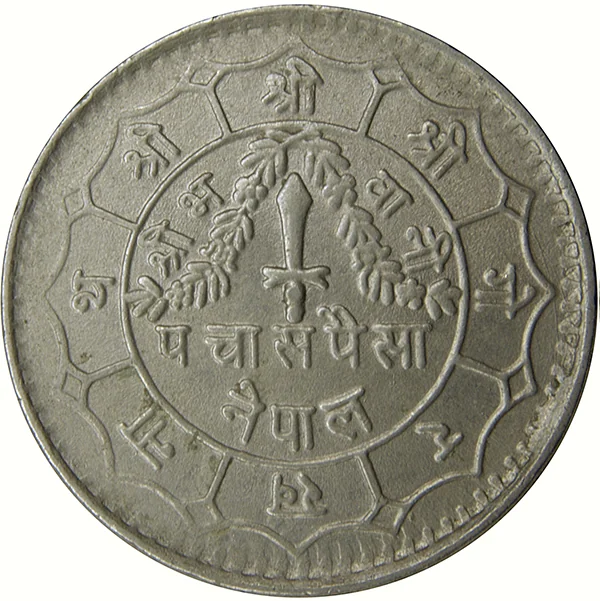
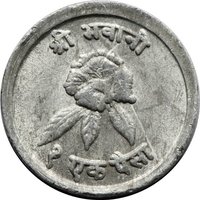
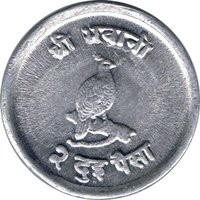
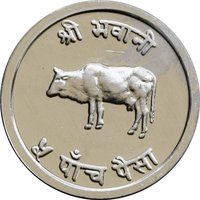
Dagger between hanging garlands.
Inscription:
श्री श्री श्री गो र ख ना थ
श्री भवानी
पचास पैसा
नेपाल
श्री भवानी
पचास पैसा
नेपाल
Translation:
Shri Shri Shri Gorakhnath
Shri Bhavani
Fifty Paisa
Nepal
Shri Bhavani
Fifty Paisa
Nepal
Script: Devanagari
Edge
Reeded
Categories
| Object> Cold weapons |
Mintings
| Year | Mint Mark | Mintage | Quality | Collection |
|---|---|---|---|---|
| 1971 | — | 5,343 | ||
| 1972 | — | 3,943 | Proof | |
| 1972 | — | 347,000 | ||
| 1973 | — | 998,000 | ||
| 1973 | — | 8,891 | Proof | |
| 1974 | — | 16,000 | ||
| 1974 | — | 10,543 | Proof | |
| 1975 | — | 227,000 | ||
| 1976 | — | 3,446,000 | ||
| 1977 | — | 6,016,000 | ||
| 1978 | — | 2,355,000 | ||
| 1979 | — | — | ||
| 1980 | — | 4,861,000 | ||
| 1981 | — | 929,000 | ||
| 1982 | — | 2,954,000 |
Historical background
In 1971, Nepal's currency situation was characterized by its continued reliance on a dual-currency system, a legacy of its historically close economic ties with India. The Nepalese rupee (NPR) circulated alongside the Indian rupee (INR) in many parts of the country, particularly in the southern Terai region bordering India. This informal but widespread use of Indian currency underscored Nepal's economic dependency and the challenges of maintaining an independent monetary policy, as economic activity and trade were heavily influenced by conditions and policies set in New Delhi.
This period fell within the era of the fixed exchange rate system established under the Bretton Woods agreement. The Nepalese rupee was pegged to the Indian rupee at a rate of 1:1.25 (1.6 NPR = 1 INR), a parity that had been set in 1960. Furthermore, the Indian rupee itself was pegged to the British pound sterling, indirectly linking Nepal to an international monetary standard. This structure provided a degree of stability for foreign trade and remittances but offered little flexibility for Nepal to respond to domestic economic pressures independently of India's monetary decisions.
The year 1971 was one of relative monetary stability but also a point of growing recognition of the need for greater financial sovereignty. This sentiment would culminate in significant reforms later in the decade, most notably the establishment of Nepal Rastra Bank as the central bank in 1973 and the subsequent demonetization of high-value Indian rupee notes in 1978 to assert control over the national money supply. Thus, the currency situation in 1971 represented the tail end of a passive monetary regime, setting the stage for a more assertive and independent national financial system in the years to follow.
This period fell within the era of the fixed exchange rate system established under the Bretton Woods agreement. The Nepalese rupee was pegged to the Indian rupee at a rate of 1:1.25 (1.6 NPR = 1 INR), a parity that had been set in 1960. Furthermore, the Indian rupee itself was pegged to the British pound sterling, indirectly linking Nepal to an international monetary standard. This structure provided a degree of stability for foreign trade and remittances but offered little flexibility for Nepal to respond to domestic economic pressures independently of India's monetary decisions.
The year 1971 was one of relative monetary stability but also a point of growing recognition of the need for greater financial sovereignty. This sentiment would culminate in significant reforms later in the decade, most notably the establishment of Nepal Rastra Bank as the central bank in 1973 and the subsequent demonetization of high-value Indian rupee notes in 1978 to assert control over the national money supply. Thus, the currency situation in 1971 represented the tail end of a passive monetary regime, setting the stage for a more assertive and independent national financial system in the years to follow.
Series: 1971 Nepal circulation coins
🌱 Common