

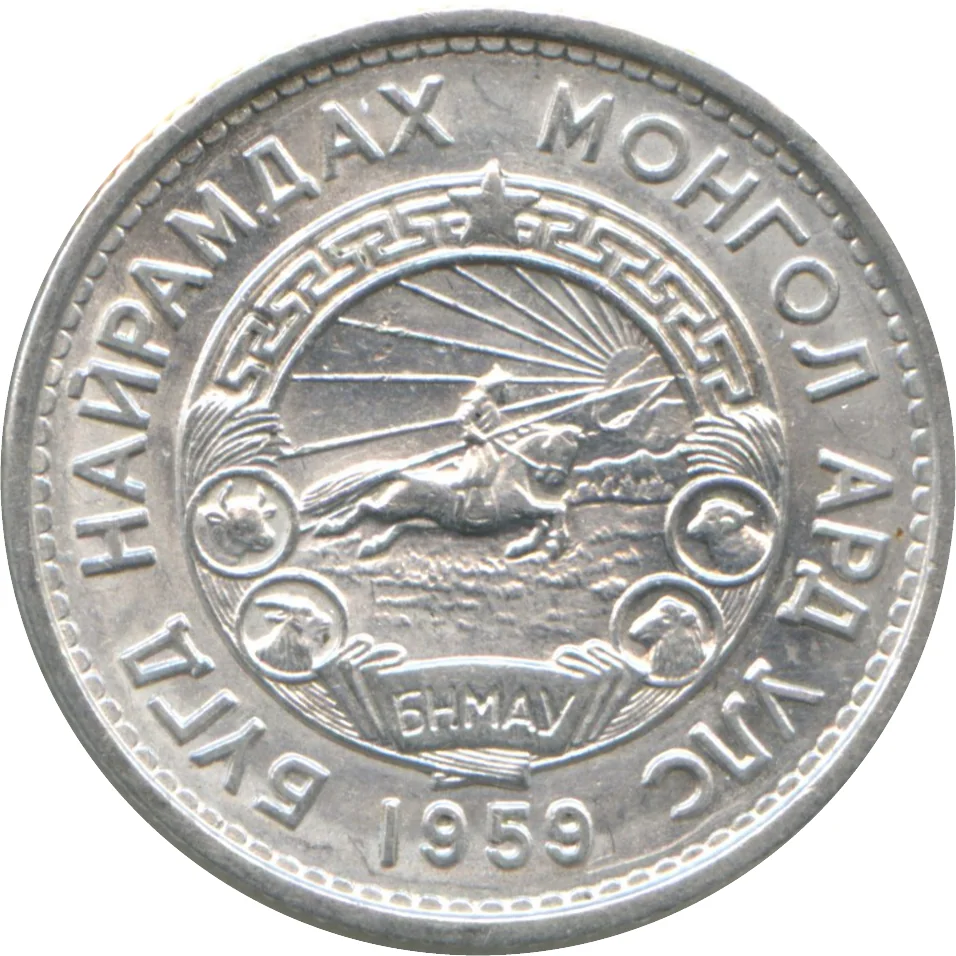

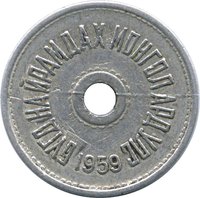
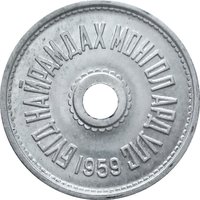
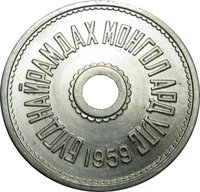
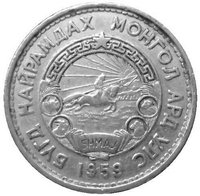
Obverse
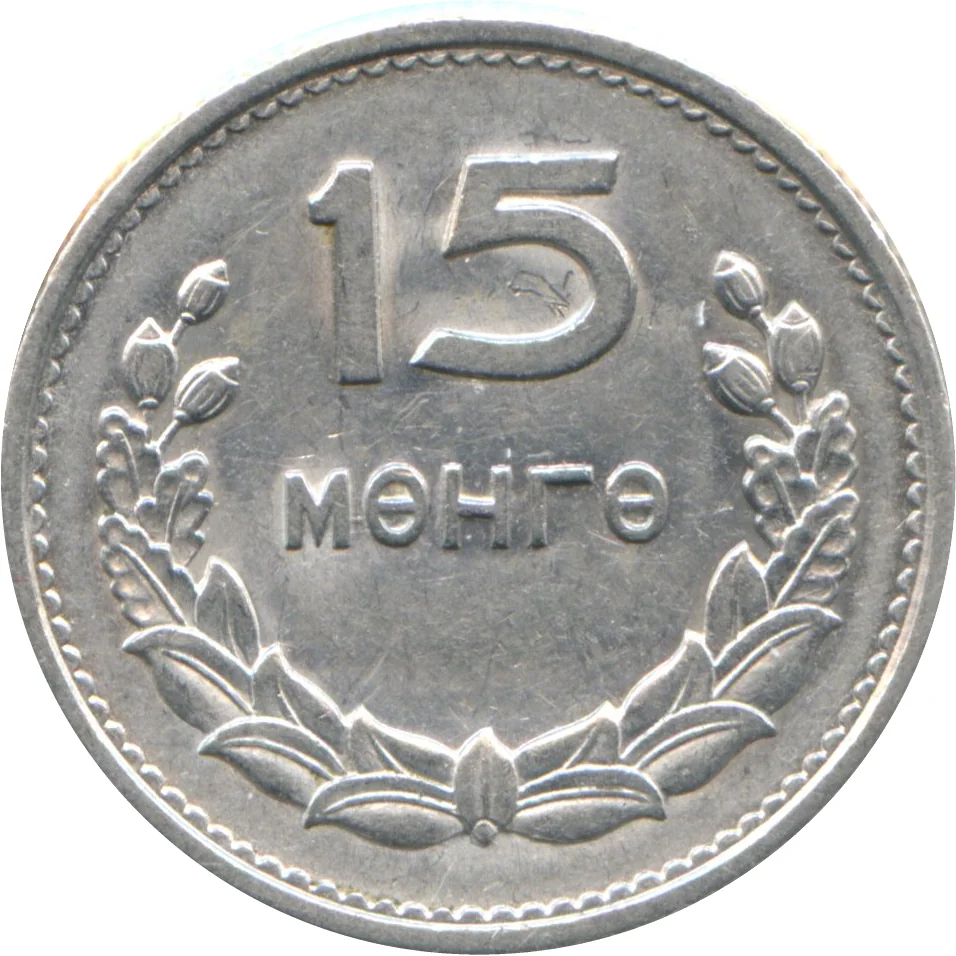
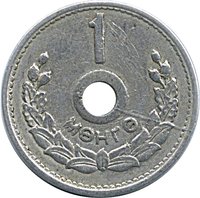
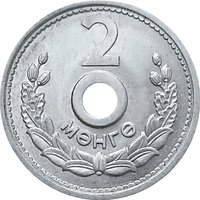
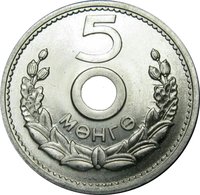
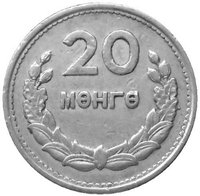
Reverse
Edge
Milled
Mintings
| Year | Mint Mark | Mintage | Quality | Collection |
|---|---|---|---|---|
| 1959 | — | 4,600,000 |
Historical background
In 1959, Mongolia's currency situation was characterized by the full integration of the tögrög (MNT) into a Soviet-style centrally planned economy, under the firm control of the ruling Mongolian People's Revolutionary Party. The currency was not convertible on international markets and its value was administratively set by the State Bank of Mongolia, primarily pegged to the Soviet ruble. This system served to facilitate trade within the Council for Mutual Economic Assistance (COMECON) bloc, with the Soviet Union as Mongolia's dominant economic partner, accounting for the vast majority of its foreign trade.
Domestically, the tögrög functioned alongside a complex system of rationing and state procurement. While used for wages and consumer purchases, the availability of goods was often limited, leading to suppressed inflationary pressures through administrative controls rather than market mechanisms. The currency's role was primarily as an accounting unit within the state plan; major investments and resource allocations were dictated by five-year plans, not by market-driven currency flows. Hard currency from the West was virtually absent from the economy.
This period represented the height of the planned economy, a decade before the introduction of the "convertible tögrög" for foreign tourists in the 1970s. The stability of the 1959 currency was thus an artificial stability of isolation and control, entirely dependent on Soviet subsidies and technical assistance. It was a system designed for centralized management and political alignment with the Eastern Bloc, insulating Mongolia from global financial currents but also limiting its economic development and creating distortions that would become apparent decades later during the post-1990 transition to a market economy.
Domestically, the tögrög functioned alongside a complex system of rationing and state procurement. While used for wages and consumer purchases, the availability of goods was often limited, leading to suppressed inflationary pressures through administrative controls rather than market mechanisms. The currency's role was primarily as an accounting unit within the state plan; major investments and resource allocations were dictated by five-year plans, not by market-driven currency flows. Hard currency from the West was virtually absent from the economy.
This period represented the height of the planned economy, a decade before the introduction of the "convertible tögrög" for foreign tourists in the 1970s. The stability of the 1959 currency was thus an artificial stability of isolation and control, entirely dependent on Soviet subsidies and technical assistance. It was a system designed for centralized management and political alignment with the Eastern Bloc, insulating Mongolia from global financial currents but also limiting its economic development and creating distortions that would become apparent decades later during the post-1990 transition to a market economy.
Series: 1959 Mongolia circulation coins
🌱 Common