

5 Pounds – Jersey
Non-circulating coins
Commemoration: Princess Diana - The Work Continues
Context
Year: 2002
Country: British Crown dependencies
Issuer: Jersey 
Ruler: Elizabeth II
Currency:
(since 1971)
Material
Diameter: 38.6 mm
Weight: 28.28 g
Thickness: 3 mm
Shape: Round
Composition: Copper-nickel
Technique: Milled
Alignment: Medal alignment
flip
References
KM: #Click to copy to clipboard111
Numista: #96147
Value
Exchange value: 5 JEP
Obverse
Description:
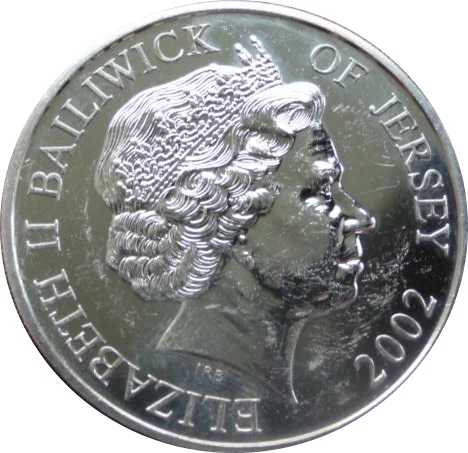
Elizabeth II bust and date
Inscription:
ELIZABETH II
BAILIWICK OF JERSEY
2002
IRB
BAILIWICK OF JERSEY
2002
IRB
Translation:
ELIZABETH II
BAILIWICK OF JERSEY
2002
IRB
BAILIWICK OF JERSEY
2002
IRB
Script: Latin
Engraver: Ian Rank-Broadley
Reverse
Description:
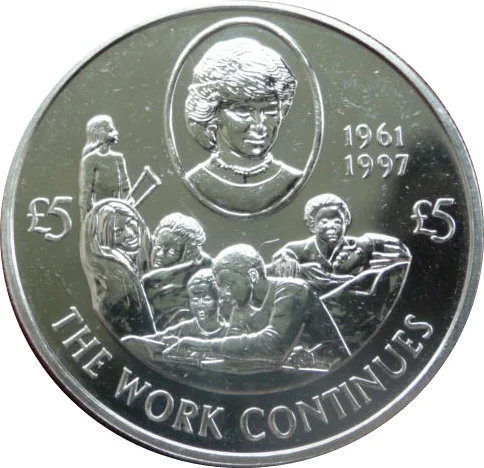
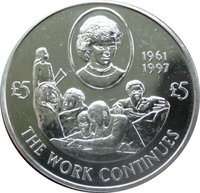
Princess Diana overseeing care and compassion.
Inscription:
£5 1961 1997 £5
THE WORK CONTINUES
THE WORK CONTINUES
Script: Latin
Edge
Milled
Mints
| Name | Mark |
|---|---|
| Royal Mint | — |
Mintings
| Year | Mint Mark | Mintage | Quality | Collection |
|---|---|---|---|---|
| 2002 | — | — |
Historical background
In 2002, Jersey's currency situation was defined by its unique and long-standing dual circulation system. The island issued its own banknotes and coins (Jersey pounds, £), which circulated alongside Bank of England notes. Crucially, both currencies were legally accepted on the island and held parity with the British pound sterling (£GBP), but this parity was a convention rather than a legally binding guarantee. This system functioned smoothly in practice, with Jersey currency being accepted at face value in the UK, though the reverse was not always true, as English businesses were not obligated to accept Jersey-issued notes.
The period around 2002 was one of stability and modernization for Jersey's currency. The States of Jersey had recently introduced a new series of banknotes in 1999, featuring enhanced security features and updated designs of local historical figures and landmarks. Furthermore, the island's economy was robust, underpinned by a thriving finance sector, which bolstered confidence in its local currency. There were no significant debates or crises regarding the currency's peg or legitimacy during this time; the system was well-established and trusted by both residents and the business community.
However, this stability existed within a broader context of evolving economic governance. As a British Crown Dependency, Jersey was increasingly mindful of international standards and transparency, particularly following the establishment of the Financial Action Task Force (FATF) recommendations. While not a direct currency issue, this regulatory environment reinforced the need for Jersey's financial systems, including its currency issuance, to be beyond reproach. Thus, in 2002, Jersey's currency was a symbol of its political and economic autonomy, operating seamlessly within the wider UK monetary area while the island carefully navigated its role in the global financial landscape.
The period around 2002 was one of stability and modernization for Jersey's currency. The States of Jersey had recently introduced a new series of banknotes in 1999, featuring enhanced security features and updated designs of local historical figures and landmarks. Furthermore, the island's economy was robust, underpinned by a thriving finance sector, which bolstered confidence in its local currency. There were no significant debates or crises regarding the currency's peg or legitimacy during this time; the system was well-established and trusted by both residents and the business community.
However, this stability existed within a broader context of evolving economic governance. As a British Crown Dependency, Jersey was increasingly mindful of international standards and transparency, particularly following the establishment of the Financial Action Task Force (FATF) recommendations. While not a direct currency issue, this regulatory environment reinforced the need for Jersey's financial systems, including its currency issuance, to be beyond reproach. Thus, in 2002, Jersey's currency was a symbol of its political and economic autonomy, operating seamlessly within the wider UK monetary area while the island carefully navigated its role in the global financial landscape.

💎 Extremely Rare