

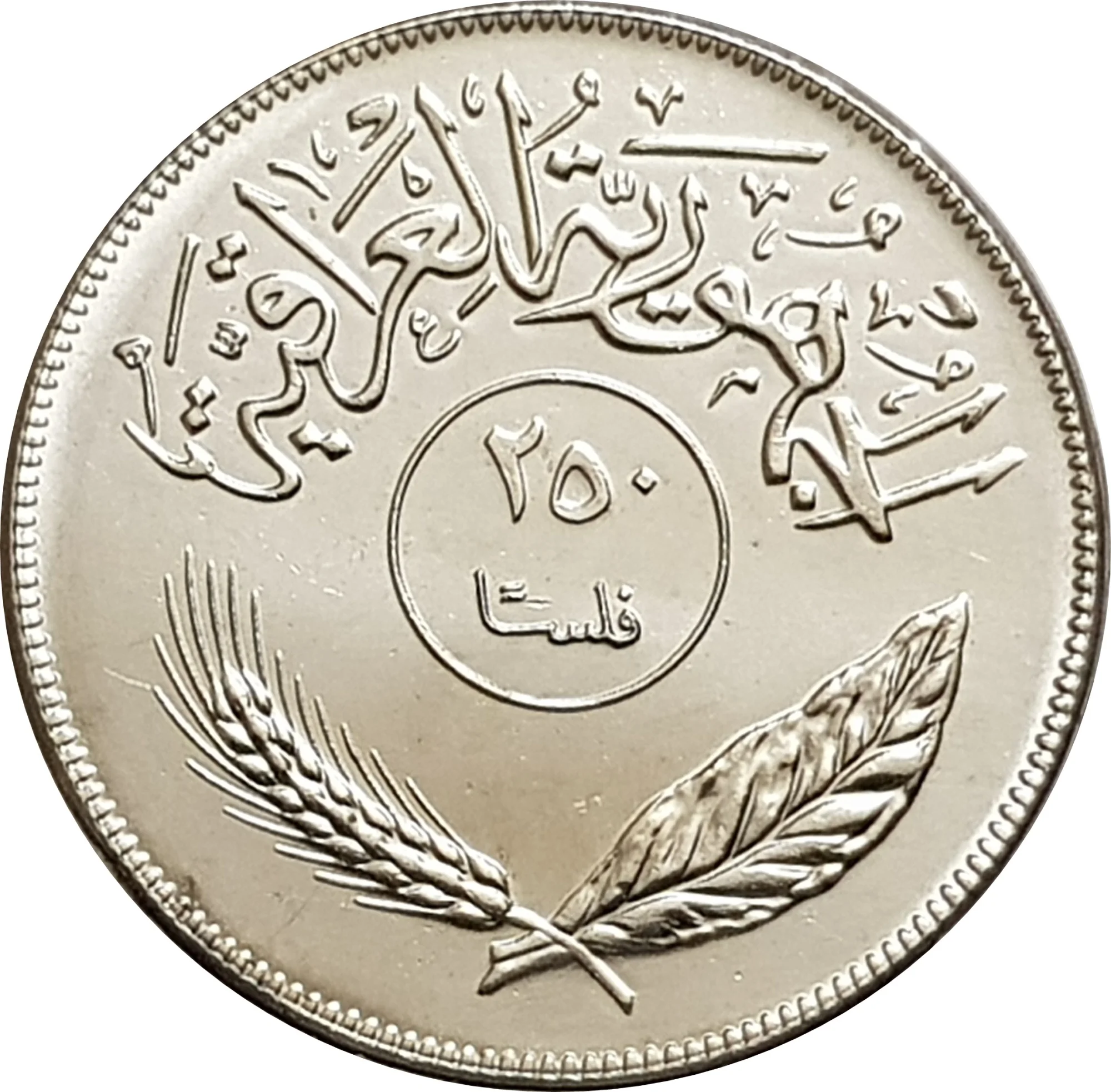
250 fils (Land Reform) – Iraq
Add to wishlist
Circulating commemorative coins
Commemoration: FAO - 12th Anniversary of Land Reform
Iraq
Context
Year: 1970
Islamic (Hijri) Year:: 1390
Issuer: Iraq
Period:
(since 1958)
Currency:
(since 1931)
Demonetized: Yes
Total mintage: 501,000
Material
References
KM: #
Numista: #9564
Value
Exchange value: 0.250 IQD
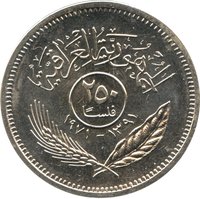
Obverse
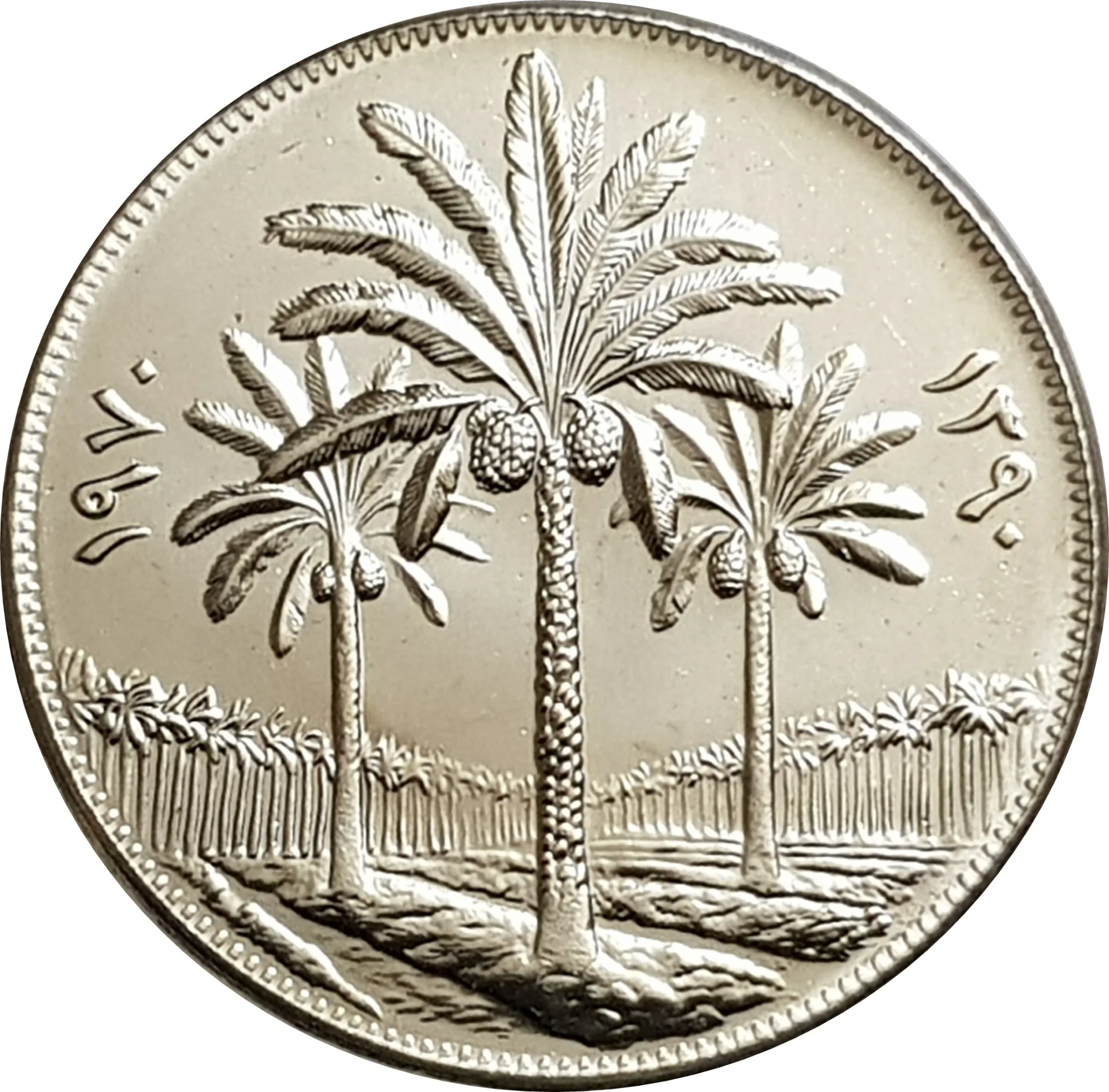
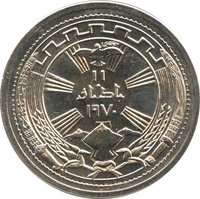
Reverse
Description:
Palms yield dates.
Inscription:
١٩٧٠١٣٩٠
Translation:
Nineteen seventy, one hundred and thirty-nine.
Script: Arabic
Language: Arabic
Engraver: Geoffrey Colley
Edge
Embossed inscription
Legend:
F.A.O. 250 F.A.O. 250 F.A.O. 250
Categories
| Organization> FAO |
Mints
| Name | Mark |
|---|---|
| Royal Mint | — |
Mintings
| Year | Mint Mark | Mintage | Quality | Collection |
|---|---|---|---|---|
| 1970 | — | 500,000 | ||
| 1970 | — | 1,000 | Proof |
Historical background
In 1970, Iraq's currency situation was characterized by stability and strong state control, underpinned by the country's booming oil revenues. The Iraqi dinar, introduced in 1932 to replace the Indian rupee, was pegged to the British pound sterling and later, following the Bretton Woods system, to the U.S. dollar at a strong fixed rate of 1 dinar = 2.8 dollars. This peg, managed by the state-owned Central Bank of Iraq, provided predictability for trade and investment, reflecting the economic confidence of the Ba'athist government, which had taken power in 1968.
Economically, the decade leading into 1970 saw Iraq's wealth and foreign exchange reserves grow substantially due to the nationalization of the Iraq Petroleum Company in 1961 and increasing global oil demand. This hydrocarbon wealth insulated the dinar from the pressures faced by many developing nations, allowing the government to finance ambitious development projects and a large public sector without resorting to excessive money printing or devaluation. The currency was not freely convertible, and exchange controls were in place, but its external value remained robust and trusted.
However, this apparent stability existed within a framework of a state-dominated economy and growing political tensions. While the dinar itself was strong, the government's increasing expenditure on military and infrastructure projects, alongside a complex web of subsidies and price controls, sowed the seeds for future inflationary pressures. Furthermore, ongoing conflicts with Kurdish groups in the north and escalating disputes with foreign oil companies introduced underlying economic risks that would challenge the currency's management in the following decades, despite the solid footing it enjoyed in 1970.
Economically, the decade leading into 1970 saw Iraq's wealth and foreign exchange reserves grow substantially due to the nationalization of the Iraq Petroleum Company in 1961 and increasing global oil demand. This hydrocarbon wealth insulated the dinar from the pressures faced by many developing nations, allowing the government to finance ambitious development projects and a large public sector without resorting to excessive money printing or devaluation. The currency was not freely convertible, and exchange controls were in place, but its external value remained robust and trusted.
However, this apparent stability existed within a framework of a state-dominated economy and growing political tensions. While the dinar itself was strong, the government's increasing expenditure on military and infrastructure projects, alongside a complex web of subsidies and price controls, sowed the seeds for future inflationary pressures. Furthermore, ongoing conflicts with Kurdish groups in the north and escalating disputes with foreign oil companies introduced underlying economic risks that would challenge the currency's management in the following decades, despite the solid footing it enjoyed in 1970.
🌱 Common