

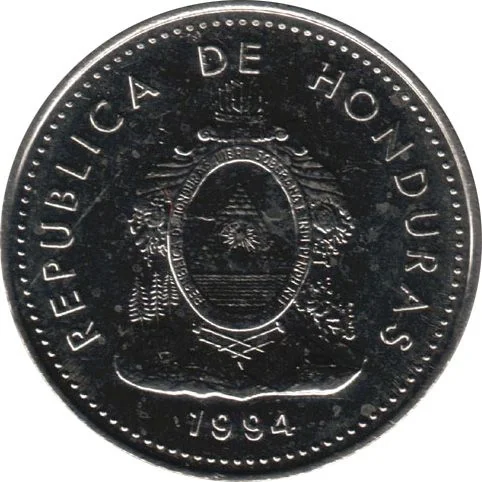
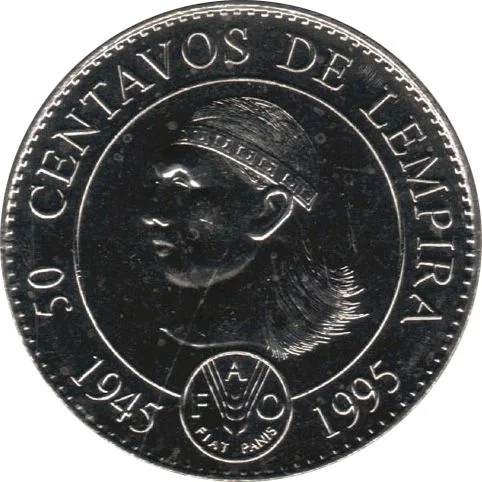
50 centavos (FAO history) – Honduras
Add to wishlist
Circulating commemorative coins
Commemoration: 50 Years of FAO
Honduras
Context
Year: 1994
Issuer: Honduras
Issuing organization: Central Bank of Honduras
Period:
(since 1862)
Currency:
(since 1931)
Total mintage: 2,000,000
Material
References
KM: #
Numista: #9560
Value
Exchange value: 0.50 HNL
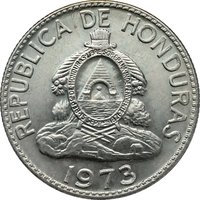
Obverse
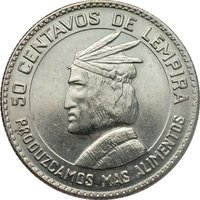
Reverse
Edge
Reeded
Categories
| Symbols> Coat of Arms |
| Organization> FAO |
Mints
| Name | Mark |
|---|---|
| Royal Canadian Mint of Winnipeg | — |
Mintings
| Year | Mint Mark | Mintage | Quality | Collection |
|---|---|---|---|---|
| 1994 | — | 2,000,000 |
Historical background
In 1994, Honduras was navigating a complex currency situation defined by the coexistence of two official currencies: the national Honduran lempira (HNL) and the United States dollar (USD). This dual-currency system was a legacy of the early 20th century, when the dollar became legal tender alongside the lempira following the country's economic ties to U.S. banana companies and substantial U.S. investment. By 1994, the U.S. dollar was widely used for major transactions, particularly in real estate, foreign trade, and banking, while the lempira remained the medium for everyday wages and local commerce.
Economically, the period was marked by a process of stabilization under President Carlos Roberto Reina. Following the hyperinflation and debt crisis of the 1980s, the government, with guidance from the International Monetary Fund (IMF), was implementing structural adjustment programs. A key pillar was maintaining a fixed exchange rate, which had been pegged at 7.26 lempiras to one U.S. dollar since 1926. This peg provided a crucial anchor for price stability and predictability in foreign trade, but it also constrained monetary policy and required careful management of foreign reserves to defend the parity.
The stability of the fixed rate, however, masked underlying pressures. Honduras's economy remained vulnerable due to its reliance on agricultural exports like coffee and bananas, which were subject to volatile global prices. While the dual system and fixed peg provided short-term stability in 1994, they also highlighted long-term challenges of dollarization, including the erosion of seigniorage income and limited tools for responding to external shocks. The situation set the stage for future debates about monetary sovereignty, which would culminate in a managed float of the lempira being adopted in the late 1990s.
Economically, the period was marked by a process of stabilization under President Carlos Roberto Reina. Following the hyperinflation and debt crisis of the 1980s, the government, with guidance from the International Monetary Fund (IMF), was implementing structural adjustment programs. A key pillar was maintaining a fixed exchange rate, which had been pegged at 7.26 lempiras to one U.S. dollar since 1926. This peg provided a crucial anchor for price stability and predictability in foreign trade, but it also constrained monetary policy and required careful management of foreign reserves to defend the parity.
The stability of the fixed rate, however, masked underlying pressures. Honduras's economy remained vulnerable due to its reliance on agricultural exports like coffee and bananas, which were subject to volatile global prices. While the dual system and fixed peg provided short-term stability in 1994, they also highlighted long-term challenges of dollarization, including the erosion of seigniorage income and limited tools for responding to external shocks. The situation set the stage for future debates about monetary sovereignty, which would culminate in a managed float of the lempira being adopted in the late 1990s.
🌱 Fairly Common