

1000 rubles (First space flight) – Russian Federation
Add to wishlist
Non-circulating coins
Commemoration: 50 Years of the Man's First Space Flight
Russia
Context
Year: 2011
Country: Russia
Issuer: Russian Federation
Period:
(since 1991)
Currency:
(since 1998)
Total mintage: 500
Material
Diameter: 50 mm
Weight: 156.4 g
Gold Weight:: 156.24 g
Thickness: 5.7 mm
Shape: Round
Composition: 99.9% Gold
Standard: Silver 5 ounces
Magnetic: No
Technique: Milled
Alignment: Medal alignment
flip
References
Value
Exchange value: 1000 RUB
Bullion value: $24051.77
Inflation-adjusted value: 3178.74 RUB
Obverse
Description:
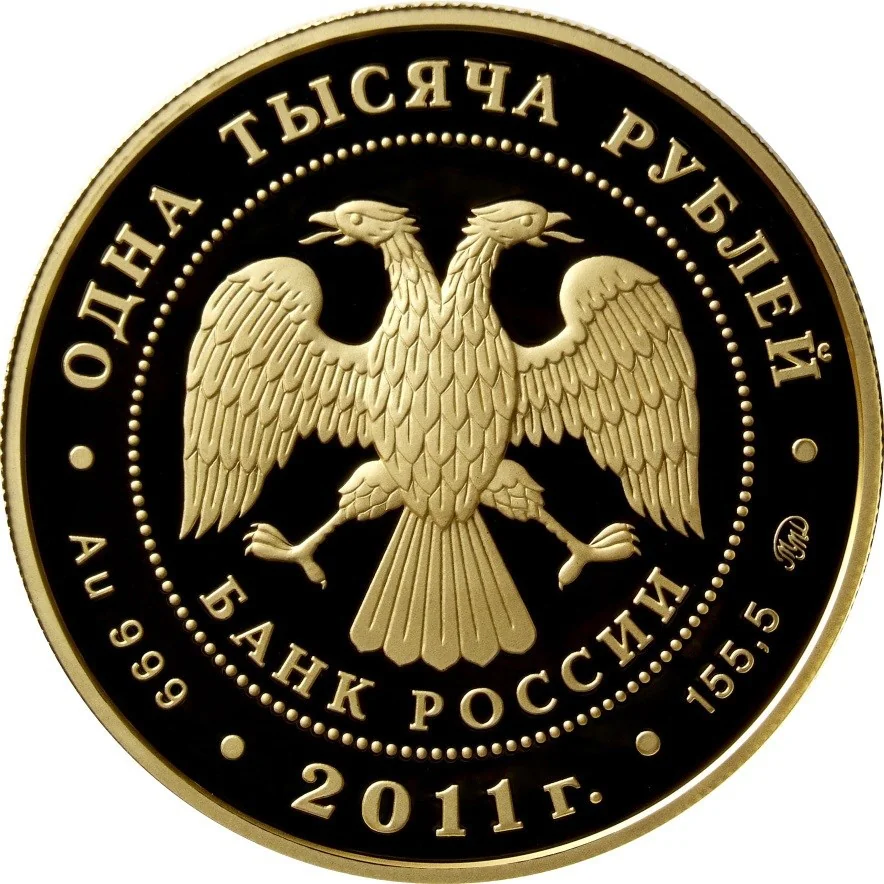
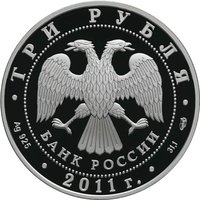
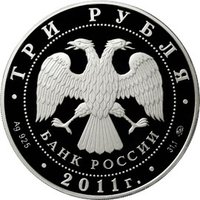
Center: Bank of Russia emblem (two-headed eagle with wings down, over semicircular "БАНК РОССИИ"), within a dotted circle. Rim inscriptions: top - "ОДНА ТЫСЯЧА РУБЛЕЙ"; bottom left - metal and fineness, center - "2011 г.", right - metal content and mint mark.
Inscription:
ОДНА ТЫСЯЧА РУБЛЕЙ
БАНК РОССИИ
• Au 999 • 2011 г. • 155,5 ММД •
БАНК РОССИИ
• Au 999 • 2011 г. • 155,5 ММД •
Translation:
ONE THOUSAND RUBLES
BANK OF RUSSIA
• Au 999 • 2011 • 155.5 MMD •
BANK OF RUSSIA
• Au 999 • 2011 • 155.5 MMD •
Language: Russian
Designer and engraver: Alexander Vasilyevich Baklanov
Reverse
Description:
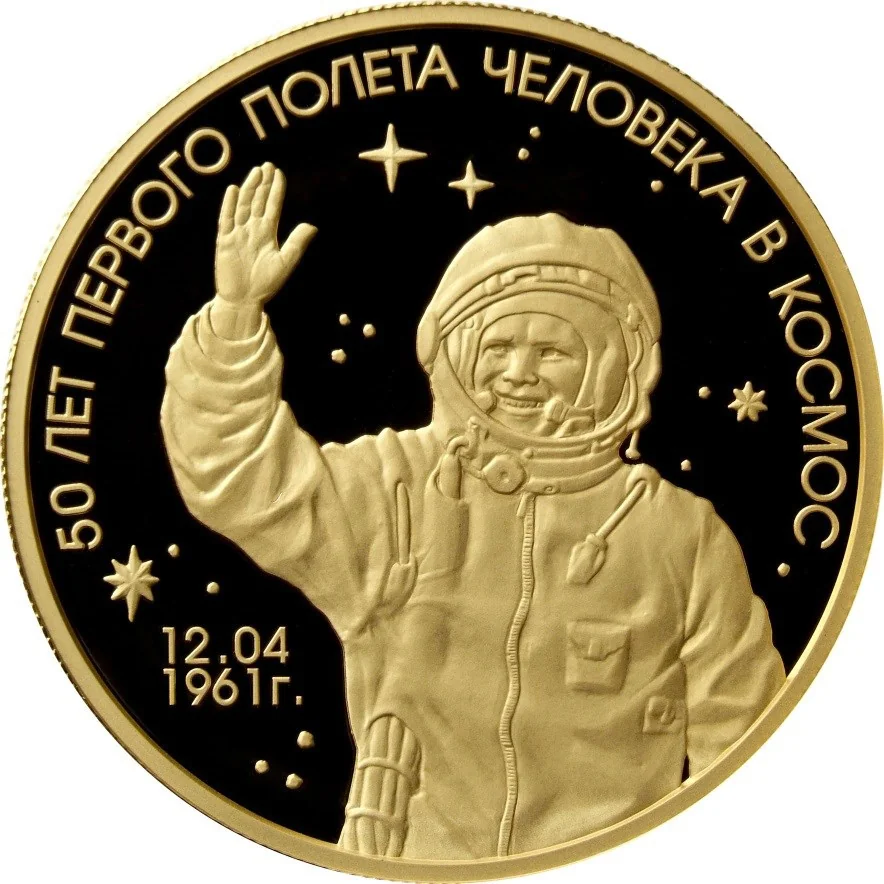
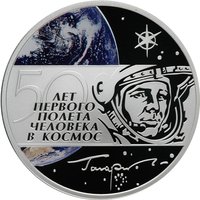
A half-length portrait of Yuri Gagarin in his spacesuit salutes against a starry sky. To the lower left is the date "12.04 1961 г.", and above, an inscription reads: "50 ЛЕТ ПЕРВОГО ПОЛЕТА ЧЕЛОВЕКА В КОСМОС".
Inscription:
50 ЛЕТ ПЕРВОГО ПОЛЕТА ЧЕЛОВЕКА В КОСМОС
12.04
1961 г.
12.04
1961 г.
Translation:
50 Years of the First Human Flight into Space
12.04
1961
12.04
1961
Script: Cyrillic
Language: Russian
Engraver: Svetlana Vladimirovna Erokhina
Designer: Sergey Kozlov
Edge
210 corrugations
Categories
| Space |
Mints
| Name | Mark |
|---|---|
| Moscow Mint | (ММД) |
Mintings
| Year | Mint Mark | Mintage | Quality | Collection |
|---|---|---|---|---|
| 2011 | ММД | 500 | Proof |
Historical background
In 2011, the Russian Federation's currency situation was characterized by a period of relative stability and managed strength for the ruble, following the severe shock of the 2008-2009 global financial crisis. The Central Bank of Russia (CBR) operated a dual-currency basket peg (55% US dollar, 45% euro) within a floating corridor, actively intervening to smooth excessive volatility. High global prices for oil and other key commodity exports, which remained above $100 per barrel for much of the year, drove strong capital inflows and bolstered the country's foreign exchange reserves, allowing the CBR to gradually widen the trading band and permit a controlled ruble appreciation to combat inflation.
This stability, however, masked underlying vulnerabilities and policy tensions. Inflation remained a persistent concern, ending the year at over 6%, prompting the CBR to engage in significant sterilization efforts—buying foreign currency to limit ruble strength while simultaneously raising reserve requirements to mop up the resulting ruble liquidity. Furthermore, the economy faced substantial capital flight, estimated at $80.5 billion for the year, as political uncertainty ahead of the 2012 presidential election and a perceived lack of structural reforms encouraged domestic investors to move assets abroad.
By the close of 2011, the currency landscape began to shift as external risks mounted. The escalating Eurozone debt crisis and a moderate decline in oil prices in the fourth quarter triggered capital outflows and put downward pressure on the ruble, forcing the CBR to switch from buying to selling foreign currency to support the exchange rate. This marked the end of the steady appreciation trend, setting the stage for the more volatile and challenging period that would follow in the coming years, ultimately leading to the move to a free float in 2014.
This stability, however, masked underlying vulnerabilities and policy tensions. Inflation remained a persistent concern, ending the year at over 6%, prompting the CBR to engage in significant sterilization efforts—buying foreign currency to limit ruble strength while simultaneously raising reserve requirements to mop up the resulting ruble liquidity. Furthermore, the economy faced substantial capital flight, estimated at $80.5 billion for the year, as political uncertainty ahead of the 2012 presidential election and a perceived lack of structural reforms encouraged domestic investors to move assets abroad.
By the close of 2011, the currency landscape began to shift as external risks mounted. The escalating Eurozone debt crisis and a moderate decline in oil prices in the fourth quarter triggered capital outflows and put downward pressure on the ruble, forcing the CBR to switch from buying to selling foreign currency to support the exchange rate. This marked the end of the steady appreciation trend, setting the stage for the more volatile and challenging period that would follow in the coming years, ultimately leading to the move to a free float in 2014.
✨ Legendary