

50 rubles – Russian Federation
Add to wishlist
Non-circulating coins
Commemoration: Millennium of the Unity of Mordovian People with the Peoples of the Russian State
Russia
Context
Year: 2012
Country: Russia
Issuer: Russian Federation
Period:
(since 1991)
Currency:
(since 1998)
Total mintage: 1,000
Material
Diameter: 22.6 mm
Weight: 7.89 g
Gold Weight:: 7.88 g
Thickness: 1.6 mm
Shape: Round
Composition: 99.9% Gold
Standard: Silver quarter ounce
Magnetic: No
Technique: Milled
Alignment: Medal alignment
flip

References
Value
Exchange value: 50 RUB
Bullion value: $1216.60
Inflation-adjusted value: 146.57 RUB
Obverse
Description:
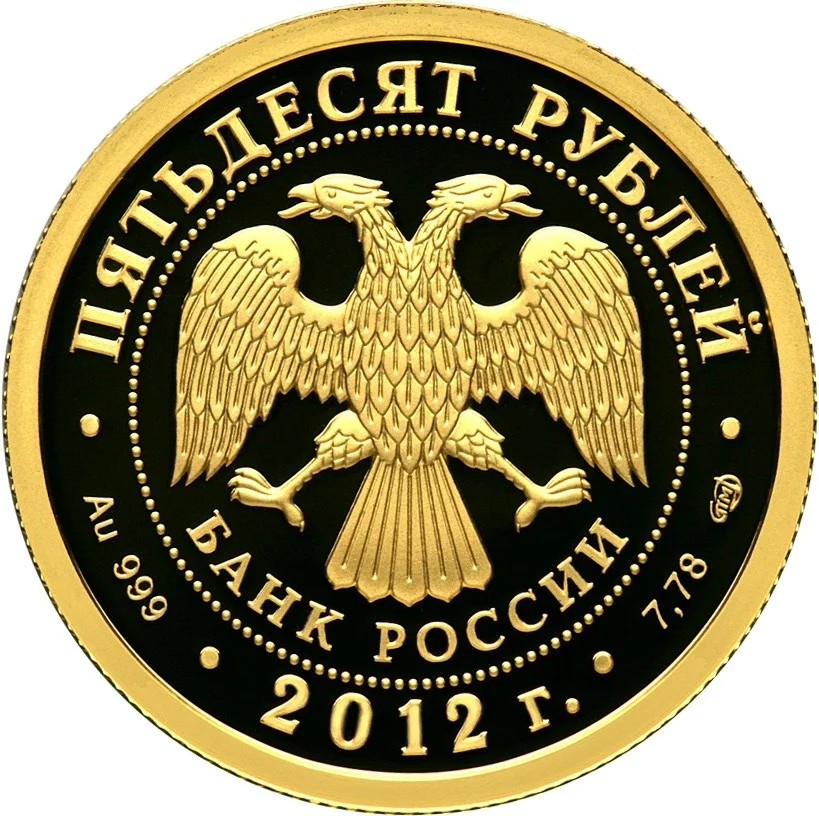
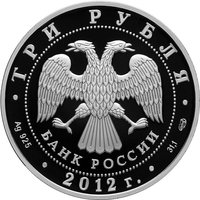
Center: Bank of Russia emblem (two-headed eagle, wings down, with "БАНК РОССИИ" below), within a dotted circle. Rim inscriptions: top - "ПЯТЬДЕСЯТ РУБЛЕЙ"; bottom left - metal and fineness; center - "2012 г."; bottom right - metal content and mint mark.
Inscription:
ПЯТЬДЕСЯТ РУБЛЕЙ
БАНК РОССИИ
• Au 999 • 2012 г. • 7,78 СПМД •
БАНК РОССИИ
• Au 999 • 2012 г. • 7,78 СПМД •
Translation:
FIFTY RUBLES
BANK OF RUSSIA
• Au 999 • 2012 • 7.78 SPMD •
BANK OF RUSSIA
• Au 999 • 2012 • 7.78 SPMD •
Language: Russian
Designer and engraver: Alexander Vasilyevich Baklanov
Reverse
Description:
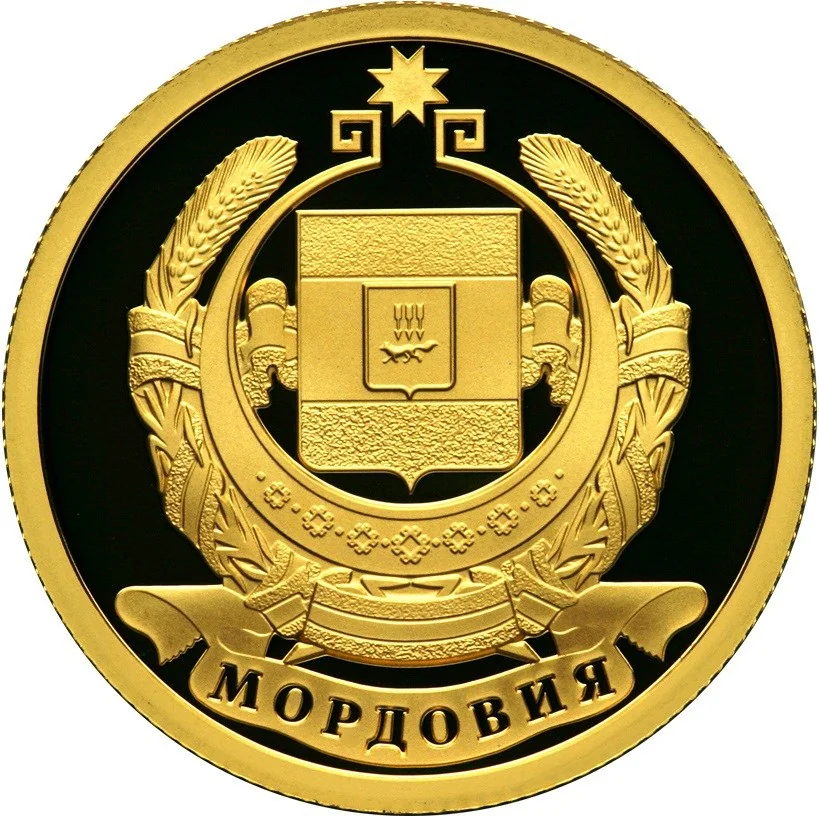
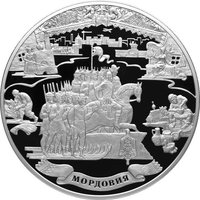
Central relief of Mordovia's coat of arms, with "МОРДОВИЯ" inscribed on a ribbon below.
Inscription:
МОРДОВИЯ
Translation:
Mordovia
Script: Cyrillic
Language: Russian
Designer: Fedor Sergeevich Andronov
Edge
134 corrugations
Categories
| Event> Millennium |
| Geography> Region |
| Symbols> Coat of Arms |
Mints
| Name | Mark |
|---|---|
| Saint Petersburg | (СПМД) |
Mintings
| Year | Mint Mark | Mintage | Quality | Collection |
|---|---|---|---|---|
| 2012 | СПМД | 1,000 | Proof |
Historical background
In 2012, the Russian currency situation was characterized by relative stability but underlying vulnerability. The Russian ruble (RUB) was trading in a managed float against a dual-currency basket (55% USD, 45% EUR), with the Central Bank of Russia (CBR) intervening to smooth excessive volatility. This period followed a strong recovery from the 2008-09 global financial crisis, supported by high global oil prices—averaging over $110 per barrel for Urals crude—which bolstered foreign exchange reserves and provided a large current account surplus. This commodity-driven inflow created an environment of ruble strength, with low inflation and controlled exchange rate bands.
However, this stability was heavily contingent on external factors, exposing structural economic weaknesses. The Russian economy remained overly dependent on hydrocarbon exports, while capital flight, driven by political uncertainty and a lack of investor confidence in institutions, persisted at high levels (estimated at $54-56 billion in 2012). Furthermore, the CBR was in a transitional phase, gradually widening the ruble's trading corridor to move toward a free float and inflation targeting by 2015. This policy shift aimed to reduce the fiscal burden of interventions but introduced elements of market uncertainty.
By the end of 2012, the pressures were becoming more apparent. Global economic slowdown fears and moderating oil prices began to test the ruble's resilience. The currency weakened slightly against the basket in the latter half of the year, foreshadowing the more significant challenges to come. The situation underscored a fundamental tension: the ruble's short-term stability was purchased with oil revenues, while long-term vulnerabilities like capital flight and a lack of diversification left it exposed to future external shocks, which would materialize sharply in the coming years with the geopolitical events of 2014.
However, this stability was heavily contingent on external factors, exposing structural economic weaknesses. The Russian economy remained overly dependent on hydrocarbon exports, while capital flight, driven by political uncertainty and a lack of investor confidence in institutions, persisted at high levels (estimated at $54-56 billion in 2012). Furthermore, the CBR was in a transitional phase, gradually widening the ruble's trading corridor to move toward a free float and inflation targeting by 2015. This policy shift aimed to reduce the fiscal burden of interventions but introduced elements of market uncertainty.
By the end of 2012, the pressures were becoming more apparent. Global economic slowdown fears and moderating oil prices began to test the ruble's resilience. The currency weakened slightly against the basket in the latter half of the year, foreshadowing the more significant challenges to come. The situation underscored a fundamental tension: the ruble's short-term stability was purchased with oil revenues, while long-term vulnerabilities like capital flight and a lack of diversification left it exposed to future external shocks, which would materialize sharply in the coming years with the geopolitical events of 2014.
✨ Legendary