

10 Euro (Juraj Turzo) – Slovakia
Non-circulating coins
Commemoration: 400th anniversary of the death of Juraj Turzo
Slovakia
Context
Material
References
KM: #Click to copy to clipboard145
Numista: #95383
Value
Exchange value: 10 EUR = $11.81
Bullion value: $46.85
Inflation-adjusted value: 14.77 EUR
Obverse
Description:
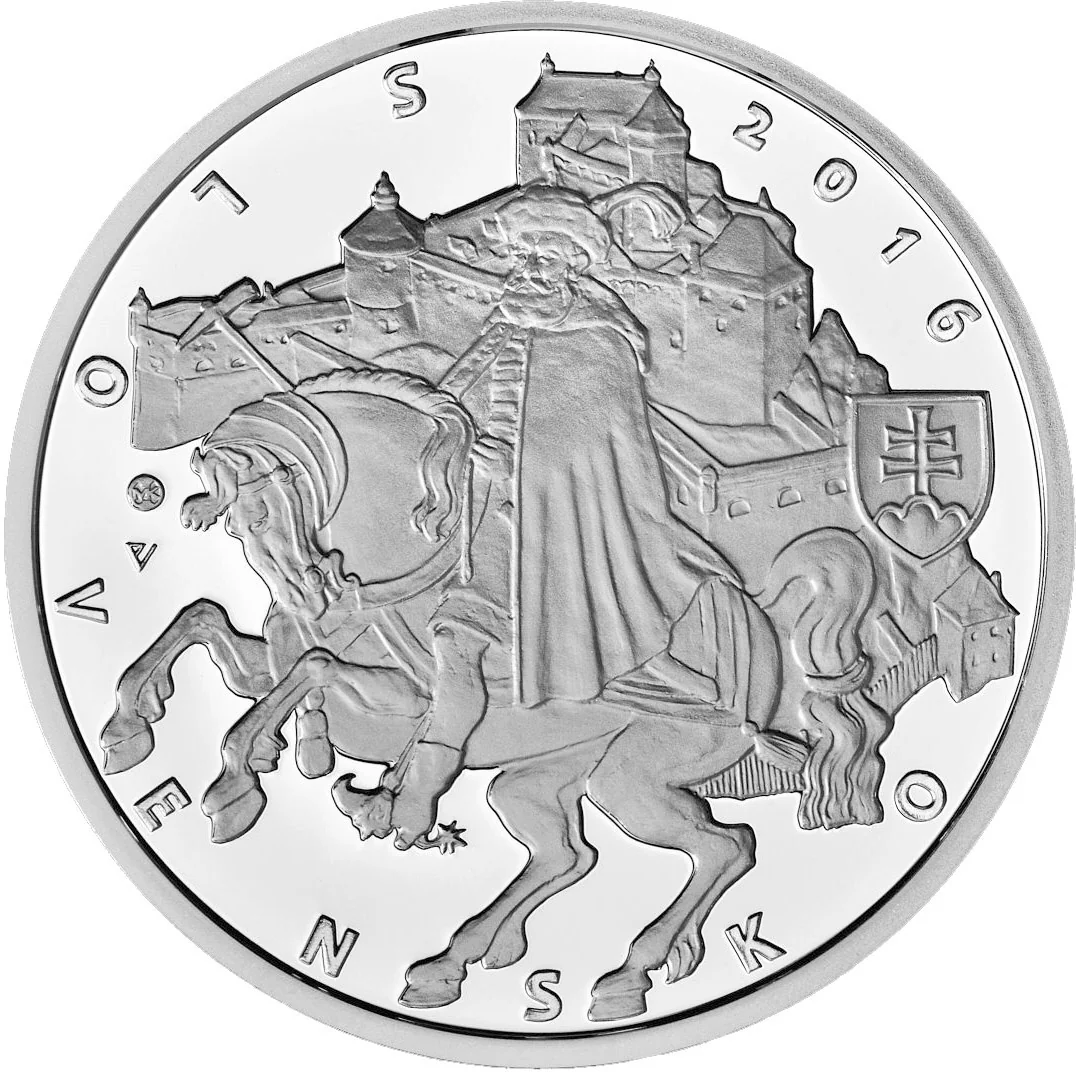
The obverse depicts Juraj Turzo riding, with an aerial view of Lietava Castle behind him. The Slovak national emblem is at the right edge, while the country name "SLOVAKIA," the year "2016," and the Kremnica Mint mark "MK" are along the left. Below are the stylized initials "PV" of the coin's designer, Mgr. art. Peter Valach.
Inscription:
SLOVENSKO 2016
Translation:
Slovakia 2016
Script: Latin
Language: Slovak
Engraver: Dalibor Schmidt
Reverse
Description:
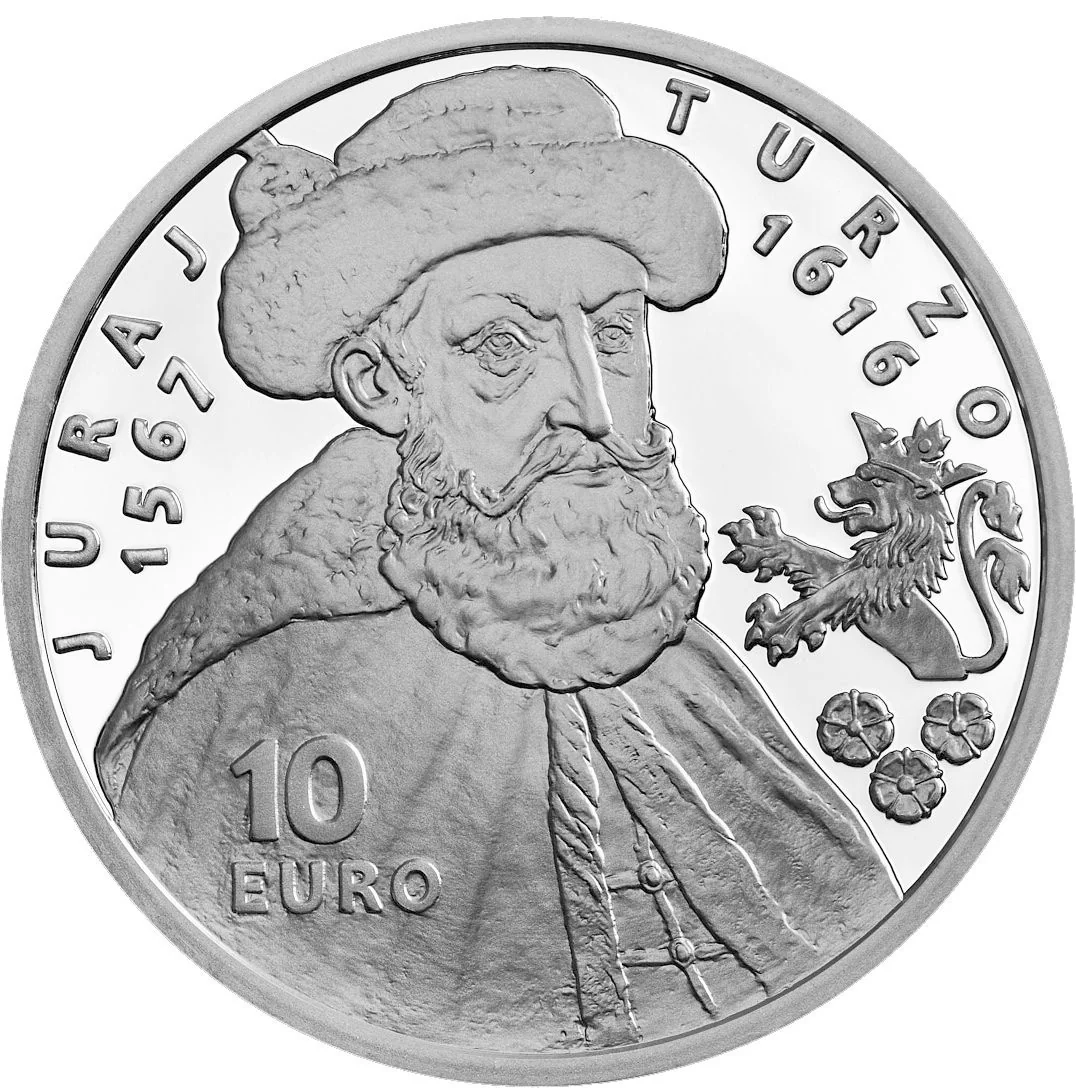
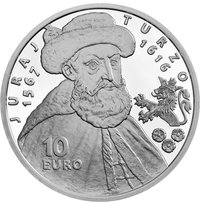
The reverse depicts Juraj Turza beside elements of the historical coat of arms. Around the edge is his name, with his birth year 1567 and death year 1616 below. The denomination "10 EURO" and the designer's mark "Mgr. art. Peter Valach PV" appear at the bottom left.
Inscription:
JURAJ TURZO
1567 1616
10
EURO
1567 1616
10
EURO
Script: Latin
Engraver: Dalibor Schmidt
Edge
Smooth with inscriptions in hollow
Legend:
VIVIT POST FUNERA VIRTUS
Categories
| Animal> Horse |
| Symbols> Coat of Arms |
| Event> Death anniversary |
| Building> Castle or fortification |
| Object> Hat |
Mints
| Name | Mark |
|---|---|
| Kremnica | (MK) |
Mintings
| Year | Mint Mark | Mintage | Quality | Collection |
|---|---|---|---|---|
| 2016 | MK | 3,100 | ||
| 2016 | MK | 5,400 | Proof |
Historical background
In 2016, Slovakia was a stable member of the Eurozone, having adopted the euro as its official currency on January 1, 2009. This meant the country no longer had an independent monetary policy, as its interest rates and broader monetary strategy were set by the European Central Bank (ECB) in Frankfurt. The primary domestic currency discussion in 2016, therefore, revolved not around exchange rates but around the practical and political implications of euro membership. The year saw ongoing public debate about the perceived benefits of price transparency and reduced transaction costs versus criticisms, often from populist and nationalist parties, regarding the loss of monetary sovereignty and the symbolic connection to the former national currency, the Slovak koruna.
Economically, Slovakia was experiencing strong growth in 2016, with GDP expanding by over 3%, significantly outpacing the Eurozone average. This robust performance was largely driven by a surge in automotive exports and increased EU fund absorption. The common currency was generally seen as a stabilizing factor that facilitated this export-led growth by eliminating foreign exchange risk within its main European market. However, the ECB's ultra-loose monetary policy, including negative interest rates and quantitative easing, was a point of contention. While it supported borrowing and investment, it also raised concerns among some Slovak policymakers about potential asset bubbles and the penalization of savers.
Politically, the euro remained a largely settled issue within the mainstream, supported by the governing center-left Smer-SD party and most of the opposition. However, the rise of the populist-nationalist ĽSNS (People's Party Our Slovakia), which openly advocated for a return to the koruna, kept the topic in the public discourse. Furthermore, the aftermath of the Greek debt crisis and the ongoing migration crisis in Europe fueled broader skepticism about EU integration, which occasionally spilled over into criticism of the single currency. Thus, in 2016, Slovakia's currency situation was characterized by operational stability and economic benefits under the euro, juxtaposed with a persistent, though minority, political undercurrent questioning its long-term desirability.
Economically, Slovakia was experiencing strong growth in 2016, with GDP expanding by over 3%, significantly outpacing the Eurozone average. This robust performance was largely driven by a surge in automotive exports and increased EU fund absorption. The common currency was generally seen as a stabilizing factor that facilitated this export-led growth by eliminating foreign exchange risk within its main European market. However, the ECB's ultra-loose monetary policy, including negative interest rates and quantitative easing, was a point of contention. While it supported borrowing and investment, it also raised concerns among some Slovak policymakers about potential asset bubbles and the penalization of savers.
Politically, the euro remained a largely settled issue within the mainstream, supported by the governing center-left Smer-SD party and most of the opposition. However, the rise of the populist-nationalist ĽSNS (People's Party Our Slovakia), which openly advocated for a return to the koruna, kept the topic in the public discourse. Furthermore, the aftermath of the Greek debt crisis and the ongoing migration crisis in Europe fueled broader skepticism about EU integration, which occasionally spilled over into criticism of the single currency. Thus, in 2016, Slovakia's currency situation was characterized by operational stability and economic benefits under the euro, juxtaposed with a persistent, though minority, political undercurrent questioning its long-term desirability.
💎 Very Rare