

100 Rubles – Russian Federation
Non-circulating coins
Commemoration: Research Expeditions of G.I. Nevelskoy to the Far East of 1848-1849 and 1850-1855
Russia
Context
Year: 2013
Country: Russia 
Issuer: Russian Federation
Period:
(since 1991)
Currency:
(since 1998)
Total mintage: 1,500
Material
Diameter: 30 mm
Weight: 15.72 g
Gold weight: 15.70 g
Thickness: 1.7 mm
Shape: Round
Composition: 99.9% Gold
Standard: Silver half ounce
Magnetic: No
Technique: Milled
Alignment: Medal alignment
flip
References
Numista: #95366
CBR: #5217-0043
Value
Exchange value: 100 RUB
Bullion value: $2619.90
Inflation-adjusted value: 278.99 RUB
Obverse
Description:
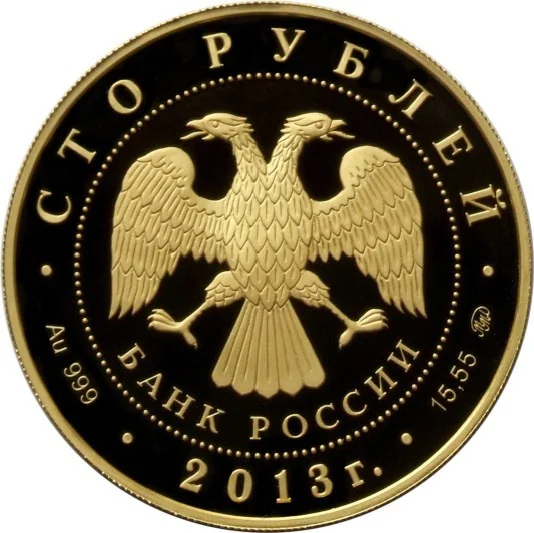
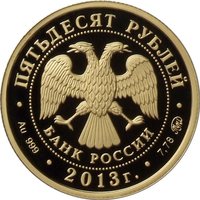
At the center, within a circle of dots, is the Bank of Russia emblem (a two-headed eagle with wings down, above the semicircular inscription "БАНК РОССИИ"). Around the rim, the top reads "СТО РУБЛЕЙ". The bottom shows the metal and fineness on the left, "2013 г." in the center, and the metal content and mint mark on the right.
Inscription:
СТО РУБЛЕЙ
БАНК РОССИИ
• Au 999 • 2013 г. • 15,55 ММД •
БАНК РОССИИ
• Au 999 • 2013 г. • 15,55 ММД •
Translation:
ONE HUNDRED RUBLES
BANK OF RUSSIA
• Au 999 • 2013 • 15.55 MMD •
BANK OF RUSSIA
• Au 999 • 2013 • 15.55 MMD •
Language: Russian
Designer and engraver: Alexander Vasilyevich Baklanov
Reverse
Description:
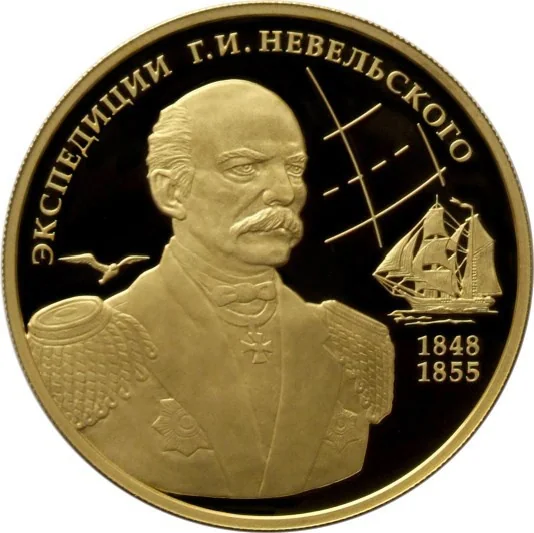
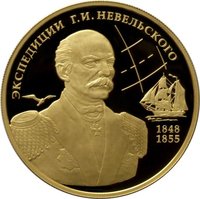
Center: relief portrait of G.I. Nevelskoy in naval uniform. Background: a flying bird (left), geographic grid and sailing vessel (right). Below: dates "1848" and "1855". Rim inscription: "ЭКСПЕДИЦИИ Г.И. НЕВЕЛЬСКОГО".
Inscription:
ЭКСПЕДИЦИИ Г.И. НЕВЕЛЬСКОГО
1848
1855
1848
1855
Translation:
Expedition of G.I. Nevelskoy
1848
1855
1848
1855
Script: Cyrillic
Language: Russian
Engraver: Fedor Sergeevich Andronov
Designer: Lidiya Alexandrovna Evdokimova
Edge
240 corrugations
Categories
| Transportation> Watercraft |
Mints
| Name | Mark |
|---|---|
| Moscow Mint | (ММД) |
Mintings
| Year | Mint Mark | Mintage | Quality | Collection |
|---|---|---|---|---|
| 2013 | ММД | 1,500 | Proof |
Historical background
In 2013, the Russian ruble exhibited relative stability, marking a period of calm before the significant volatility that would characterize the following years. The currency traded in a managed float within a dual-currency basket band (55% USD, 45% EUR) set by the Central Bank of Russia (CBR). This stability was underpinned by high global oil prices, which averaged over $100 per barrel for much of the year, ensuring strong foreign currency inflows from hydrocarbon exports. Consequently, Russia maintained substantial foreign exchange reserves, exceeding $500 billion, which provided a robust buffer against external shocks and allowed the CBR to intervene smoothly to curb excessive fluctuations.
However, underlying structural vulnerabilities and external pressures were mounting beneath this stable surface. The Russian economy was experiencing a pronounced slowdown, with GDP growth decelerating to just 1.3% for the year, its weakest pace since the 2009 global financial crisis. This stagnation was driven by a lack of investment, poor productivity growth, and a deteriorating business climate, highlighting the economy's deep dependence on commodity revenues. Furthermore, geopolitical tensions were beginning to simmer, with debates over Ukraine's potential association agreement with the European Union creating unease in financial markets, though the full-scale crisis was still ahead.
By the end of 2013, the ruble's stability was increasingly perceived as fragile and contingent on sustained high energy prices. The CBR was in a transitional phase, gradually widening the ruble's trading band as part of a long-stated policy move towards a free float, aiming to insulate its reserves and shift to inflation targeting. This period, therefore, represented the final chapter of relative calm, with the economy's fundamental weaknesses and looming geopolitical events setting the stage for the currency turbulence that would erupt in 2014 following the annexation of Crimea and the concurrent collapse in oil prices.
However, underlying structural vulnerabilities and external pressures were mounting beneath this stable surface. The Russian economy was experiencing a pronounced slowdown, with GDP growth decelerating to just 1.3% for the year, its weakest pace since the 2009 global financial crisis. This stagnation was driven by a lack of investment, poor productivity growth, and a deteriorating business climate, highlighting the economy's deep dependence on commodity revenues. Furthermore, geopolitical tensions were beginning to simmer, with debates over Ukraine's potential association agreement with the European Union creating unease in financial markets, though the full-scale crisis was still ahead.
By the end of 2013, the ruble's stability was increasingly perceived as fragile and contingent on sustained high energy prices. The CBR was in a transitional phase, gradually widening the ruble's trading band as part of a long-stated policy move towards a free float, aiming to insulate its reserves and shift to inflation targeting. This period, therefore, represented the final chapter of relative calm, with the economy's fundamental weaknesses and looming geopolitical events setting the stage for the currency turbulence that would erupt in 2014 following the annexation of Crimea and the concurrent collapse in oil prices.


✨ Legendary