

5 Pence – Gibraltar
United Kingdom
Context
Years: 1990–1997
Country: United Kingdom 
Issuer: Gibraltar 
Ruler: Elizabeth II
Currency:
(since 1971)
Material
Diameter: 18 mm
Weight: 3.25 g
Thickness: 1.7 mm
Shape: Round
Composition: Copper-nickel
Technique: Milled
Alignment: Medal alignment
flip
References
KM: #Click to copy to clipboard22.2
Numista: #9531
Value
Exchange value: 0.05 GIP
Inflation-adjusted value: 0.16 GIP
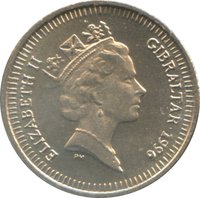
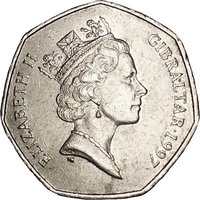
Obverse
Description:
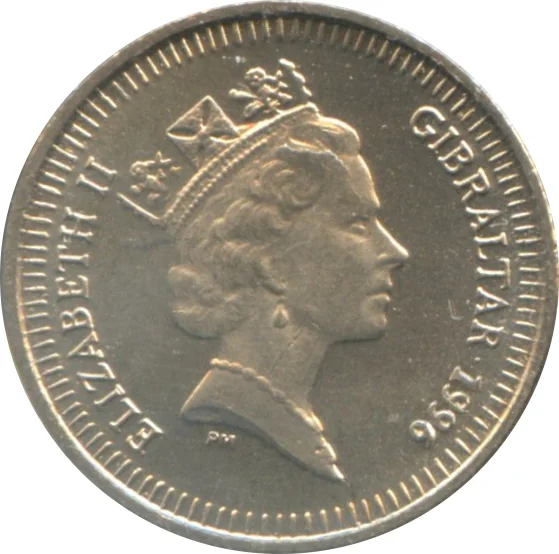
Queen Elizabeth II facing right, wearing the George IV State Diadem.
Inscription:
ELIZABETH II GIBRALTAR · 1996
RDM
PM
RDM
PM
Script: Latin
Designer: Raphael David Maklouf
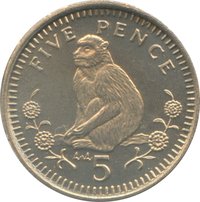
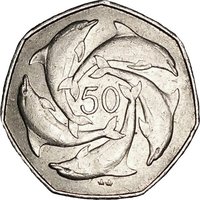
Reverse
Description:
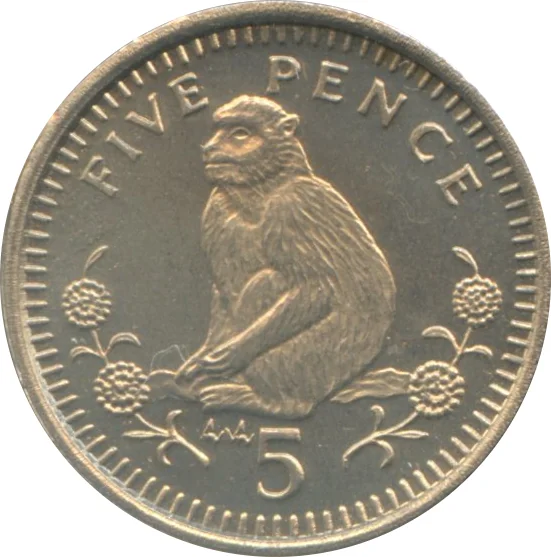
Barbary macaque and Gibraltar candytuft designations.
Inscription:
FIVE PENCE
AA
5
AA
5
Script: Latin
Engraver: Alfred Ryman
Edge
Reeded
Mints
| Name | Mark |
|---|---|
| Pobjoy Mint | (PM) |
Mintings
| Year | Mint Mark | Mintage | Quality | Collection |
|---|---|---|---|---|
| 1990 | PM | — | ||
| 1991 | PM | — | ||
| 1992 | PM | — | ||
| 1993 | PM | — | ||
| 1994 | PM | — | ||
| 1995 | PM | — | ||
| 1996 | PM | — | ||
| 1997 | PM | — |
Historical background
In 1990, Gibraltar's currency situation was defined by a unique and practical dual-currency system, with both the Gibraltar pound (GIP) and the British pound sterling (GBP) circulating as legal tender at par value (1:1). The Gibraltar pound, issued by the Government of Gibraltar, was not a major international currency but served as the local note issue, featuring distinct designs of local significance. Sterling coins and Bank of England notes were equally accepted in everyday transactions, creating a seamless monetary environment for residents and businesses.
This arrangement was underpinned by Gibraltar's constitutional status as a British Overseas Territory. The local currency was fully backed by sterling reserves held at the Bank of England, ensuring absolute confidence in its parity. Economically, this peg provided stability, anchoring Gibraltar's economy—then heavily reliant on the UK in trade, tourism, and its role as a strategic port—to a major and stable international currency. It effectively outsourced monetary policy to the Bank of England, shielding the territory from exchange rate volatility.
The system in 1990 reflected Gibraltar's historical and economic ties to the United Kingdom, while also asserting a degree of symbolic autonomy through its own banknotes. There was little impetus for change, as the arrangement provided both the stability of sterling and the convenience of a local note issue. This pragmatic dual-system remained a settled feature of Gibraltar's financial landscape throughout the decade and beyond.
This arrangement was underpinned by Gibraltar's constitutional status as a British Overseas Territory. The local currency was fully backed by sterling reserves held at the Bank of England, ensuring absolute confidence in its parity. Economically, this peg provided stability, anchoring Gibraltar's economy—then heavily reliant on the UK in trade, tourism, and its role as a strategic port—to a major and stable international currency. It effectively outsourced monetary policy to the Bank of England, shielding the territory from exchange rate volatility.
The system in 1990 reflected Gibraltar's historical and economic ties to the United Kingdom, while also asserting a degree of symbolic autonomy through its own banknotes. There was little impetus for change, as the arrangement provided both the stability of sterling and the convenience of a local note issue. This pragmatic dual-system remained a settled feature of Gibraltar's financial landscape throughout the decade and beyond.
🌱 Very Common