

10 dollars – United States
Add to wishlist
Non-circulating coins
Commemoration: First Spouse series - Helen Taft
United States
Context
Material
Diameter: 26.5 mm
Weight: 15.55 g
Gold Weight:: 15.55 g
Thickness: 1.88 mm
Shape: Round
Composition: 99.99% Gold
Standard: Silver half ounce
Magnetic: No
Technique: Milled
Alignment: Coin alignment
flip
References
KM: #
Numista: #95243
Value
Exchange value: 10 USD = $10.00
Bullion value: $2393.49
Inflation-adjusted value: 13.98 USD
Obverse
Description:
Helen Taft portrait
Inscription:
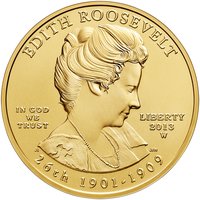
EDITH ROOSEVELT
IN GOD WE TRUST
LIBERTY
2013
W
27th 1909-1913
IN GOD WE TRUST
LIBERTY
2013
W
27th 1909-1913
Script: Latin
Engravers: Phebe Hemphill, William C. Burgard III
Reverse
Description:
Abstracted cherry blossoms, symbolizing Helen Taft's role in bringing the trees to Washington, D.C.
Inscription:
· UNITED STATES OF AMERICA ·
·E PLURIBUS UNUM ·
$10 · 1/2 Oz. .9999 FINE GOLD
·E PLURIBUS UNUM ·
$10 · 1/2 Oz. .9999 FINE GOLD
Script: Latin
Engravers: Richard Masters, Charles Lessie Vickers
Edge
Reeded
Mints
| Name | Mark |
|---|---|
| United States Mint of West Point | W |
Historical background
In 2013, the United States was in the midst of an unprecedented period of monetary policy experimentation following the 2008 financial crisis. The Federal Reserve, under Chairman Ben Bernanke, was deeply engaged in its third round of quantitative easing (QE3), a program involving the monthly purchase of $85 billion in Treasury bonds and mortgage-backed securities. The primary goals were to suppress long-term interest rates, stimulate borrowing and investment, and boost employment, as the economic recovery remained sluggish and unemployment stubbornly high at around 7.5%. This aggressive expansion of the Fed's balance sheet fueled ongoing domestic and international debates about the risks of future inflation and asset bubbles.
The year was also marked by significant political friction over fiscal policy, which directly impacted perceptions of the U.S. dollar. A protracted debate over the debt ceiling culminated in a 16-day government shutdown in October, after Congress failed to enact appropriations legislation. While the immediate crisis was resolved, the brinksmanship damaged confidence and led to a first-ever downgrade of the U.S. credit outlook by a major ratings agency. These events underscored fears about fiscal sustainability but, paradoxically, the dollar retained its safe-haven status amid global uncertainty, as investors had few alternatives of comparable depth and liquidity.
Internationally, the dollar's dominance was unchallenged, but there were nascent discussions about a "multipolar" currency system. The eurozone was grappling with its own sovereign debt crisis, which limited the euro's appeal as a rival. Meanwhile, China continued its long-term strategy of promoting the international use of the renminbi, though it remained a minor player in global reserves and trade settlement. Thus, while the U.S. monetary and fiscal landscape in 2013 was one of domestic contention and unconventional policy, the global position of the dollar remained fundamentally secure, underpinned by the lack of a credible competitor.
The year was also marked by significant political friction over fiscal policy, which directly impacted perceptions of the U.S. dollar. A protracted debate over the debt ceiling culminated in a 16-day government shutdown in October, after Congress failed to enact appropriations legislation. While the immediate crisis was resolved, the brinksmanship damaged confidence and led to a first-ever downgrade of the U.S. credit outlook by a major ratings agency. These events underscored fears about fiscal sustainability but, paradoxically, the dollar retained its safe-haven status amid global uncertainty, as investors had few alternatives of comparable depth and liquidity.
Internationally, the dollar's dominance was unchallenged, but there were nascent discussions about a "multipolar" currency system. The eurozone was grappling with its own sovereign debt crisis, which limited the euro's appeal as a rival. Meanwhile, China continued its long-term strategy of promoting the international use of the renminbi, though it remained a minor player in global reserves and trade settlement. Thus, while the U.S. monetary and fiscal landscape in 2013 was one of domestic contention and unconventional policy, the global position of the dollar remained fundamentally secure, underpinned by the lack of a credible competitor.
✨ Legendary