

20000 won – South Korea
Add to wishlist
Non-circulating coins
Commemoration: 560th Year of Hangeul-Alphabet
South Korea
Context
Material
Diameter: 32.5 mm
Weight: 19 g
Silver Weight:: 18.98 g
Thickness: 2.3 mm
Shape: Round with a square hole
Composition: 99.9% Silver
Magnetic: No
Technique: Milled
Alignment: Medal alignment
flip
References
KM: #
Numista: #95190
Value
Exchange value: 20000 KRW
Bullion value: $46.56
Inflation-adjusted value: 31146.60 KRW
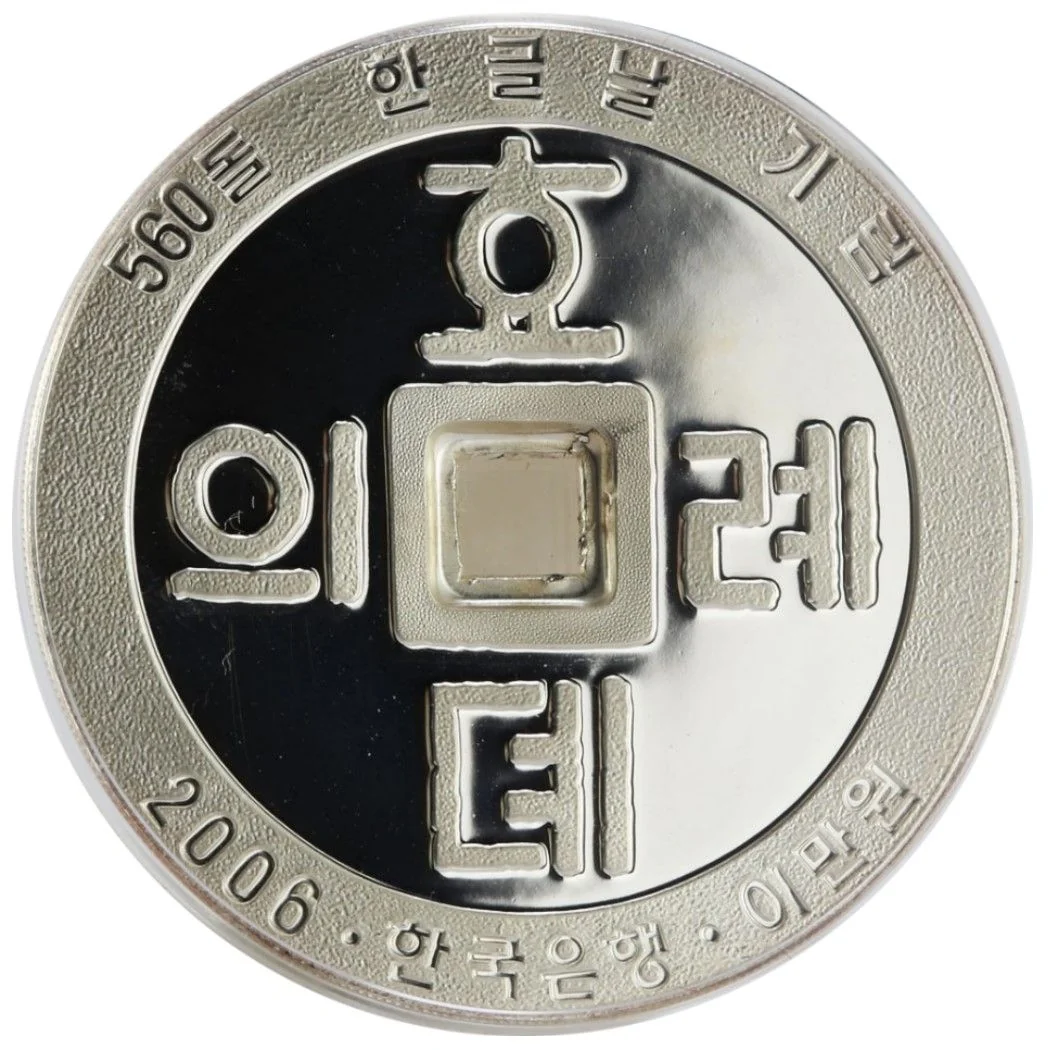
Obverse
Description:
Ancient script with date
Inscription:
560돌 한글날 기 림
효례
뎨의
2006 한국은행
이만원
효례
뎨의
2006 한국은행
이만원
Translation:
560th Anniversary Hangul Day Commemoration
Hyorye
Jeui
2006 Bank of Korea
Twenty Thousand Won
Hyorye
Jeui
2006 Bank of Korea
Twenty Thousand Won
Language: Korean
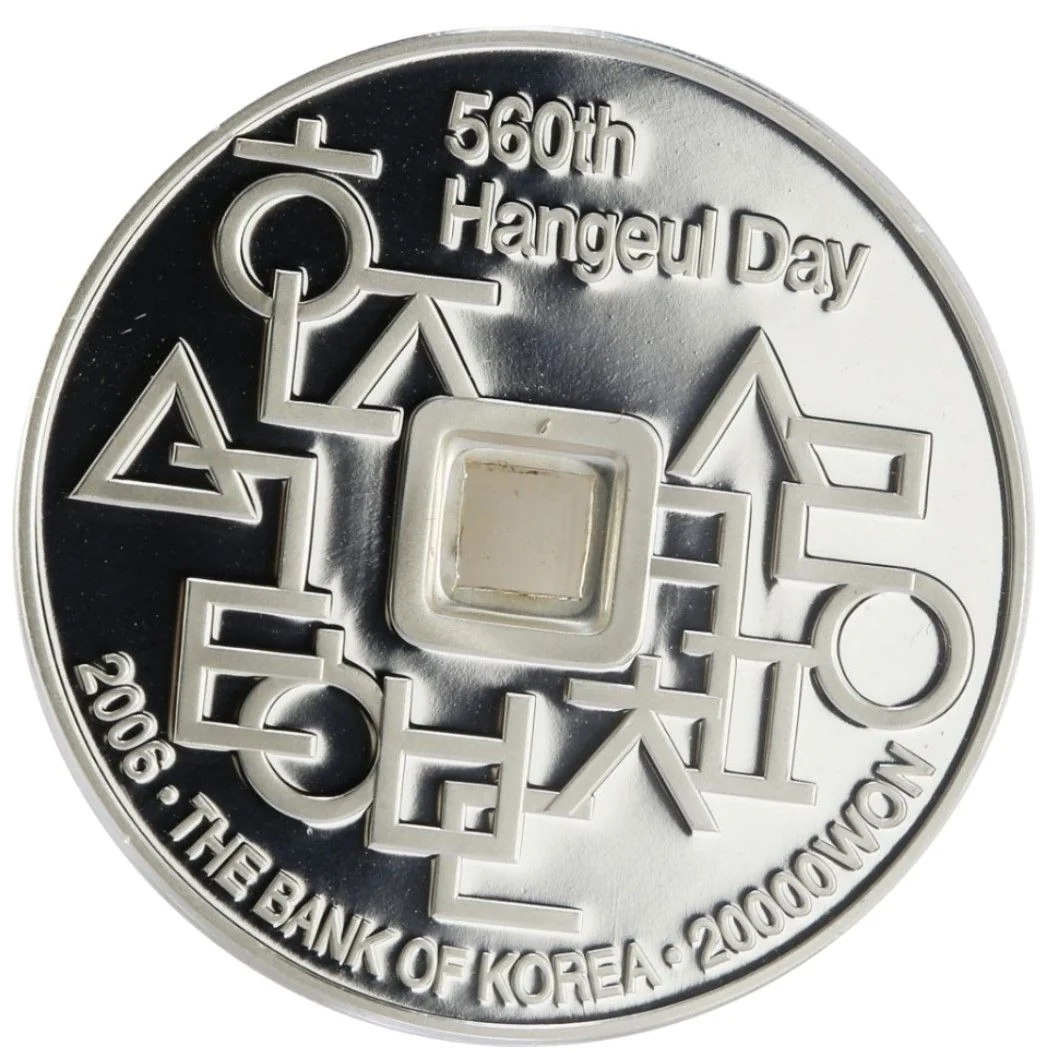
Reverse
Description:
Modern alphabet with value and date.
Inscription:
560th
Hangeul Day
2006 · THE BANK OF KOREA · 20000 WON
Hangeul Day
2006 · THE BANK OF KOREA · 20000 WON
Edge
Reeded
Mints
| Name | Mark |
|---|---|
| Korea Minting and Security Printing Corporation | — |
Mintings
| Year | Mint Mark | Mintage | Quality | Collection |
|---|---|---|---|---|
| 2006 | — | 51,000 | Proof |
Historical background
In 2006, South Korea's currency situation was characterized by a period of significant appreciation for the Korean Won (KRW) against the US Dollar, driven by strong economic fundamentals and substantial capital inflows. The year saw the won strengthen to its highest level in nearly a decade, approaching the psychologically important 900 won per dollar mark by the end of the year. This appreciation was fueled by a robust current account surplus, record-breaking exports, and a surge in foreign investment into the Korean stock market, as investor confidence grew in the nation's advanced technology and manufacturing sectors.
This strong won presented a complex policy challenge for the South Korean government and the Bank of Korea (BOK). While a stronger currency boosted the nation's purchasing power and helped contain import-driven inflation, it also threatened the price competitiveness of key export industries, such as automobiles, shipbuilding, and electronics, which were the primary engines of economic growth. Authorities intervened cautiously in the foreign exchange market to smooth volatility and slow the pace of appreciation, while also implementing capital flow liberalization measures to reduce upward pressure on the currency.
Overall, the 2006 currency dynamic reflected South Korea's successful emergence from the 1997 Asian Financial Crisis as a mature and globally integrated economy. The won's strength was a testament to the country's economic resilience and attractiveness to foreign capital. However, it also underscored the ongoing vulnerability of its export-dependent growth model to exchange rate fluctuations, setting the stage for continued careful management by monetary authorities in the years to follow.
This strong won presented a complex policy challenge for the South Korean government and the Bank of Korea (BOK). While a stronger currency boosted the nation's purchasing power and helped contain import-driven inflation, it also threatened the price competitiveness of key export industries, such as automobiles, shipbuilding, and electronics, which were the primary engines of economic growth. Authorities intervened cautiously in the foreign exchange market to smooth volatility and slow the pace of appreciation, while also implementing capital flow liberalization measures to reduce upward pressure on the currency.
Overall, the 2006 currency dynamic reflected South Korea's successful emergence from the 1997 Asian Financial Crisis as a mature and globally integrated economy. The won's strength was a testament to the country's economic resilience and attractiveness to foreign capital. However, it also underscored the ongoing vulnerability of its export-dependent growth model to exchange rate fluctuations, setting the stage for continued careful management by monetary authorities in the years to follow.
✨ Legendary