

50 Centimos – Venezuela
Venezuela
Obverse
Description:
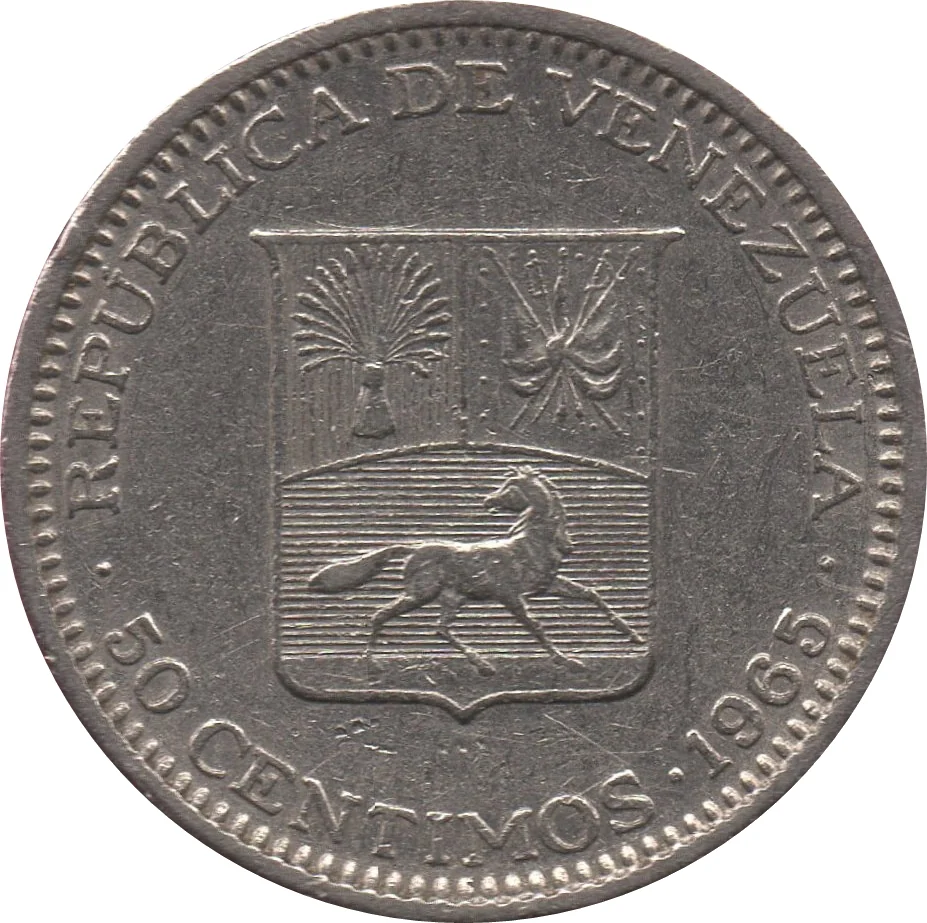
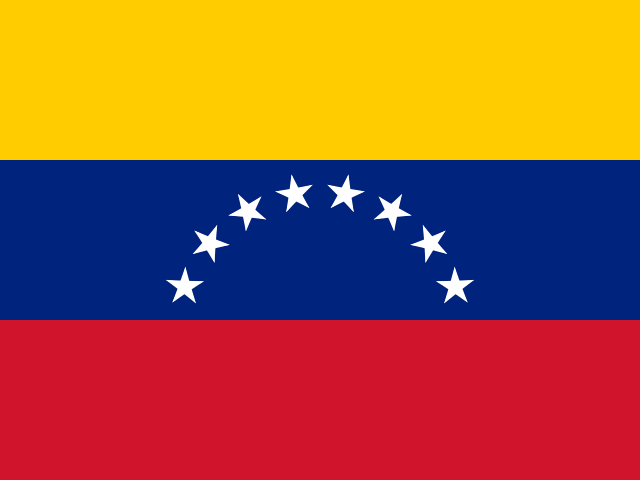
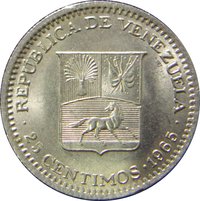
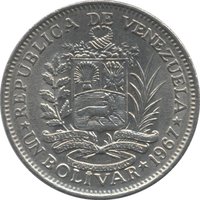
The shield is divided like the national flag. Red upper left: wheat for the union of the original 20 states and national wealth. Yellow upper right: weapons and flags tied with laurel, symbolizing wartime triumph. Blue bottom: a wild white horse represents freedom and independence.
Inscription:
• REPÚBLICA DE VENEZUELA •
50 CENTIMOS • 1965
50 CENTIMOS • 1965
Translation:
REPUBLIC OF VENEZUELA
50 CENTIMOS • 1965
50 CENTIMOS • 1965
Script: Latin
Language: Spanish
Reverse
Description:
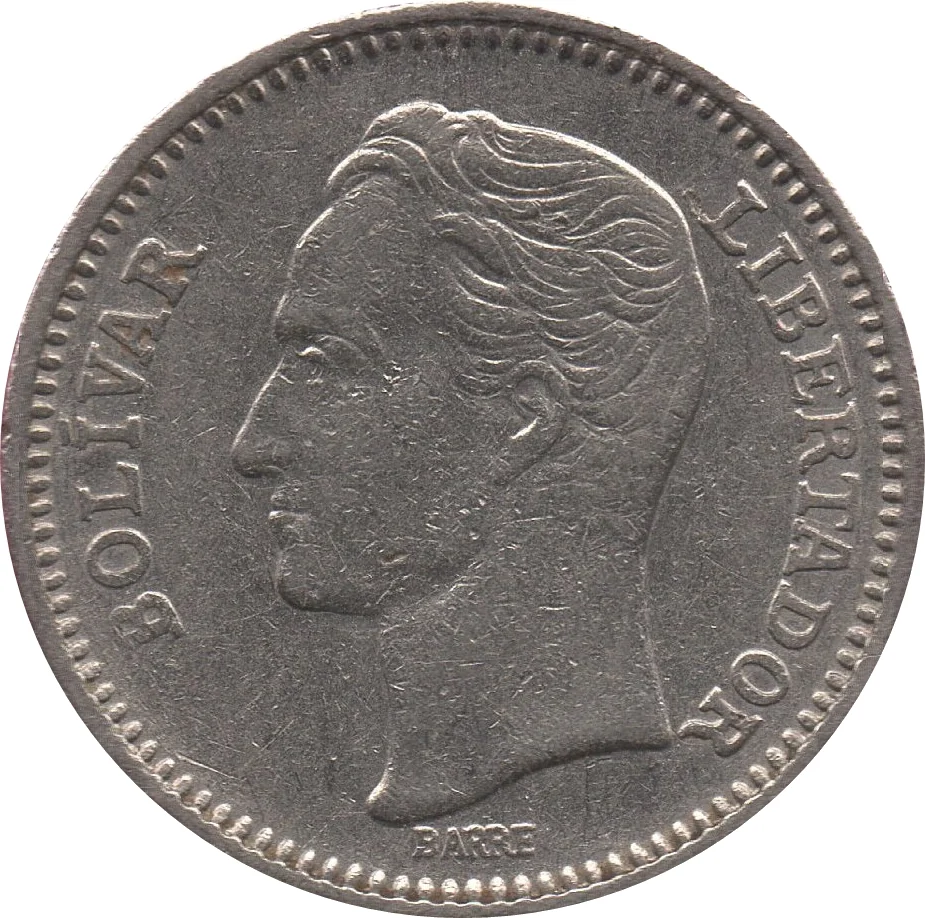
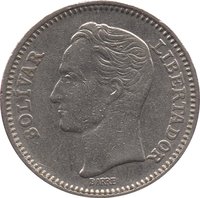
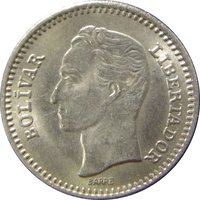
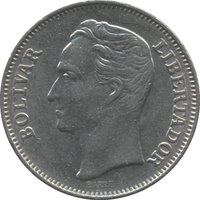
Bust of Simón Bolívar, the Venezuelan leader who liberated six South American nations from Spanish rule. Legend and engraver's name at bottom.
Inscription:
BOLÍVAR LIBERTADOR
BARRE
BARRE
Translation:
Bolivar Liberator
Barre
Barre
Script: Latin
Language: Spanish
Engraver: Désiré-Albert Barre
Edge
Reeded
Categories
| Symbols> Coat of Arms |
| Animal> Horse |
| Person> Military leader |
| Person> Politician |
Mints
| Name | Mark |
|---|---|
| Royal Canadian Mint of Winnipeg | — |
| Royal Mint (Tower Hill) | — |
Mintings
| Year | Mint Mark | Mintage | Quality | Collection |
|---|---|---|---|---|
| 1965 | — | 180,000,000 | ||
| 1985 | — | 50,000,000 |
Historical background
In 1965, Venezuela's currency, the bolívar, was a symbol of national stability and economic strength, firmly anchored to the gold standard and informally pegged to the US dollar at a fixed rate of 3.35 bolívares to one dollar. This era of monetary confidence was a direct product of the nation's oil boom, which had transformed Venezuela into Latin America's wealthiest and most stable democracy. The bolívar was not only fully convertible but was also considered a hard currency within the region, with its value backed by substantial international reserves accumulated from petroleum exports.
The country's fiscal and monetary policy was conservatively managed, with price stability and a strong currency being primary objectives of the government and the Central Bank of Venezuela (BCV). Inflation was low, and the bolívar's purchasing power was high, fostering a period of significant industrial growth and infrastructure development known as the "Venezuelan Miracle." This economic environment attracted foreign investment and allowed for the importation of a wide range of consumer goods, reinforcing a high standard of living for a large segment of the population.
However, this apparent stability was almost entirely dependent on a single commodity: oil. While the currency itself faced no immediate crisis in 1965, the economy exhibited underlying vulnerabilities. The fixed exchange rate and reliance on oil revenues created a structure that would later prove inflexible in the face of external shocks. The prosperity of the mid-1960s, therefore, represented the peak of a model that was prosperous yet precarious, setting the stage for future challenges when oil prices eventually fluctuated and economic diversification efforts fell short.
The country's fiscal and monetary policy was conservatively managed, with price stability and a strong currency being primary objectives of the government and the Central Bank of Venezuela (BCV). Inflation was low, and the bolívar's purchasing power was high, fostering a period of significant industrial growth and infrastructure development known as the "Venezuelan Miracle." This economic environment attracted foreign investment and allowed for the importation of a wide range of consumer goods, reinforcing a high standard of living for a large segment of the population.
However, this apparent stability was almost entirely dependent on a single commodity: oil. While the currency itself faced no immediate crisis in 1965, the economy exhibited underlying vulnerabilities. The fixed exchange rate and reliance on oil revenues created a structure that would later prove inflexible in the face of external shocks. The prosperity of the mid-1960s, therefore, represented the peak of a model that was prosperous yet precarious, setting the stage for future challenges when oil prices eventually fluctuated and economic diversification efforts fell short.
🌱 Very Common