

50 Cents (First Fleet) – Australia
Circulating commemorative coins
Commemoration: 200th Anniversary First Fleet
Australia
Context

Material
Diameter: 31.51 mm
Weight: 15.55 g
Thickness: 3 mm
Shape: Dodecagonal
Standard: Silver half ounce
Technique: Milled
Alignment: Medal alignment
flip
References
KM: #Click to copy to clipboard99
Numista: #9495
Value
Exchange value: 0.50 AUD = $0.36
Inflation-adjusted value: 1.50 AUD
Obverse
Description:
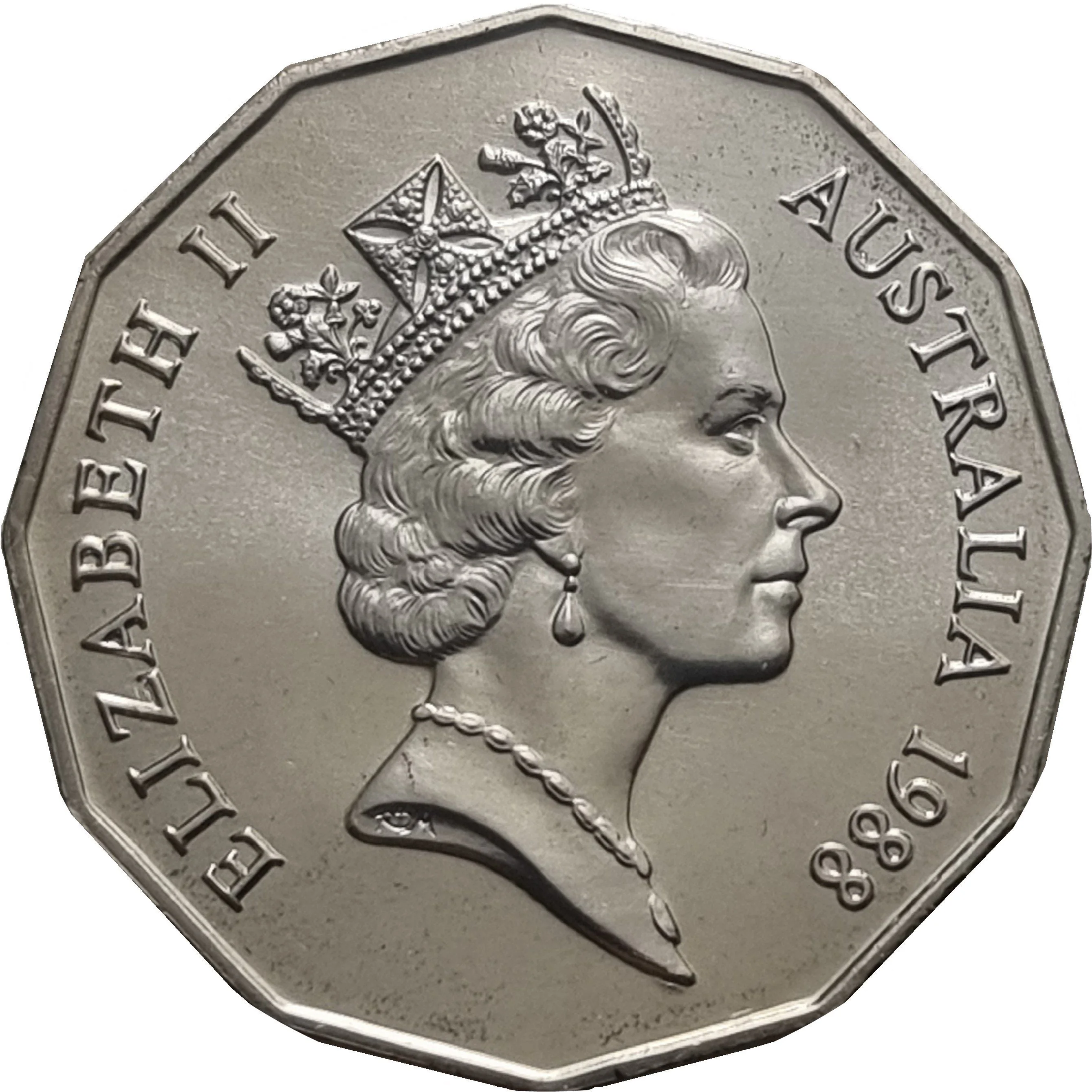
Queen Elizabeth III facing right in the King George IV State Diadem.
Inscription:
ELIZABETH II AUSTRALIA 1988
RDM
RDM
Script: Latin
Designer: Raphael David Maklouf
Reverse
Description:
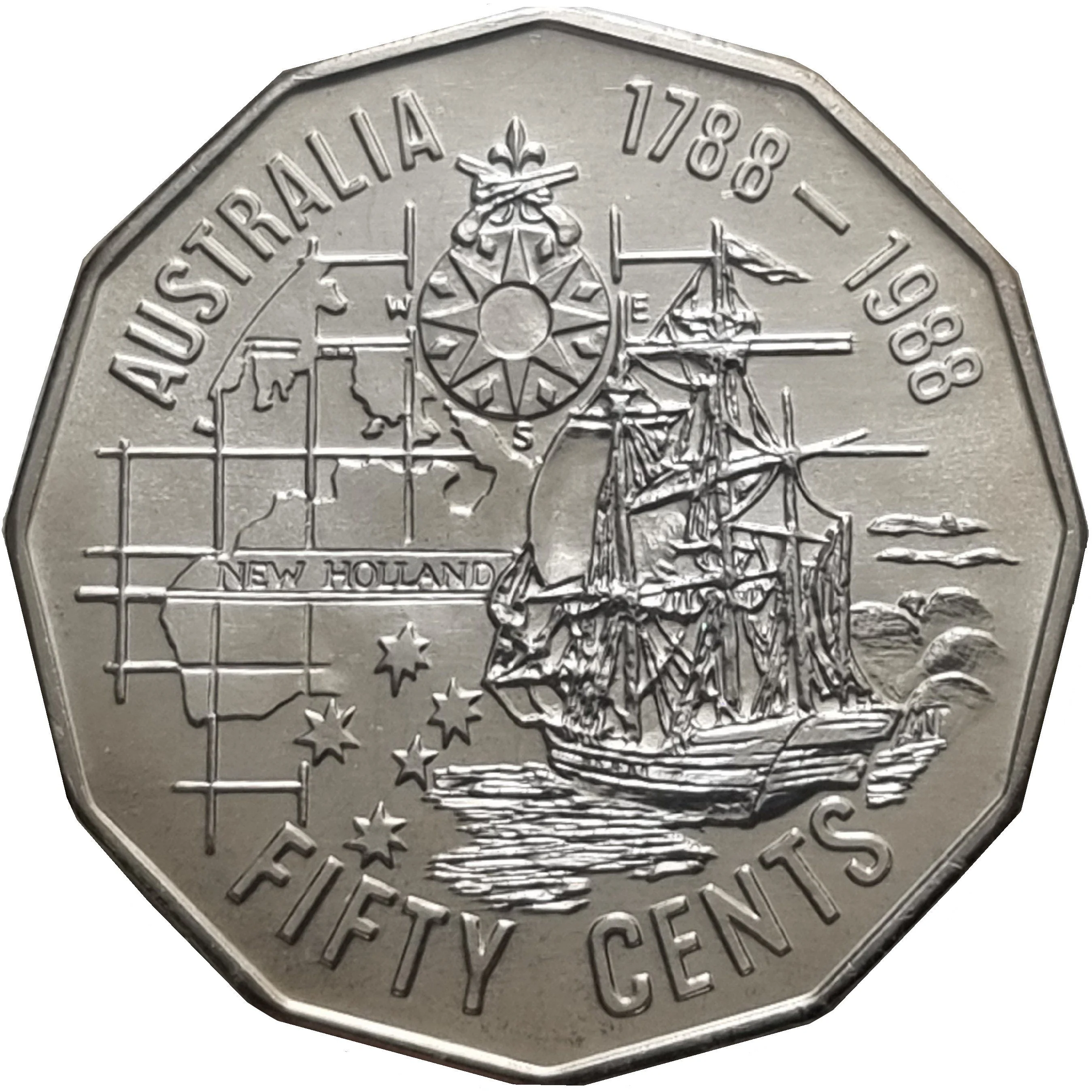
Map of uncharted New Holland with the Southern Cross and a First Fleet ship.
Inscription:
AUSTRALIA 1788-1988
W S E
NEW HOLLAND
FIFTY CENTS
W S E
NEW HOLLAND
FIFTY CENTS
Script: Latin
Designer: Michael Tracey
Edge
12 Sided Smooth
Categories
| Transportation> Watercraft |
| Person> Explorer |
| Geography> Sea |
Mints
| Name | Mark |
|---|---|
| Royal Australian Mint | — |
Mintings
| Year | Mint Mark | Mintage | Quality | Collection |
|---|---|---|---|---|
| 1988 | — | — | BU | |
| 1988 | — | 8,998,800 | ||
| 1988 | — | 104,518 | Proof |
Historical background
In 1988, Australia's currency situation was characterised by a managed float of the Australian dollar (AUD) operating within a broader context of economic liberalisation and external pressures. Just three years prior, in December 1983, the Hawke-Keating Labor government had deregulated the financial system and floated the dollar, abandoning a fixed exchange rate. By 1988, the currency was therefore valued by market forces of supply and demand, with the Reserve Bank of Australia (RBA) intervening only to smooth out excessive volatility or address disorderly market conditions. This new regime was still being tested, with the dollar's value heavily influenced by commodity prices, particularly for key exports like coal and wool, and shifting interest rate differentials with major trading partners.
The year saw the AUD under significant downward pressure, depreciating notably against the US dollar and other major currencies. This weakness was driven by a widening current account deficit, which ballooned to around 4% of GDP, and a high level of foreign debt accumulated during the 1980s. Market sentiment was concerned about Australia's "twin deficits" (both fiscal and current account), leading to periodic sell-offs of the currency. In response, the RBA maintained a tight monetary policy, with high interest rates throughout 1988 (the cash rate reached 15.5% in early 1989) to curb inflationary pressures from strong domestic demand and to support the currency by attracting foreign capital.
Overall, the currency situation in 1988 reflected a challenging transition for an economy opening itself to global financial markets. The floating dollar acted as a shock absorber, but its depreciation highlighted underlying structural issues and exposed the economy to the discipline of international investors. This environment set the stage for the "recession we had to have" in the early 1990s, as policymakers continued to grapple with balancing external imbalances, inflation, and growth in the new financial landscape they had created.
The year saw the AUD under significant downward pressure, depreciating notably against the US dollar and other major currencies. This weakness was driven by a widening current account deficit, which ballooned to around 4% of GDP, and a high level of foreign debt accumulated during the 1980s. Market sentiment was concerned about Australia's "twin deficits" (both fiscal and current account), leading to periodic sell-offs of the currency. In response, the RBA maintained a tight monetary policy, with high interest rates throughout 1988 (the cash rate reached 15.5% in early 1989) to curb inflationary pressures from strong domestic demand and to support the currency by attracting foreign capital.
Overall, the currency situation in 1988 reflected a challenging transition for an economy opening itself to global financial markets. The floating dollar acted as a shock absorber, but its depreciation highlighted underlying structural issues and exposed the economy to the discipline of international investors. This environment set the stage for the "recession we had to have" in the early 1990s, as policymakers continued to grapple with balancing external imbalances, inflation, and growth in the new financial landscape they had created.
🌱 Common