

5 pence – Ireland
Add to wishlist
Ireland
Context
Years: 1969–1990
Issuer: Ireland
Period:
(since 1937)
Currency:
(1971—2001)
Demonetized: Yes
Total mintage: 162,849,750
Material
References
KM: #
Numista: #948
Value
Exchange value: 0.05 IEP
Inflation-adjusted value: 0.95 IEP
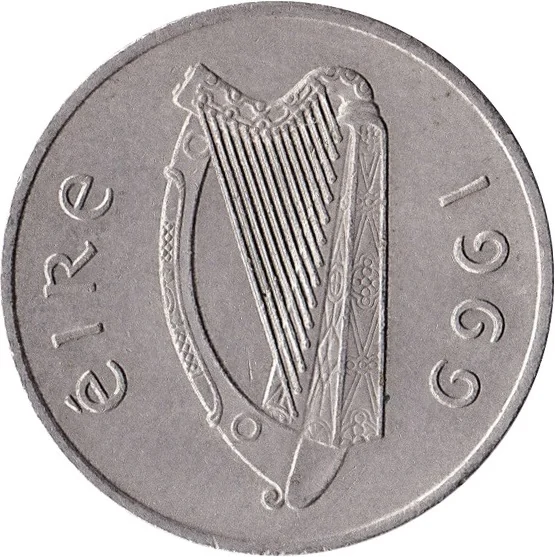
Obverse
Description:
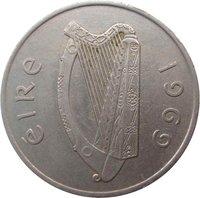
Irish harp, country left, date right.
Inscription:
éIRe 1969
Translation:
Ireland 1969
Script: Latin (Gaelic)
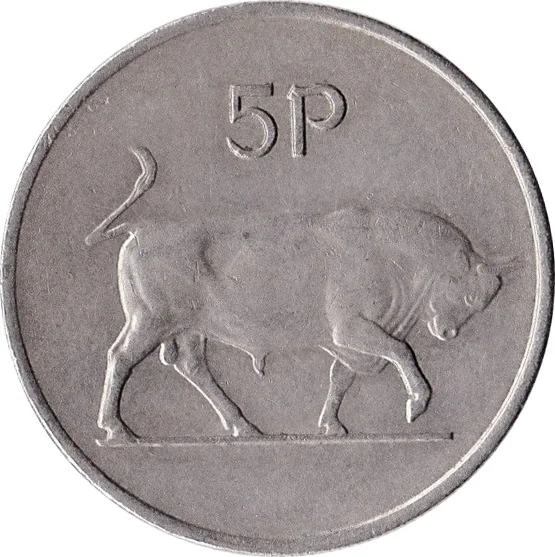
Reverse
Description:
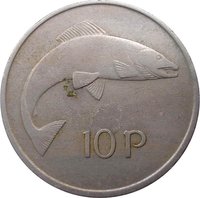
Bull right, value above.
Inscription:
5p
Script: Latin (Gaelic)
Designer: Percy Metcalfe
Edge
Reeded
Mints
| Name | Mark |
|---|---|
| Irish Mint | — |
| Royal Mint | — |
Mintings
| Year | Mint Mark | Mintage | Quality | Collection |
|---|---|---|---|---|
| 1969 | — | 5,000,000 | ||
| 1970 | — | 10,000,000 | ||
| 1971 | — | 8,000,000 | ||
| 1971 | — | 50,000 | Proof | |
| 1974 | — | 7,000,000 | ||
| 1975 | — | 10,000,000 | ||
| 1976 | — | 20,616,000 | ||
| 1978 | — | 28,536,000 | ||
| 1980 | — | 22,190,000 | ||
| 1982 | — | 24,404,000 | ||
| 1985 | — | 4,202,000 | ||
| 1986 | — | 6,750 | Proof | |
| 1986 | — | 15,298,000 | ||
| 1990 | — | 7,547,000 |
Historical background
In 1969, the currency situation in Ireland was defined by its continued participation in the Irish Pound–Sterling link. Since independence, Ireland had maintained a one-for-one fixed parity with the British Pound Sterling (GBP), and both currencies were legally interchangeable on the island. This meant the Irish Pound (or "Punt") was effectively a regional variant of Sterling, underpinned by the UK's monetary policy set by the Bank of England in London. The Central Bank of Ireland managed the currency but had limited independent control, as its primary obligation was to maintain the fixed exchange rate.
This arrangement reflected deep-seated economic and historical ties. Ireland's economy was heavily integrated with Britain's, being its largest trading partner. The fixed link provided stability for trade, investment, and cross-border economic activity, particularly with Northern Ireland. However, it also meant that Ireland had to shadow UK interest rates and monetary conditions, even when they were unsuitable for the specific needs of the Irish economy, such as controlling domestic inflation or stimulating growth.
By the late 1960s, this dependency was beginning to be questioned. As Ireland pursued a more outward-looking economic policy, culminating in its 1973 accession to the European Economic Community (EEC), the limitations of the Sterling link became more apparent. The devaluation of Sterling in 1967 had forced an unwanted devaluation of the Irish Pound, highlighting the risks of the tie. While 1969 itself was a year of monetary stability within the existing framework, it represented the final phase of that system, with active preparations and debate underway for Ireland to eventually break the link and establish an independent, decimalised currency in the coming decade.
This arrangement reflected deep-seated economic and historical ties. Ireland's economy was heavily integrated with Britain's, being its largest trading partner. The fixed link provided stability for trade, investment, and cross-border economic activity, particularly with Northern Ireland. However, it also meant that Ireland had to shadow UK interest rates and monetary conditions, even when they were unsuitable for the specific needs of the Irish economy, such as controlling domestic inflation or stimulating growth.
By the late 1960s, this dependency was beginning to be questioned. As Ireland pursued a more outward-looking economic policy, culminating in its 1973 accession to the European Economic Community (EEC), the limitations of the Sterling link became more apparent. The devaluation of Sterling in 1967 had forced an unwanted devaluation of the Irish Pound, highlighting the risks of the tie. While 1969 itself was a year of monetary stability within the existing framework, it represented the final phase of that system, with active preparations and debate underway for Ireland to eventually break the link and establish an independent, decimalised currency in the coming decade.
🌱 Very Common